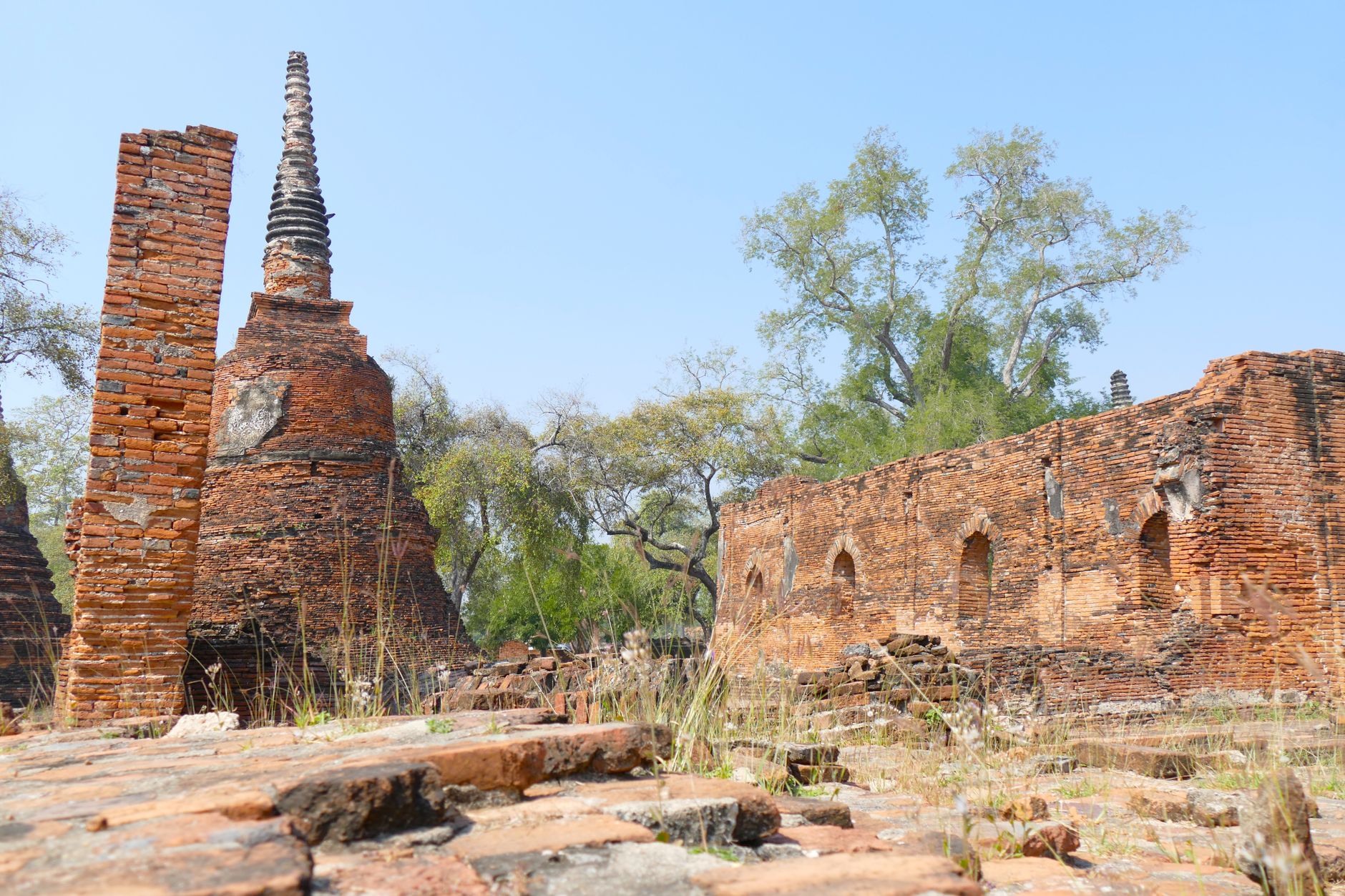
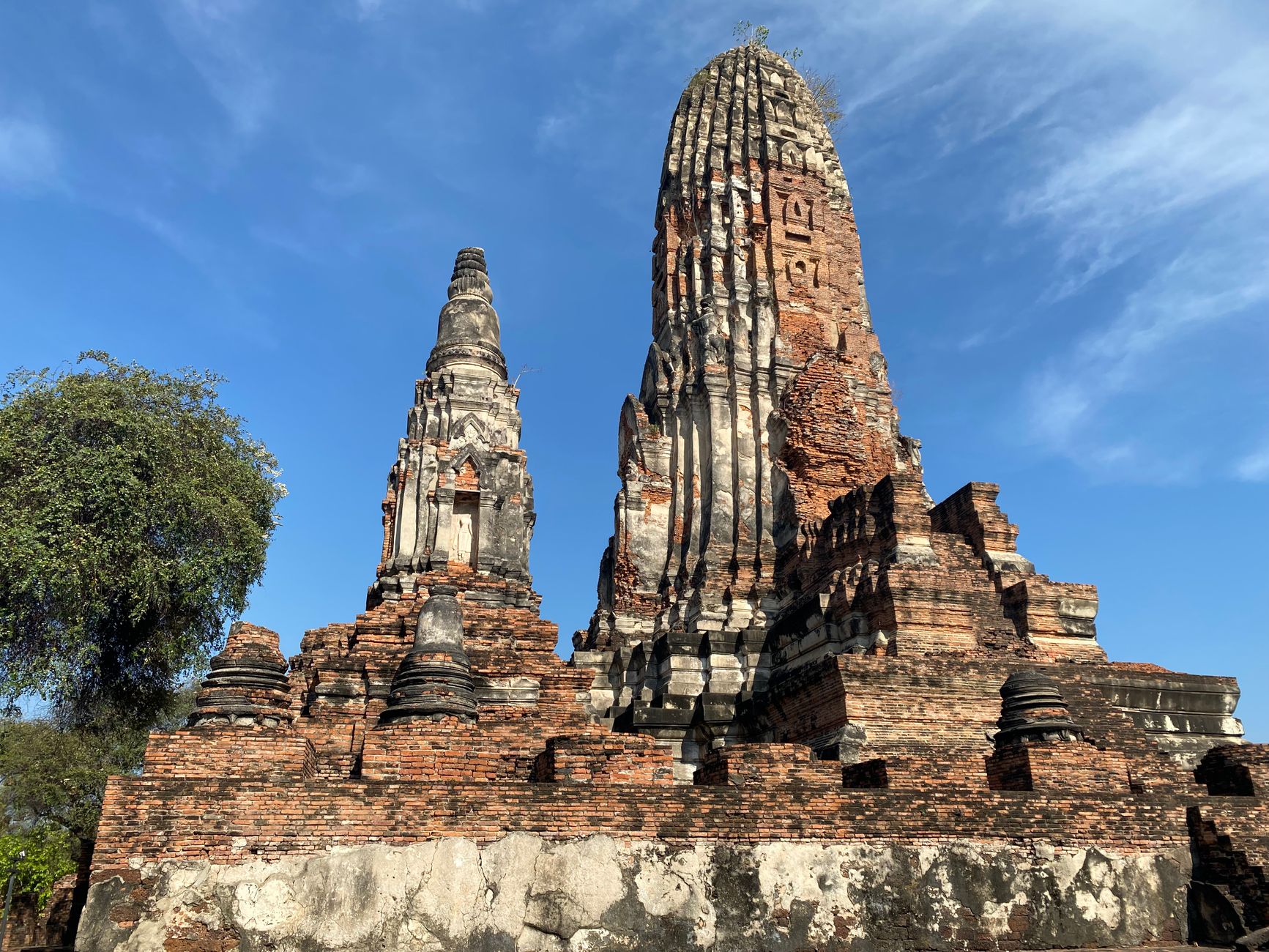
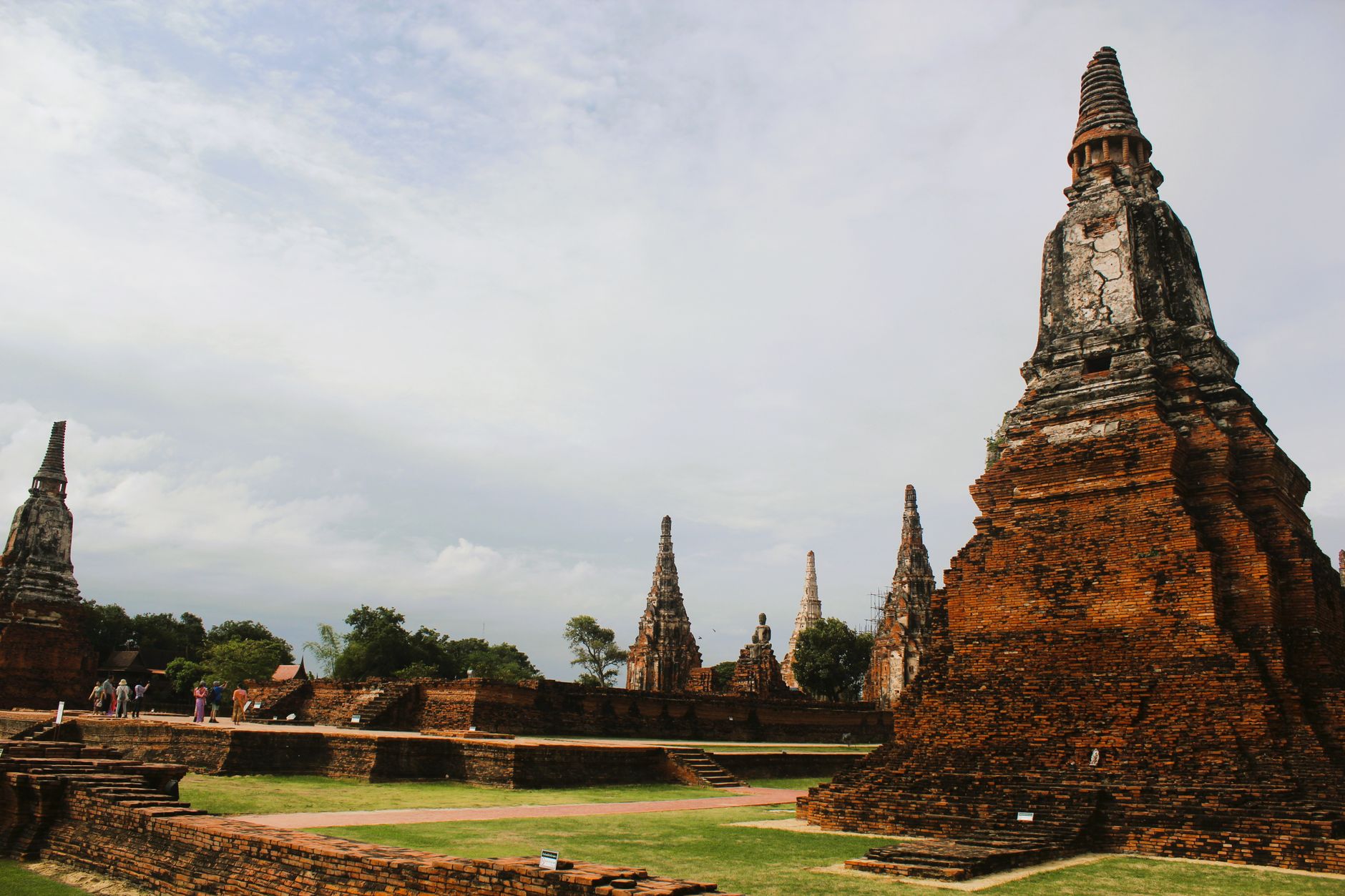
Two tower shapes date almost every ruin on this island, and knowing them is the difference between walking through scenery and reading a city. A prang is the tall corn-cob, rounded and ribbed and tapering, inherited from Angkor, and here it belongs to the early city, roughly the fourteenth century into the early fifteenth. A chedi is the bell on a stepped base rising to a ringed spire, a Sinhalese form that takes over from the middle of the fifteenth century as Siamese kings pulled away from the Khmer model. There is almost no interpretation on the ground at Ayutthaya, so this is the substitute: learn the two silhouettes and any pile of brick will tell you roughly when it went up.
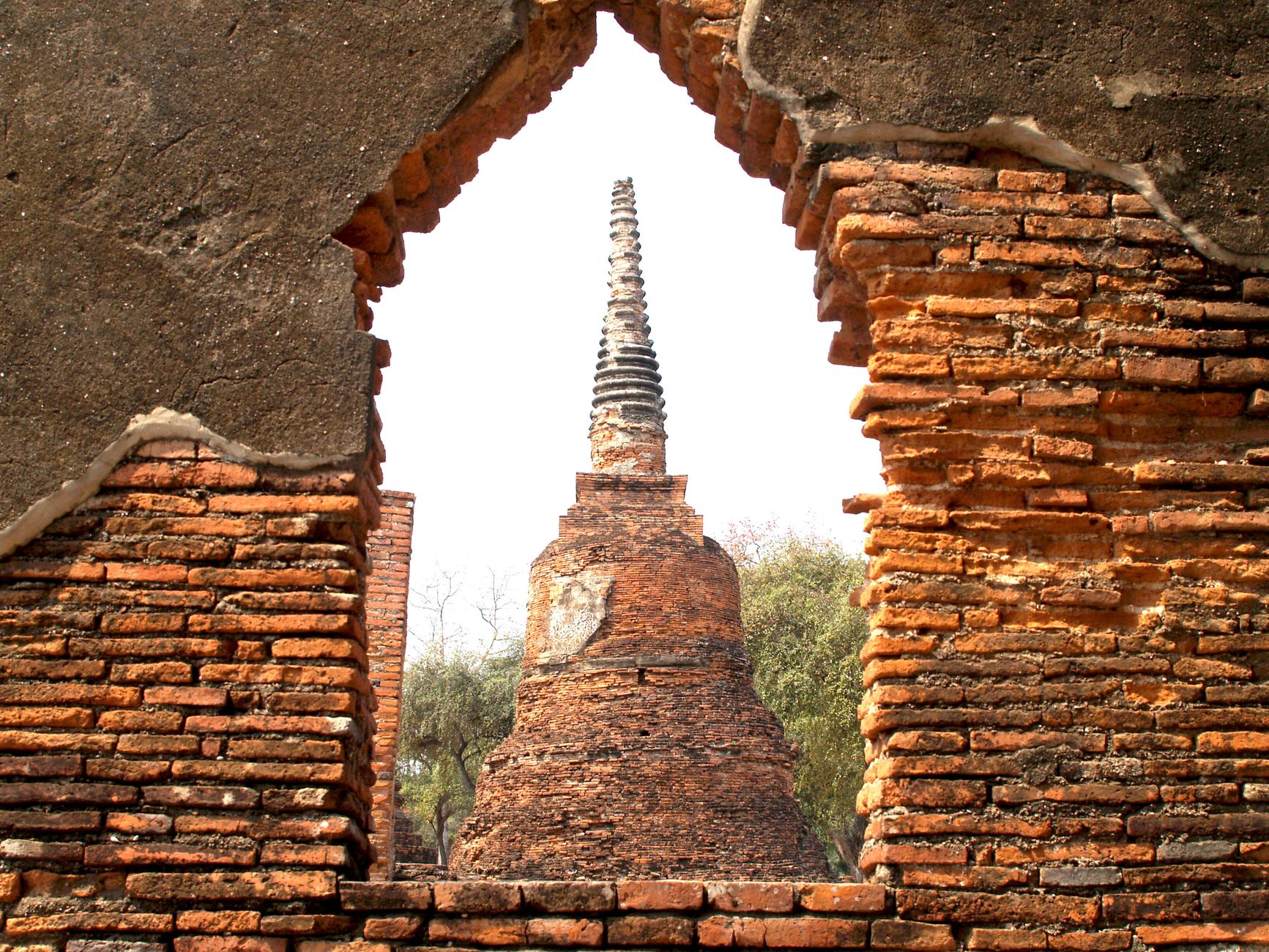
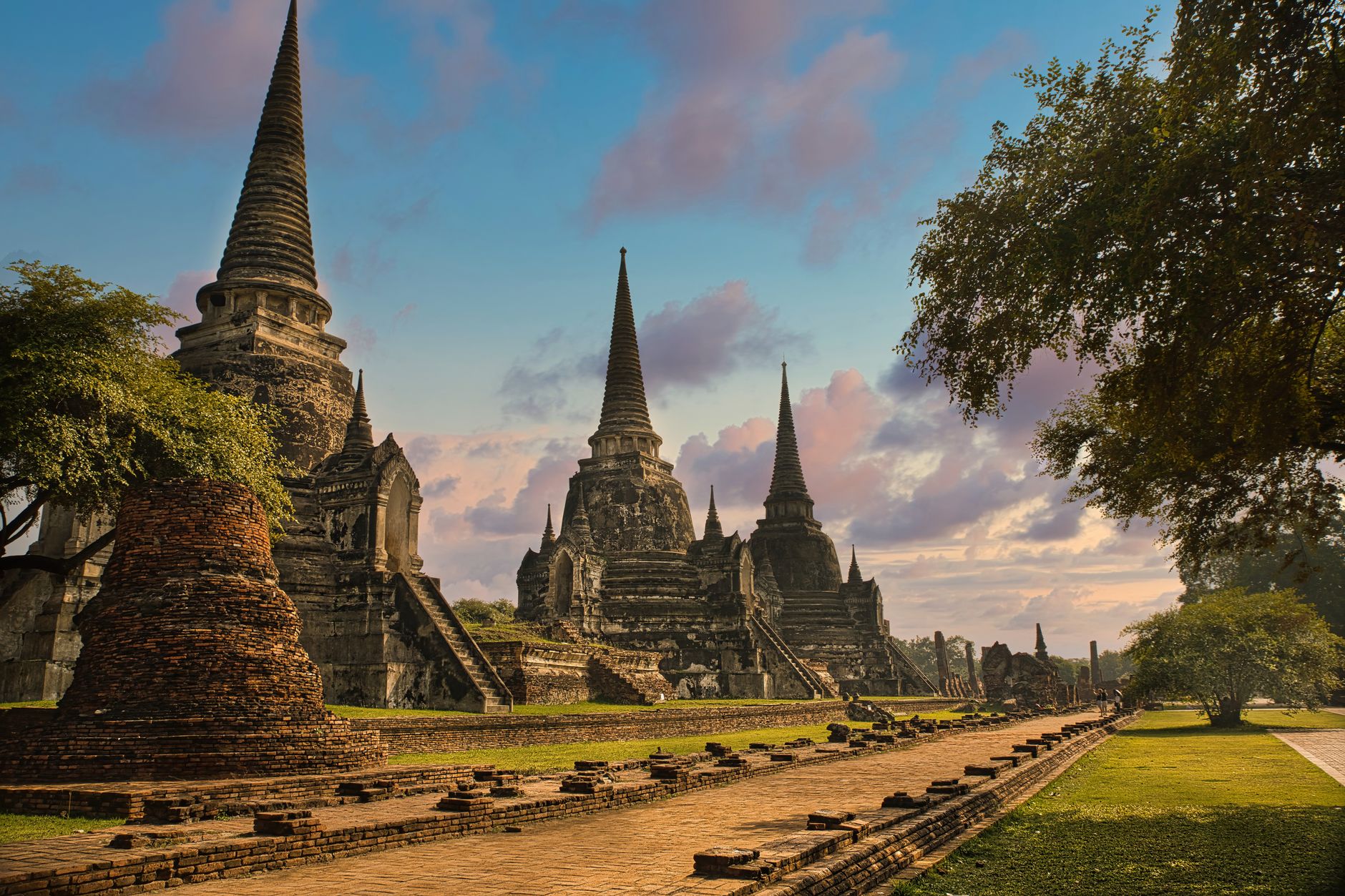
The second habit is looking at surfaces. Ayutthayan builders worked in brick under a stucco skin that was moulded, painted and often gilded, so a field that reads as austere now came from a city that was coloured and loud. Where stucco survives, in a niche or under a cornice, that patch is the truer picture of the whole. Restoration teaches the same lesson backwards: the three chedis at Wat Phra Si Sanphet look complete because the Fine Arts Department rebuilt them in 1956, and what stands there is 1956 masonry over fifteenth-century cores.
The brick was structure. The stucco was the building, and it is the stucco that is gone.
Both surfaces went for the same reason. Konbaung Burma took the island in April 1767 after a siege of fourteen months, ending a capital of 417 years and 33 kings, and the city was stripped as well as burned. One loss can be followed object by object: Phra Si Sanphetdayan, a standing Buddha of about 16 metres cast in bronze in 1492 and clad in 343 kilograms of gold, lost its hall to a fire set to melt the gold off it. The gold went to Burma. The ruined bronze core ended up inside a chedi at Wat Pho in Bangkok, where it still is.
The decapitated Buddhas all over the island run on that logic doubled, because a head carried metal worth taking and because cutting the head from an image is a deliberate humiliation of a devoutly Buddhist enemy, the image being treated as the Buddha's presence and the head as the most sacred part of a body. The looting did not stop with the war. In 1957 thieves emptied the crypt beneath the main prang at Wat Ratchaburana of roughly 100 kilograms of gold objects; under a fifth was recovered, and what came back is the founding collection of the Chao Sam Phraya National Museum, which is the one place to see what the island used to hold.
Nobody rebuilt here. Taksin put his capital downriver at Thonburi, Rama I crossed the river in 1782 to found Bangkok, and Ayutthaya was left as a field.
A ride follows from all that, and it starts with the two prangs facing each other across Chi Kun Road. Wat Ratchaburana was built in 1424 by Borommarachathirat II over the cremation ground of his two elder brothers, who had killed each other in an elephant duel over the succession. Its prang is one of the few on the island with an interior stair climbing to a chamber part way up, and below that chamber is the crypt the thieves emptied, holding fifteenth-century murals that are among the oldest wall painting surviving in Thailand.
The lowest level has been closed at times for conservation and for safety, so ask at the ticket window and treat it as a bonus. Wat Mahathat is straight across the road with its own gate and its own ticket, founded in 1374 as the seat of the Supreme Patriarch. Its great prang did not fall in the war: it collapsed at the niche level early one morning in May 1904.
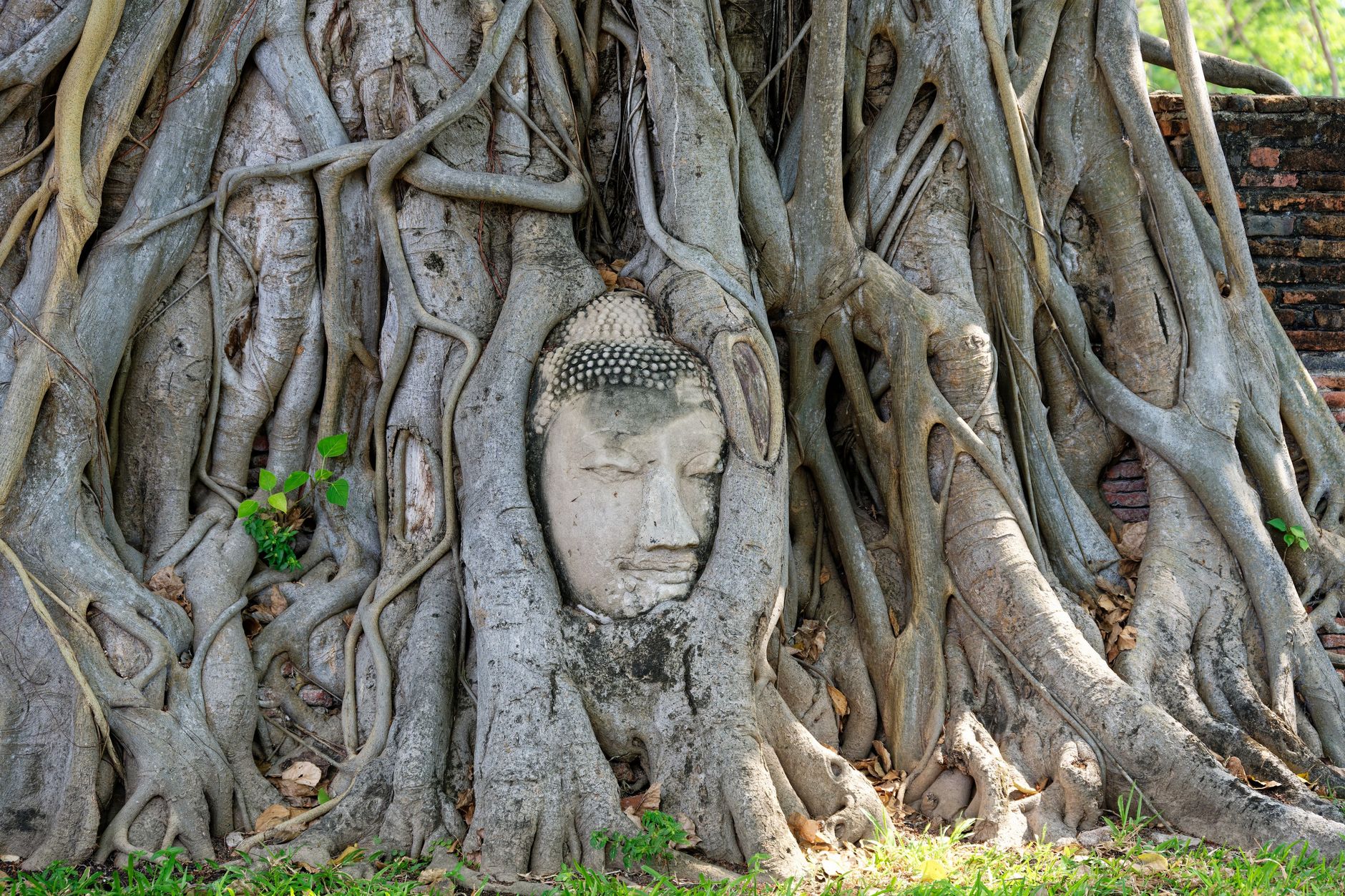
The head in the tree roots is here, in the northeast corner, with a marked spot and usually a queue. Crouch or kneel to photograph it so your own head is never higher than the Buddha's, and expect a whistle from a guard if you stand.
West of those two the ground opens out. Bueng Phra Ram, the lake park in the middle of the island, is free and shaded and the obvious place to stop moving for half an hour, with Wat Phra Ram on its edge. Beyond it is the royal precinct, where Wat Phra Si Sanphet served as the palace chapel and had no resident monks, its three chedis raised over the ashes of three kings in 1492 and 1529.
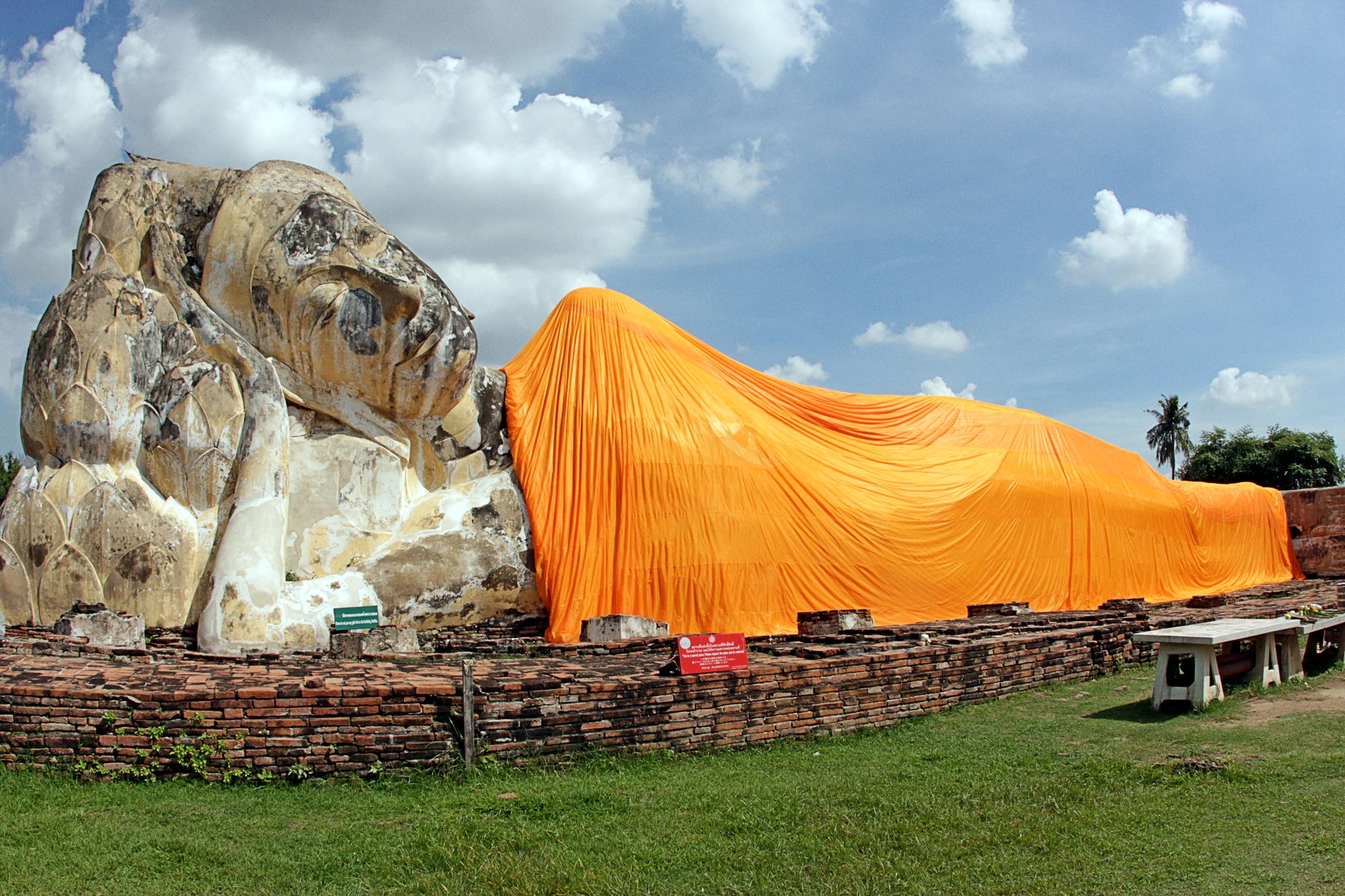
There is no shade in there at all, and none at Chaiwatthanaram either, so a hat, sunscreen reapplied through the day and more water than seems necessary are service items rather than advice. Next door, Wihan Phra Mongkhon Bophit is a twentieth-century hall over a large bronze Buddha, ten minutes long, and the only place on the island that shows what a roofed wihan felt like from the inside. Ride west from there to Wat Lokayasutharam, where the reclining Buddha lies under open sky with no gate and no ticket window.
Two rides leave the island and both are worth the crossing. West, over real traffic and no painted lane, is Wat Chaiwatthanaram, built in 1630 by King Prasat Thong on his mother's ground to hold his parents' ashes, its plan a diagram of the Buddhist cosmos with a central prang as Mount Meru ringed by towers standing for the continents. It took two metres of water in the 2011 flood and came through a twelve-year conservation programme that closed in November 2024, so a scaffold against one tower is normal and does not mean the place is shut.
Southeast is Wat Yai Chai Mongkhon, where the register changes completely because it is a working monastery with worshippers in it. Its bell chedi, usually called the tallest in Ayutthaya, was raised by King Naresuan after he killed the Burmese crown prince in single combat on elephant-back in 1592, and a long row of seated Buddhas in saffron runs round the cloister. If time is short, trade a second prang for this.
The conduct rules here are the ones posted across the island: no climbing on ruins or on Buddha images, and no posing in front of an image with your back to it. Elephant riding is sold in Ayutthaya, the operations are widely reported to use bullhooks and heavy howdahs, and the answer is no.
Ticketing is per temple. Six Fine Arts Department sites sell their own entry at the gate, and a combination ticket covering all six is sold in cash at any of those windows and stays valid for a month. Against the single-site price it only starts paying from the fifth temple, so it is money lost on a three-temple morning and roughly a wash on four.
The booths take cash only, there is no online sale, and the site toilets want coins, so arrive with small notes. Active temples such as Wat Yai Chai Mongkhon and Wat Phanan Choeng charge their own smaller entry, and Thai nationals go free at the Fine Arts sites, which is why some gates post two prices. Several of the best things cost nothing at all: Wat Lokayasutharam, Wat Thammikarat, the palace ruins from outside, and the view of Chaiwatthanaram from the east bank.
Dress is checked at the gate, shoulders and knees covered, for all genders, and the stalls at the main entrances rent sarongs to anyone turned back.
Closing time is where a day comes apart. Most of the royal precinct shuts in the middle of the afternoon while Wat Chaiwatthanaram, off the island, runs latest and is therefore the sunset one, and every ticket window stops selling well before its gate closes. So the order is fixed: the royal precinct first, Chaiwatthanaram last. Posted hours online are unreliable for these sites and the sign at the gate wins, so check it on the way in rather than planning around a search result.
Getting there is the easy part. Ayutthaya is about 80 kilometres north of Bangkok and the default is the train from Krung Thep Aphiwat Central Terminal at Bang Sue, running through the day and taking a little over an hour on the faster services. A handful of ordinary trains still work in and out of Hua Lamphong and take closer to two, so read which Bangkok station the ticket actually names. Minivans leave from Mochit New Van Terminal, a walk from BTS Mo Chit, and take an hour and a half to two depending on traffic.
The catch is at the other end: Ayutthaya station sits on the east bank of the Pa Sak and the historical park does not. A shuttle boat crosses from the pier behind the station to Chao Phrom Market pier in about two minutes, runs from early morning to mid evening, adds a small surcharge for a bicycle and leaves when it is full. If it is not running, the Pridi Thamrong and King Naresuan bridges are about 500 metres south, with a walkway and stairs down on both banks.
Hire the bicycle on the island side, which saves the boat surcharge and costs no more. Stands sit opposite the station and around Naresuan Road on the island. What you get is a heavy single-speed town bike, so squeeze the brakes before any money changes hands, ask for lights if the plan includes the Chaiwatthanaram evening, and keep nothing in the front basket, which is a known way to lose it.
The island is flat and gridded, with painted lanes on many of the asphalt roads and the core temples five to fifteen minutes apart, so the difficulty is traffic and heat rather than distance. A scooter legally requires an international driving permit endorsed for motorcycles, without which no insurance will answer, and a tuk-tuk is negotiated in advance and confirmed as a whole-day rate, not per stop.
Late November to February is the window, dry and coolest, and the season when the Fine Arts Department has run evening illuminations of the main monuments on the island. That schedule moves from year to year, so confirm it with the Tourism Authority of Thailand before fixing dates around it. March to May is the hot season and unmanageable on a bicycle through the middle of the day: ride early, stop by mid morning, start again in late afternoon and do nothing in between. An umbrella is the cheapest shade on the island and nobody looks twice at one. September to November is flood season, peaking in October when high tides stop the Chao Phraya draining. The island itself is usually defended and open, but riverside approaches, boat trips and outlying temples can shut at short notice, so check the provincial announcements in the days before travelling. One day works and a night is better, since it buys the early morning and the late light at either end of the heat. The bed is the one thing to book ahead, and in the cool season and over Songkran it needs it.