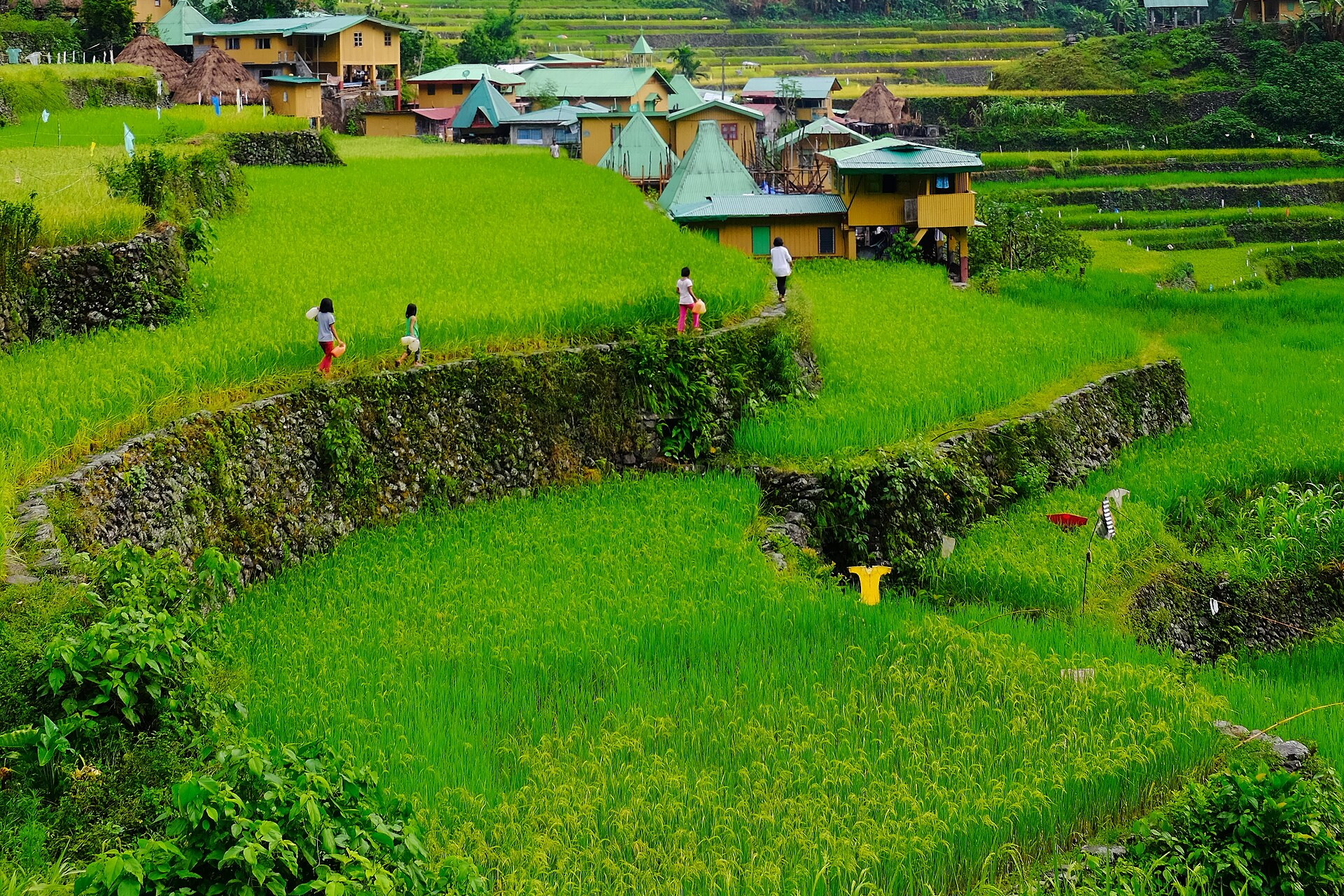
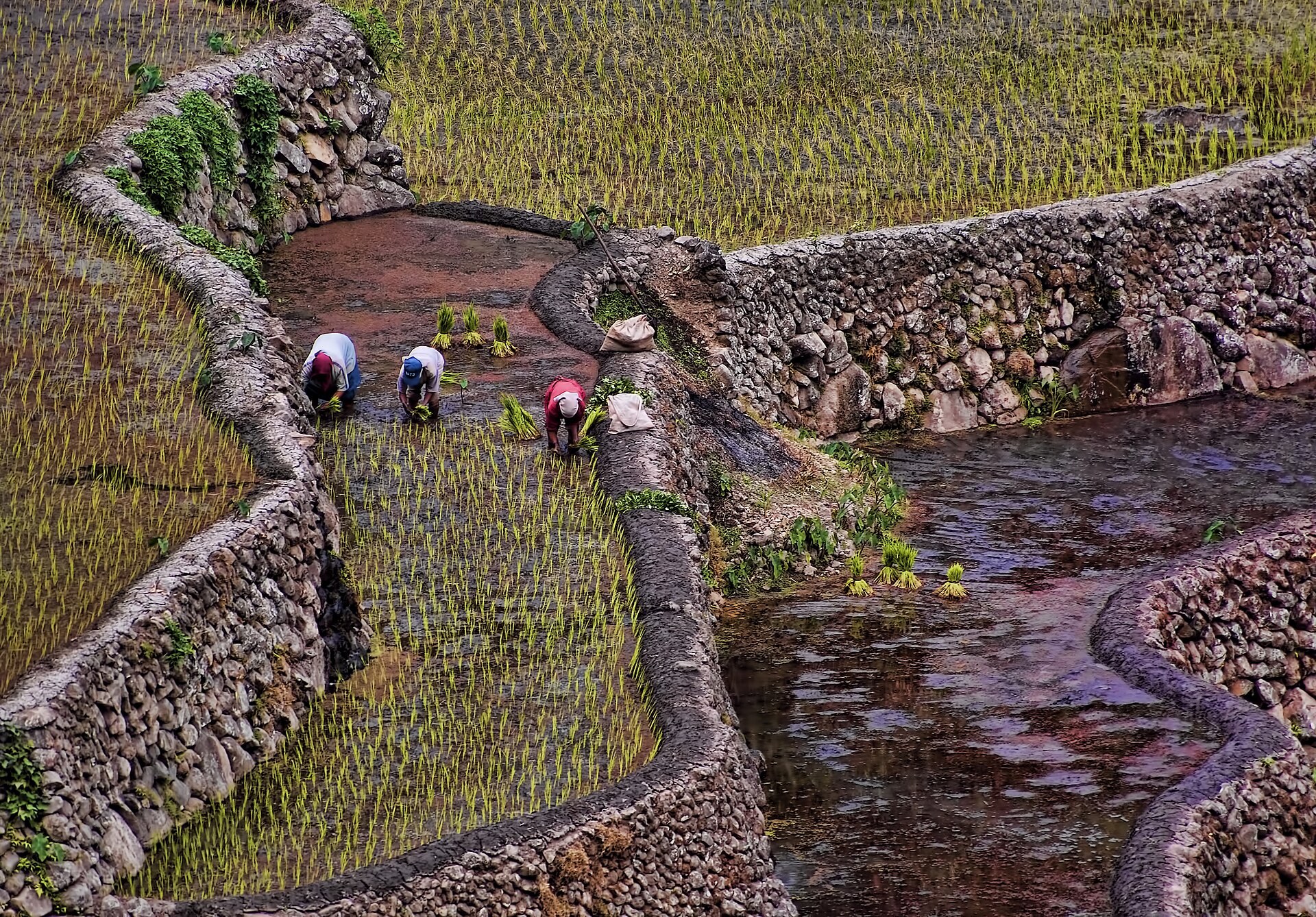
On the steep ground the walls of the Ifugao rice terraces are dry stone, tuping, set without mortar and packed behind with fill. Where the slope eases and the ground turns to clay they are earth, mim-i, and earth walls wash out in the rainy season. Two named techniques keep them standing: mim-i, layering moist soil, interlocking it and tamping it with the heel, and hodhod, backfilling cracks and scraping back sections that have bulged out of line. A new wall has to hold through the following harvest or it is built again. What that costs is the unit this landscape is really measured in. Harold Conklin's Ethnographic Atlas of Ifugao, published in 1980 and still the figure quoted by Ifugao knowledge-documentation projects, puts a standard unit of stone walling at two metres high and four metres long, and puts the labour in it at roughly five man-days and twenty-five bundles of rice in repayment.
Quick patching goes in during the early planting season in November and December, the walls are watched for erosion between planting and harvest, and the serious rebuilding of slumped and storm-broken sections waits until the harvest is in and there are hands free. None of it runs on a market wage. The owner of the largest pond field in a cluster usually calls the labour together, and it is settled in rice, in a day rate, or through ubbu, reciprocal exchange in which a day given is a day owed back. The wider communal work obligation is called bachang. Both are institutions rather than favours, and both depend on there being enough working-age people in the village to call on.
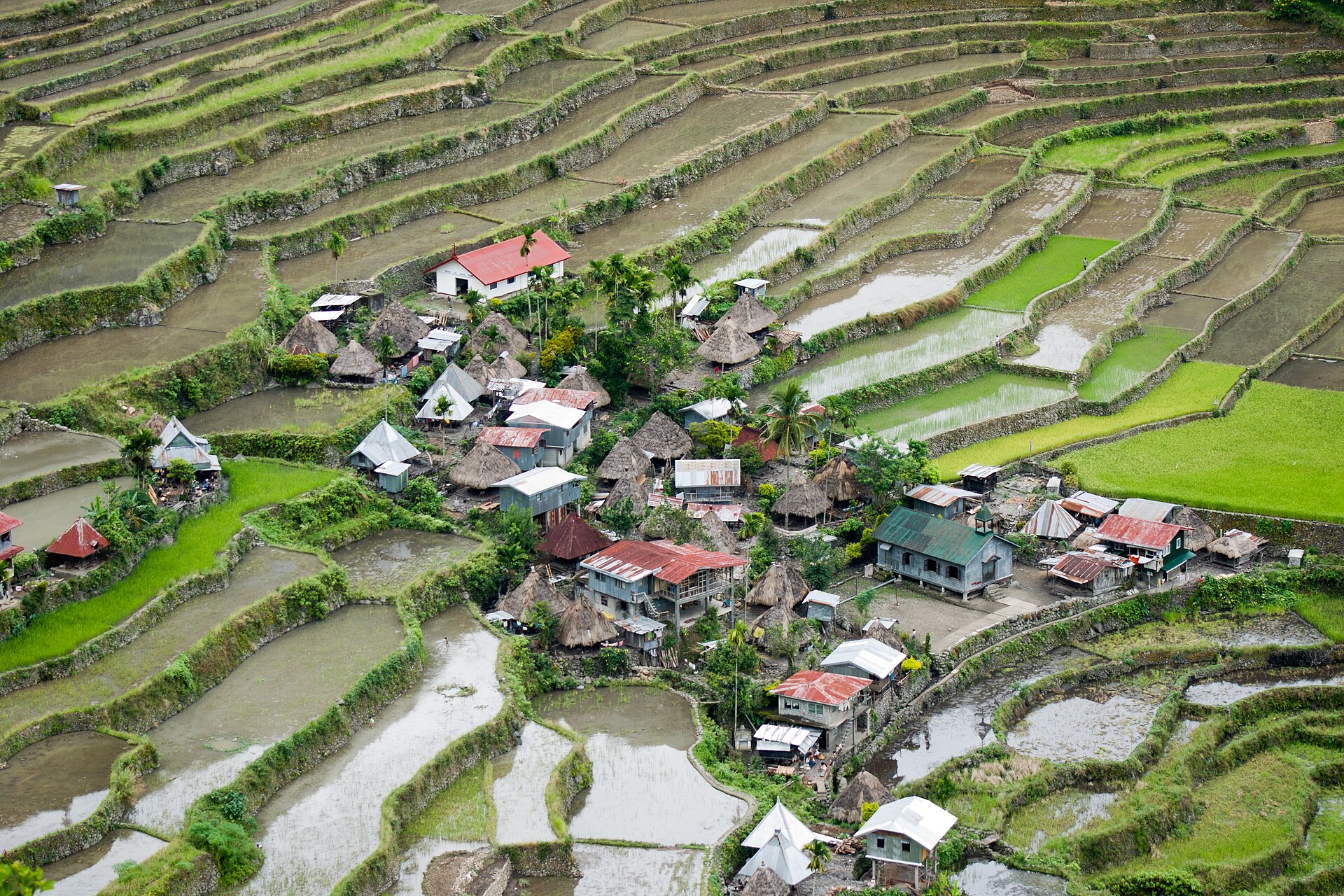
The wall is the visible part of a water system. Above the paddies sits the muyong, a privately owned but communally governed woodlot that caps each cluster and recharges the springs feeding the ditches below it. A 2001 survey of muyong plots recorded 264 plant species in 71 families, 234 of them in community use. Thin the muyong and the ditches run low, and a paddy that cannot be flooded is a paddy nobody will spend five days a wall on.
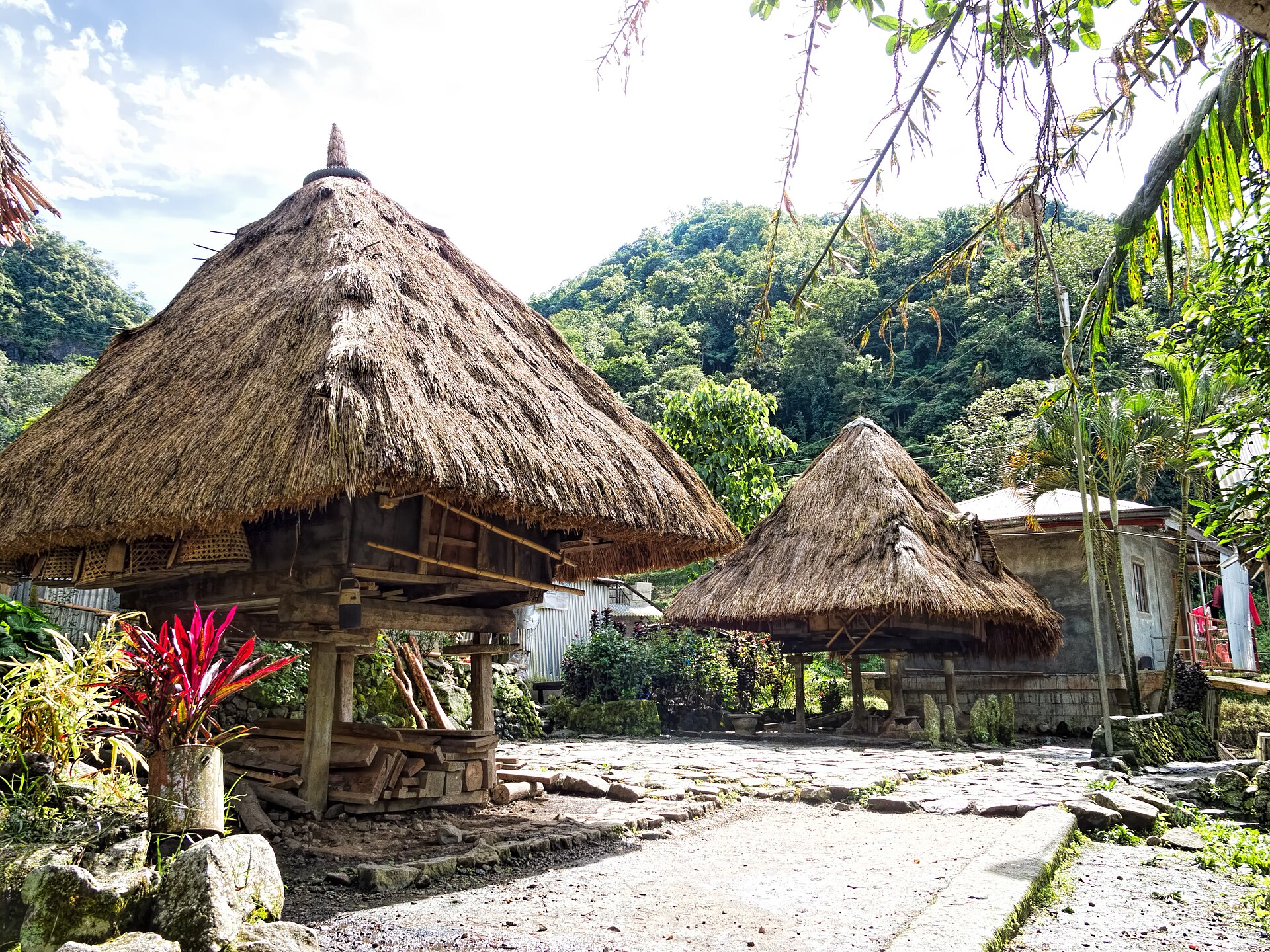
The sums have stopped balancing. Municipal figures from 2018 put roughly 540 of Banaue's 1,607 hectares of rice terraces out of cultivation, much of that ground lost to erosion once the walls went unrepaired, which is about a third of the municipality's terraces. In Bangbang, over in Hungduan, one resident's estimate of his own village puts something like half the original terraces out of use. Provincial and national percentages circulate and disagree, because they count different things over different areas, so the Banaue figure is the one to hold. The causes are the ones that put the property on the List of World Heritage in Danger in 2001, where it stayed eleven years: deforestation, landslides, giant earthworms tunnelling through the walls, an irrigation system falling behind its own repairs, pests, land converted to other uses, and young Ifugao leaving for work that pays. It came off the list in 2012. In December 2019 the FAO described the terraces as being in a very critical stage of deterioration.
Then came November 2025. Super Typhoon Fung-wong, called Uwan in the Philippines, set off landslides that killed two people at Batad, destroyed an irrigation canal that had been carrying water for centuries, and damaged 2.2 hectares of paddy spread across more than eighty individual fields, hitting around 150 farmers. Residents told Al Jazeera in July 2026 that nothing in memory had harmed the community this much. Steve Baccay, who heads Ifugao's Provincial Agriculture and Environment Office, has put the cost of restoring the Batad terraces at the equivalent of about US$500,000, and the money has not arrived in full. So the canal is going back the way the walls always have. Batad residents have come together repeatedly for bachang, the same communal obligation that dug it, and in June 2026 Ifugao officials publicly appealed to the President to release money that had not come. What arrived instead was a short emergency-employment scheme: in mid-2026 the labour department's Cordillera office put the restoration through TUPAD, hiring 128 Batad residents for twenty days on a P1 million allocation, with P2 million more committed by the province. The work is under way rather than finished. Batad has recorded landslides in 2011, in 2023 and again in 2025.
Five days of work and twenty-five bundles of rice, settled inside the village, is the only budget this landscape has ever run on.
What is inscribed and what is not will change an itinerary. The Rice Terraces of the Philippine Cordilleras went on the World Heritage List in 1995 under cultural criteria three, four and five, and the property is five separate clusters, all in Ifugao province: Batad and Bangaan in the municipality of Banaue, Mayoyao Central in Mayoyao, the Hapao terraces at Hungduan, Nagacadan in Kiangan. The terraces on the postcards, seen from the roadside viewpoints a few minutes above Banaue town, are none of these. They were left out on integrity grounds, because too many modern structures stand among them. They are a National Cultural Treasure, declared under Presidential Decree No. 260 in 1973, they sit at around 1,500 metres, and a vehicle sets you down in front of them. Bangaan and Hapao both have roadside views too, so the real distinction is between seeing a cluster and being in one. Only Batad has no road to it at all. That matters to anyone planning a fast trip up from Manila.
How old the terraces are is an open question with two dated answers. The figure in UNESCO's listing material, and the one a visitor is most likely to be told on the ground, is that they are believed to be older than 2,000 years; it goes back to an estimate by the anthropologist H. Otley Beyer. The Ifugao Archaeological Project, led by Stephen Acabado of UCLA and in the field since the 2000s, dates the wet-rice fields to around 1600 AD, working from radiocarbon dates, faunal isotopes, archaeobotany and spatial data. Published in the Journal of Field Archaeology in 2019, that work argues the terraces were built quickly, by highland communities absorbing people and pressure from a Spanish colonial lowland. Acabado has made the point himself that older is not automatically better. A landscape built as an act of political refusal loses nothing by being four centuries old.
The rice sets the pace of everything else. Tinawon means once a year, and that is what the heirloom variety yields: one crop, with seedbeds prepared in December, sowing in January, transplanting through February and harvest from mid-June into August, staggered by how high a paddy sits. A fallow of beans and taro follows, and second crops need other, non-heirloom varieties. Tied to the same calendar are the hudhud, narrative chants proclaimed by UNESCO in 2001 and inscribed on its Representative List in 2008: more than 200 of them, each some forty episodes long, performed mostly by elderly women as the community's historians at sowing, at harvest and at funeral wakes. Hand harvesting is the occasion for them, so as the number of growers falls the chants lose the event they were sung at, and the narrators who hold the long versions are already very old.
Reaching all of this starts with an overnight bus. Ohayami Trans leaves Manila for Banaue at 21:00 and 22:00 on a run of about nine hours, fares in the region of P958, returning from Banaue at 18:30 and 19:00; seats are worth booking ahead on +639276493055 or through ohayamitrans.com. Coda Lines runs Cubao to Sagada via Banaue and Bontoc, leaving at 20:00 and 21:00. From Banaue town to Batad Saddle is roughly twelve kilometres of road, partly paved and partly washed out, and takes 45 minutes to an hour. The public jeepney covers it on what is only loosely a timetable: departures from the market are irregular, somewhere between one and three a day, one of them often in the mid afternoon, and the reliable method is to walk down to the market the evening before and ask. Tricycle charter is the alternative, and quoted rates differ so widely between accounts that no single figure is worth printing. Expect to negotiate, and expect a visitor's price.
The concrete has been pushed past the saddle, but the road is unfinished, so everyone walks the last stretch down into Batad whatever they arrived in. Depending on where the driver stops that is fifteen minutes and about 500 metres at best, twenty to thirty more usually, and as much as forty. The direction to plan for is the return, which is the same track uphill with a pack on. Parties record ninety minutes from the village back to the road, and most of them arrive at the top soaked through. Budget the ninety minutes, not the twenty. The only scheduled jeepney back to Banaue leaves the end of the road at about 09:00, which means a later start is a charter, and it is the timing that most often costs people money.
A P50 environmental and heritage fee is collected at a booth on the path into Batad, and a separate P20 environmental fee at the Banaue tourism office, where registering on arrival is the normal first move. Not everybody reports being charged both. Carry cash for all of it, because there is no ATM in Banaue or in Batad, cards are barely usable, and signal is intermittent. A guide is optional for the village and the viewpoints and genuinely useful once you are out on the bunds, where the paths are unmarked and directions from the field run to walk towards the red-roofed house. Reckon on P400 to P500 for a local orientation walk, around P1,200 for Tappiya Falls or the trek to Bangaan, about P1,500 for Kinakin to Cambulo. Tappiya is a half day at minimum: an hour or so down over uneven stone steps and a river-side up-and-down with landslip visible along it, then thirty to ninety minutes back up, hot and unshaded. Sticks rent for about P20 at the top of the descent, and parties routinely take double the time they were quoted.
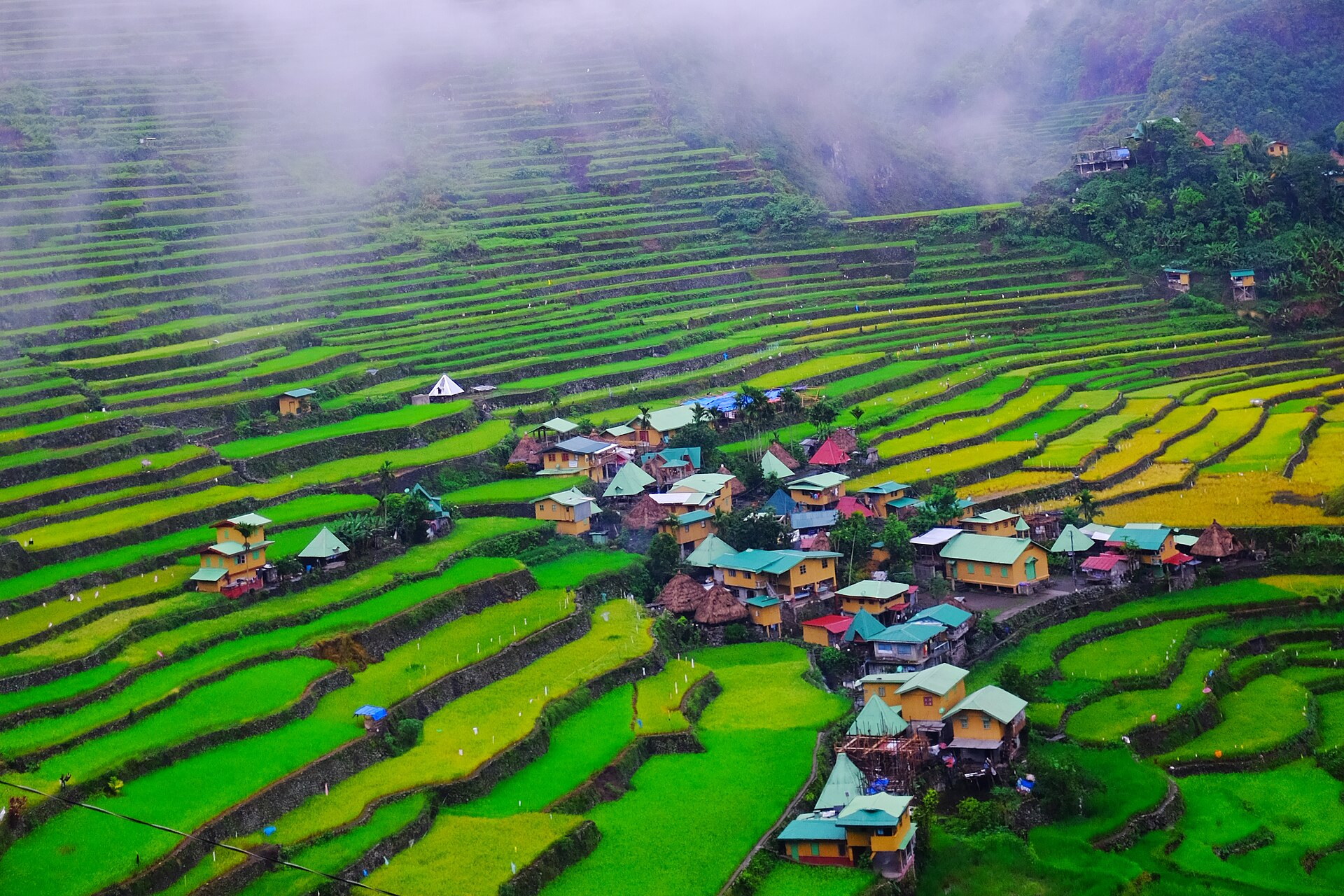
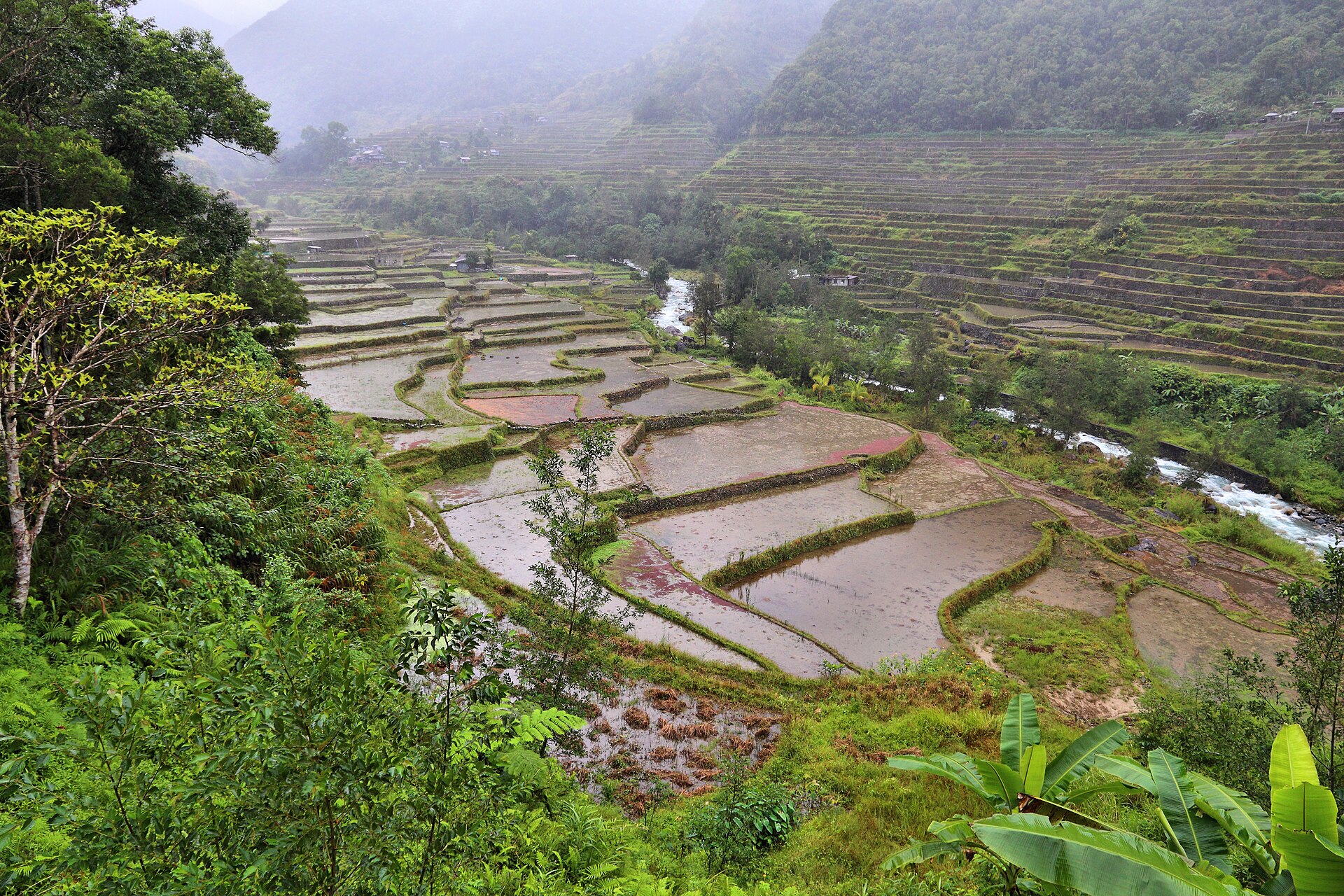
April and May are the window most often recommended, with young rice, green terraces and the driest walking. October and November come second, when the paddies hold water and throw the sky back, and they carry the weather risk that November 2025 demonstrated at Batad. December to February is transplanting: brown, muddy, partly bare ground with people working in it. Mid-June to August runs gold, then harvest, then cut stubble, with the rain building behind it. The best weather and the best colour fall in different months, so decide which of the two a trip is for before the flights are booked, and treat September through November as a season with a real chance of landslides and closed roads.
Tourism is part of the arithmetic too. Ifugao lodgings took an annual average of 71,400 visitors across 2017 to 2019, nearly half of them foreign, and in 2019 tourists in the province spent close to US$18 million. The Save the Ifugao Terraces Movement and the Ifugao Rice Terraces GIAHS Centre work at moving some of that toward the walls. The minimum sensible stay is one night in Batad, two if Tappiya Falls or a walk to Bangaan or Cambulo is wanted; a same-day return from Banaue spends both good light windows on the road. The two long-established names in Batad village, Ramon's Native Homestay and Restaurant and Rita's Mount View Inn and Restaurant, both take advance bookings through Booking.com and Agoda. Many of the smaller village houses are not on any platform and are taken by phone or on arrival. In Banaue town Uyami's Green View Lodge sits on the Banaue-Mayoyao road. Confirm before travelling, because ownership turns over here and the 2025 typhoon changed what is standing. The repairs after this year's harvest will be organised exactly as they were after the last one. The owner of the biggest field calls the labour together, and the wall goes back up in five days.