The Ethnographic Museum of Montenegro has occupied the same house since 2002. It was built in 1883, as King Nikola's wedding gift to his daughter Zorka on her marriage to Petar Karađorđević, who would become king of Serbia. Thirty-one years later Serbia moved its diplomatic mission into it. Dynastic marriage, then legation, then a museum of Montenegrin folk life, one building, in that order. It faces the King's Palace across the street, and nothing on it says any of this.
Cetinje is full of buildings like it, and they are not marked. Four of the legations can be checked against the institutions now inside them. The National Library holds two, the French mission of 1910 and the Italian of the same year, which became the library's headquarters when the holdings outgrew the first building. Rough Guides adds the British legation, now the Academy of Music, and the Ottoman, now the Faculty of Dramatic Arts. Two more are named consistently, but only by travel sources: the Russian, now the Faculty of Fine Arts, and the Austro-Hungarian, now the State Institute for the Protection of Cultural Monuments. Neither identification can be checked against the institution itself. Buildings are also pointed out as the Bulgarian, German, American and Belgian missions, on thinner ground again. Most of them stand along and just off one pedestrian axis, with the Italian legation out on its own in a park at the edge of town. There are no plaques, no marked trail and no interpretation board, and the only workable instruction anyone has published is to look for any oldish building sporting a crest.
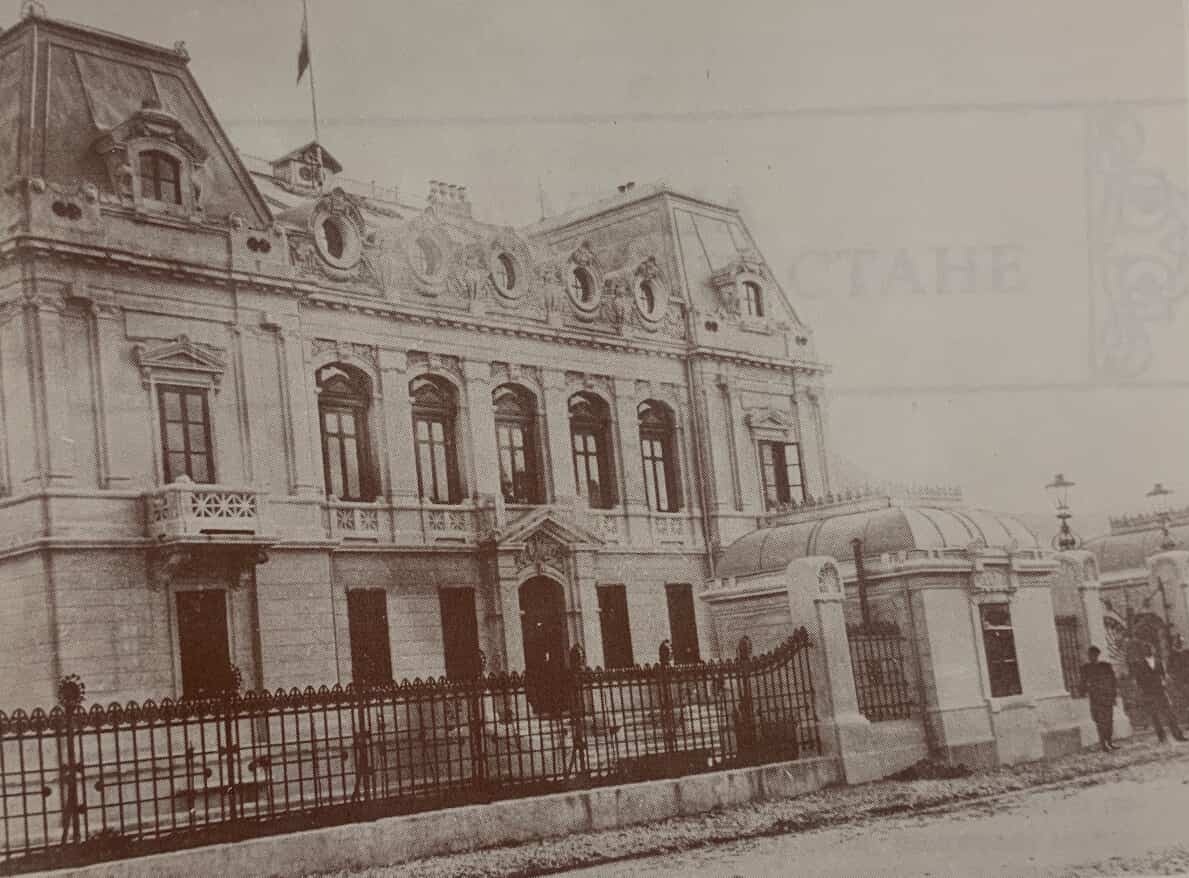
A place this size acquired that diplomatic weight in a single generation. Montenegro was recognised as an independent principality at the Congress of Berlin in 1878, and Nikola I Petrović-Njegoš, who ruled for fifty-eight years and took the title of king in 1910, married his daughters into the royal and grand-ducal houses of Europe, among them Italy, Russia and Serbia. The great powers wanted missions in the new state, and they built or bought them here. The Ottoman Empire did not build at all: it acquired a house in 1885, which makes its mission the oldest of them.
The town had been here for four centuries by then. Ivan Crnojević moved his seat up to this high karst field in the 1480s, pushed back from the coast by Ottoman pressure, and founded a monastery to go with it. His son Đurađ set up a printing press around 1493. The Croatian Glagolitic Missal of 1483 beat it into print by a decade, so this was not the first book among the South Slavs. What it was is narrower and still remarkable: the Oktoih prvoglasnik, finished on 4 January 1494, came off a Cyrillic press in a mountain settlement within four decades of Gutenberg, two years after Caxton died at Westminster, and while most of the Balkans was under Ottoman rule.
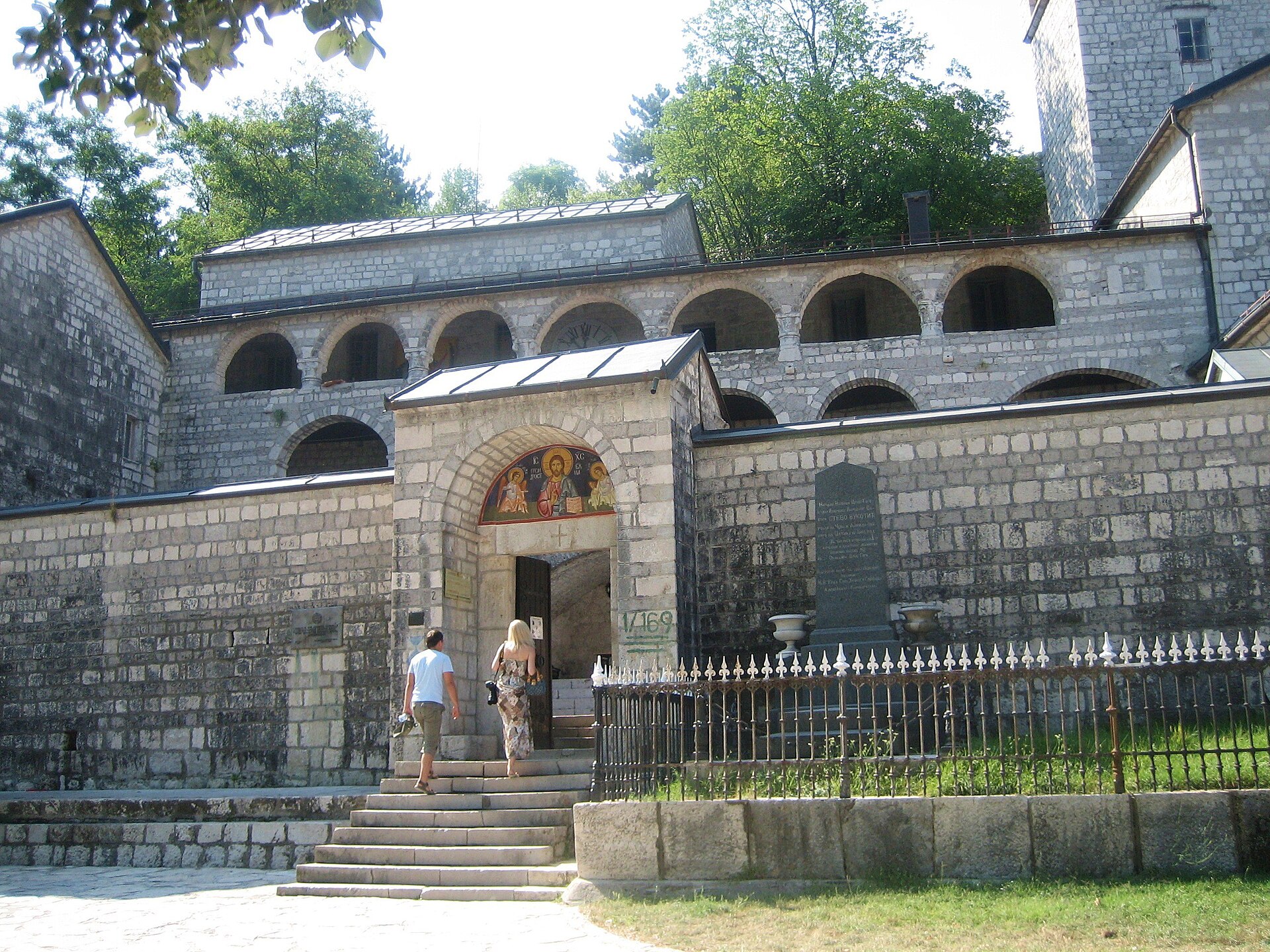
The monastery holds what it venerates as the right hand of St John the Baptist, and a fragment held to be of the True Cross, which reached Montenegro through the Russian imperial connection. They are not on display. A priest opens a chest on request, and asks where you are from and what your religion is before he does. Photography inside is prohibited and the rule is enforced. Entry is free, and it is a working seat of the Metropolitanate rather than a museum, so arrive with shoulders and knees covered. Opening is less predictable than the published hours suggest: one visitor in October 2025 found the gate shut with nobody about, and the Court Church at Ćipur closed as well.
There are no plaques and no marked trail. Look for any oldish building sporting a crest.
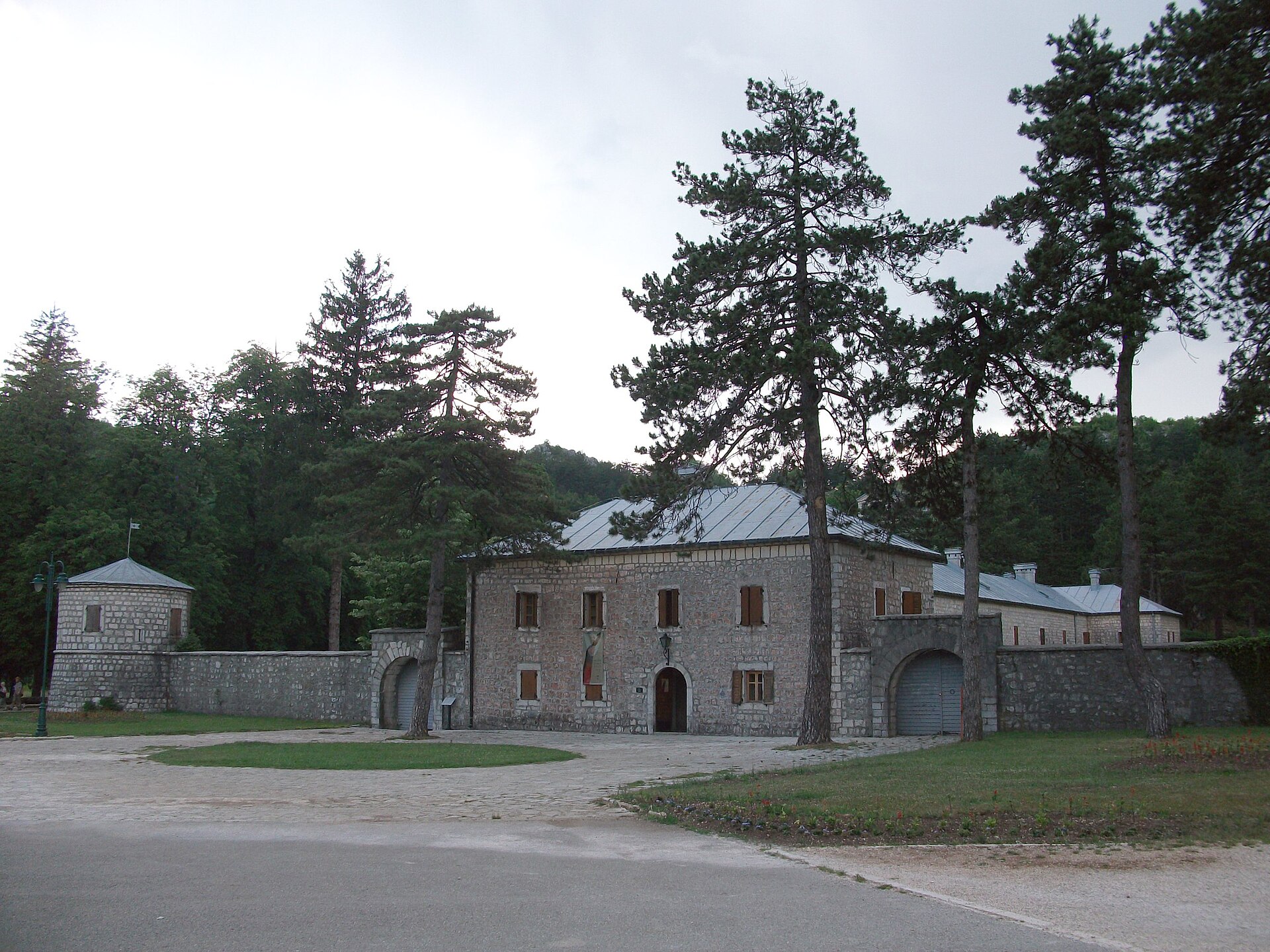
Biljarda, the long low residence Njegoš built in 1838, is named, as the town tells it, for a billiard table brought up from the coast, which in 1838 meant over the Lovćen massif by mule track. It was built as much like a small fort as a house, with a round tower at each corner and a wall enclosing the yard, which tells you what a head of state expected of the 1830s here. In its grounds is a relief map of Montenegro built in 1917 to the order of the Austro-Hungarian military administration, which was occupying the country and needed to model its terrain. Biljarda divides visitors sharply along one line: it rewards an interest in the history, and offers little to anyone without one.
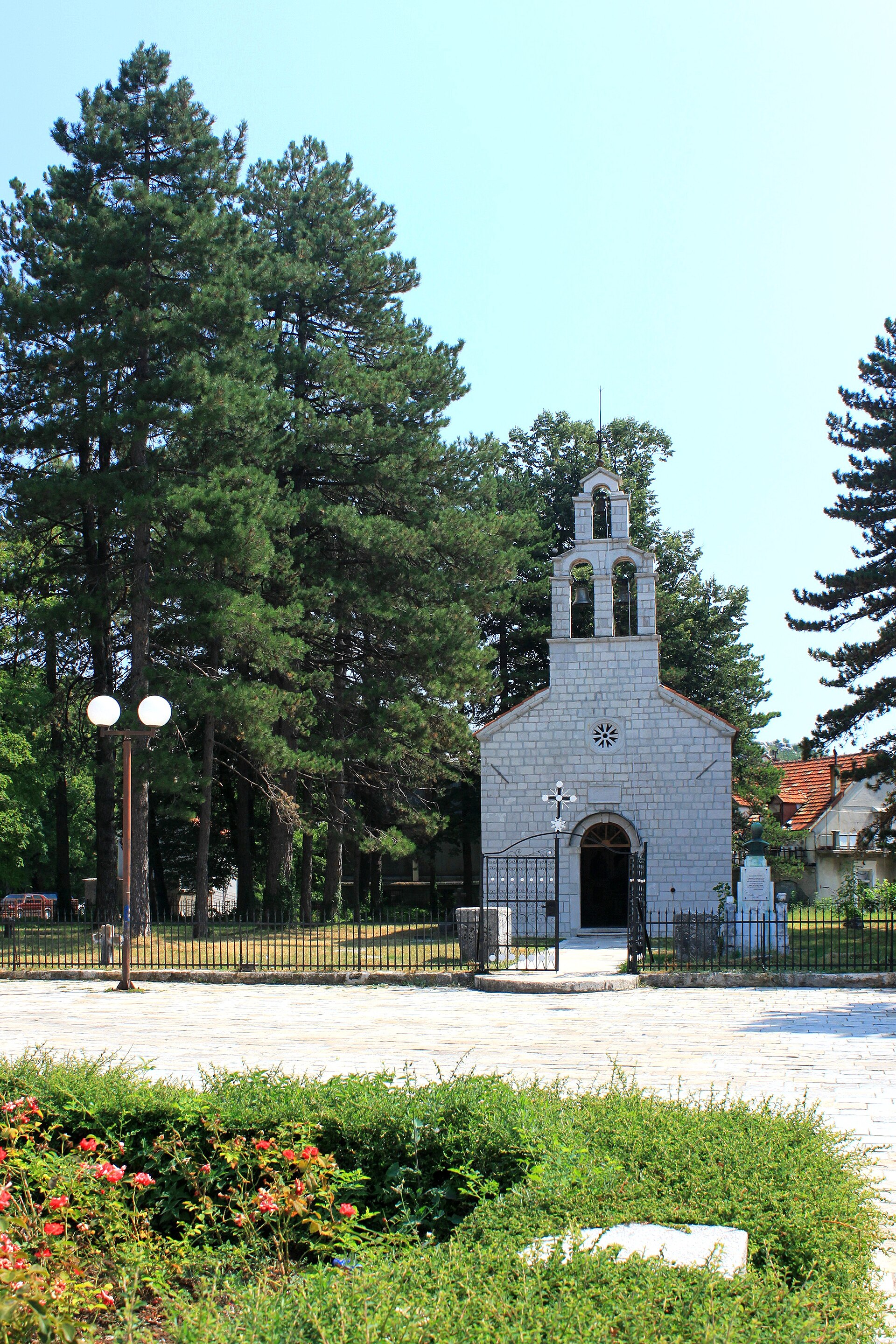
Two more buildings close the walk. Ćipur, the court church below Biljarda, stands where the Crnojević monastery originally stood, and Nikola and his queen Milena are buried in it, brought back from exile in Italy in 1989. King Nikola's palace, a little further along, is the one interior almost every visitor recommends, and the pale blue Government House at the edge of the centre still serves as an official residence of the President of Montenegro.
The capital years themselves ended quickly. Elections in November 1918 split the country between Whites, who wanted unconditional union with Serbia, and Greens, who wanted union as an equal partner. The Whites won, and the Podgorica Assembly deposed the Petrović-Njegoš dynasty and voted Montenegro into union with Serbia under the Karađorđevićs, a decision contested from the day it was taken and annulled by Montenegro's parliament in 2018. The administration moved away. The legations, by then, had nobody to be accredited to.
Visitors often describe the town as quiet, and several say too quiet. Some of the buildings are crumbling with age while others are in the midst of restoration, and Rick Steves calls it a workaday, two-storey town with barely a hint of its old status. What none of that quite reaches is the more interesting fact, which is that the buildings did not empty out. A national library, a heritage institute, a music academy and two university faculties are working inside the diplomatic quarter of a state that stopped existing in 1918. That is also the practical point for a visitor: these are offices and faculties, not sites, so the circuit is an exterior walk, and the Ethnographic Museum is the one you can go into.
For a visit, the museums are the decision. King Nikola's palace is the one people consistently say to go inside, and it enforces a no-photography rule. The Ethnographic Museum draws warmer reviews than its billing suggests. The History Museum is listed on the National Museum's own site as closed for visiting, under a redevelopment that has run for years, so check before counting on it. A single collective ticket covers the National Museum units, and it also covers the Njegoš mausoleum on Lovćen and the Njegoš birth house at Njeguši, which changes the arithmetic for anyone doing Cetinje and Lovćen on the same trip. That is a summer proposition, though: both of those close for visiting in the cold half of the year, which is exactly when the collective ticket is worth least. Ask for the ticket at the first museum you reach.
The opening pattern is the trap. In the cold season the National Museum units run on weekdays only, so they are shut at weekends in winter, the reverse of the closed-Monday rhythm most European museums keep and the reverse of what a weekend visitor will assume. Give the town an hour or two on foot if the museums are shut, and most of a day if they are open. Park once and walk: the centre is paid and zoned, in two zones charged by SMS against the registration, under a tariff in force since September 2024, so the frequent claim that parking here is free is out of date. Restaurant Kole, a few hundred metres off the main square, is the name that survives every account, and it is trading. Buses from Podgorica and Budva run frequently and take under an hour, which makes Cetinje one of the few inland Montenegrin destinations that works without a car. Podgorica is about 35 km on good road; Kotor is about 20 km but over 800 m of climb on the Lovćen serpentine, where a seasonal one-way regime governs the direction of travel in high season and mist and ice govern it the rest of the year. Come over Lovćen if the point is the drive, and from Podgorica if the point is Cetinje. The town sits at about 650 m, so pack for weather a good deal cooler than the coast you left.