In December 2024 a hotel began taking bookings inside the UNESCO boundary at Hegra, in the restored Hejaz Railway station and the fort beside it. The Chedi Hegra is small and, for this particular ground, improbable, because for generations this was ground travellers were told not to sleep on. Islamic tradition identifies the valley with the Thamud and the prophet Salih, which is where the later name Mada'in Salih comes from, and pilgrims on the road to Mecca were warned to pass through without stopping. The valley stayed in use and on the record all the same. Charles Doughty walked in and wrote it up in 1876. The Ottomans held a fort here as a pilgrim station. The Hejaz Railway was driven straight down the valley in the first decade of the twentieth century, and families were still living on the site into the 1970s, when they were resettled. What kept visitors away was avoidance, and that ended in 2020, when Saudi Arabia opened the site to general tourism.
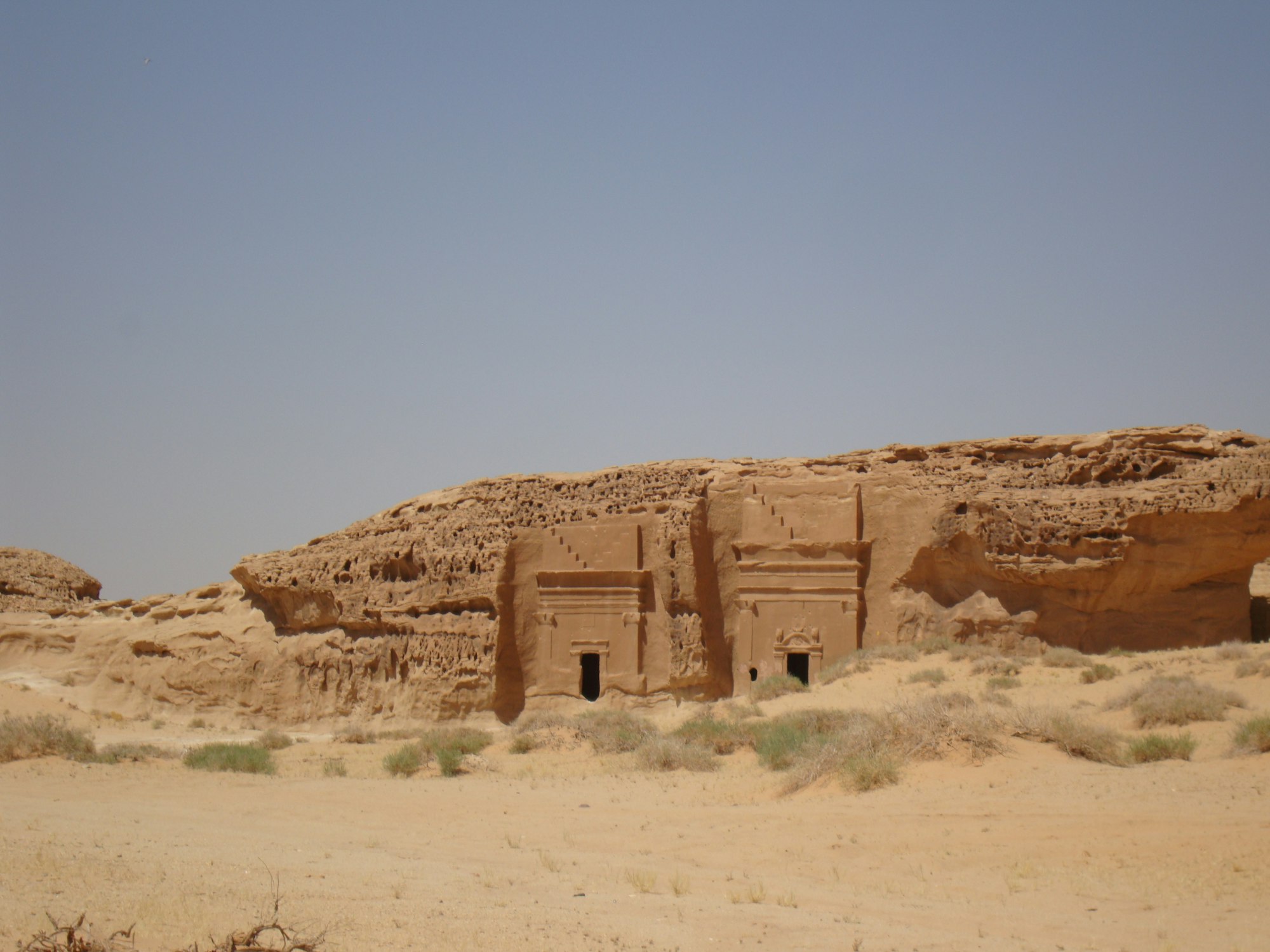
The city belonged to the Nabataeans, the Arab caravan traders who cut Petra out of its gorge in what is now Jordan. Hegra was their southernmost major settlement and their second city, and most of the carving dates to the first century AD under Aretas IV Philopatris, who reigned from 9 BC to 40 AD. It sat where the north-south incense road crossed a route running from the Red Sea toward the Persian Gulf, and it was rich enough to build in permanent stone. There are 111 monumental tombs here, 94 of them with decorated facades, cut into freestanding sandstone outcrops, along with roughly fifty pre-Nabataean inscriptions and rock drawings and a network of deep wells that watered the oasis. Rome annexed the kingdom in 106 AD under Trajan, and Hegra thinned out from there.
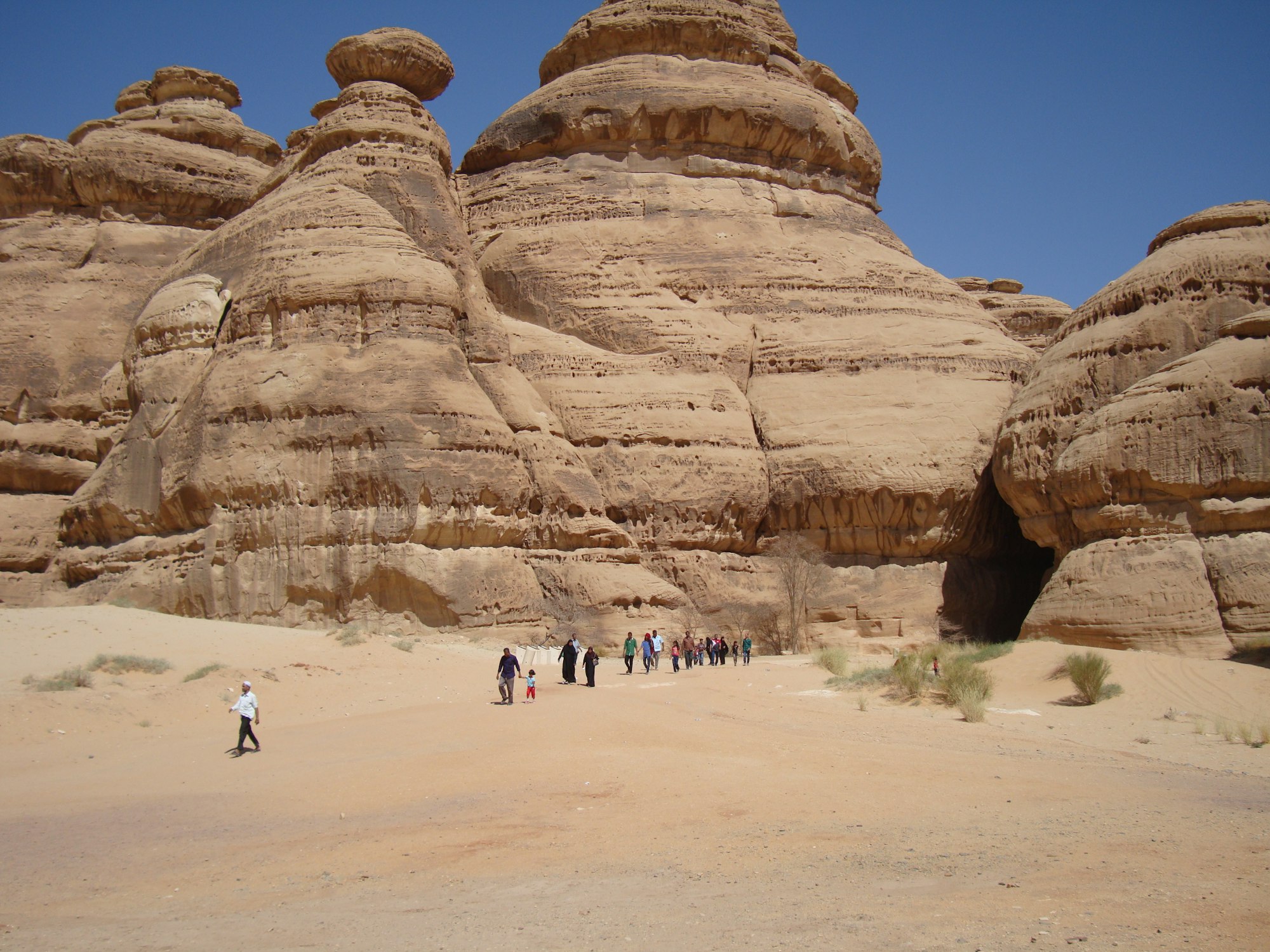
Anyone arriving with Petra in their head should adjust the picture. Petra funnels its visitors: one siq, one reveal, facades stacked along a canyon wall. Hegra works on the opposite geometry, tombs cut into isolated outcrops scattered across a flat plain, so you cross open desert to reach each one and each stands alone against the sky. That dispersal is why the site rarely feels crowded even on a full day, and why site transport exists at all.
The difference that matters is written. Nearly every facade at Petra is anonymous, decorated and silent about who paid for it. More than thirty of Hegra's carry an inscription above the door, and those texts read closer to conveyancing than to epitaph. They name the owner, set out who may be buried inside, forbid sale, lease or pledge of the tomb, and date themselves by the regnal year of the reigning king. That last habit is why a necropolis in the Arabian desert counts as one of the best-dated ancient sites of its kind.
Read enough of those texts and the property law falls out of them. Nabataean women held property in their own names and commissioned tombs on their own account, and one cluster of facades is known as Jabal AlBanat, the mountain of the daughters. The tomb catalogued IGN 117, on the slope of Jabal Al-Ahmar, opens: "This is the tomb which Hinat, daughter of Wahbu, made for herself and for her children and her descendants forever." It dates to roughly 60 AD. In February 2023 a forensic and 3D reconstruction team unveiled a face for her, built from remains recovered in the tomb, and the silicone bust now stands in the Hegra Welcome Centre. It is the first reconstruction of a Nabataean person anywhere.
The dead of Hegra did not leave epitaphs. They left deeds.
Qasr al-Farid is the tomb everybody photographs, and the reason it looks the way it does is that nobody finished it. Formally the Tomb of Lihyan son of Kuza, it stands about 22 metres high on a single freestanding boulder out on open sand. Four pilasters run across its front, where the rest of Hegra makes do with two. The masons worked downward from the top, and the bottom third is still rough, unsmoothed rock, so the facade doubles as a diagram of its own construction: finished cornice above, quarry face below.
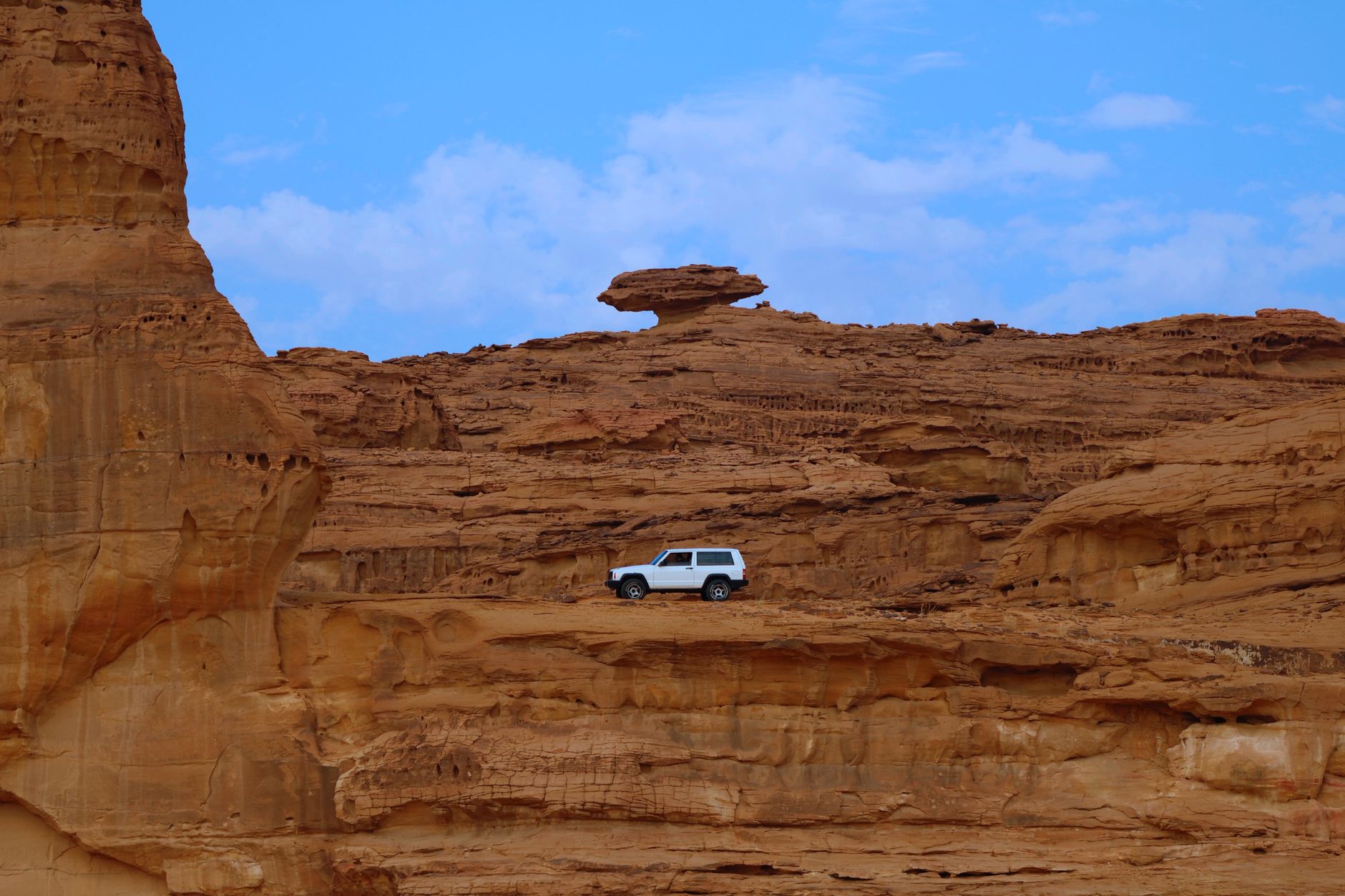
Now the constraint that shapes every visit. Hegra cannot be entered independently: no walking in, no hire car, no exceptions. Access is a timed seat on official Experience AlUla transport with a Rawi, the site's storyteller-guide, either a shared coach from the Winter Park stop or a private 4x4 from the Hegra Visitor Centre. Winter Park sits outside AlUla town, so a transfer has to be built in ahead of the tour's own start time. Same-day tickets are not guaranteed and cool-season slots go early, so book before flying rather than on arrival, and take the wider bundle if Dadan, Jabal Ikmah and Old Town are also on the list.
Dwell time is where trip reports sour. A standard tour runs about two to three hours across a handful of stops, typically the Diwan and the Jabal Ithlib canyon, the Jabal AlBanat cluster and Qasr al-Farid, and the roster shifts when conservation work closes a cluster. Groups move as a unit. Tombs are viewed from marked paths and from the outside, and touching the carvings or removing anything is prohibited. Guiding varies, so an hour of reading about the Nabataeans beforehand is worth more than anything on offer at the gate.
Timing is the other lever. Midday is the worst hour to be standing here: the light goes flat, the facades lose their shadow, and the heat is the part most people remember afterwards. The last departure of the afternoon is the one to hold out for, when low sun rakes the sandstone and the carving comes back. It costs something. Late slots sell out first, and anyone landing mid-morning spends the middle of the day indoors waiting for one. The season is October to March, roughly 15C to 25C by day. April to September routinely passes 40C. Drones need a GACA permit in Saudi Arabia, so plan on leaving it at home.
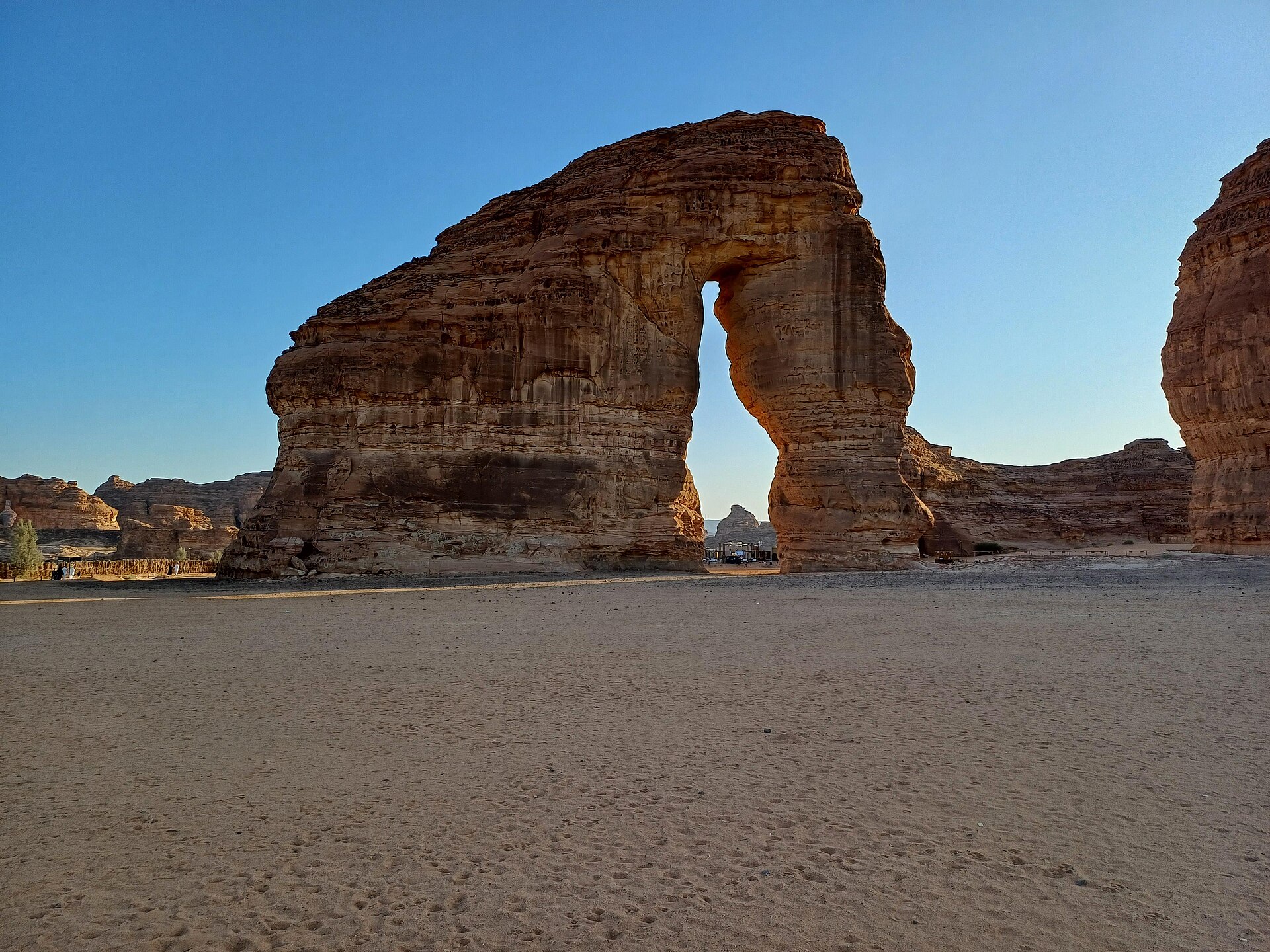
Hegra alone does not fill a trip. The same valley holds Dadan, capital of the Lihyanites who ran this oasis before the Nabataeans arrived, and Jabal Ikmah, a canyon whose walls carry so many inscriptions it is usually described as an open-air library. AlUla Old Town is a labyrinth of mudbrick houses under restoration, with a citadel viewpoint above it. Jabal AlFil, the Elephant Rock, is a 52 metre natural arch with food carts at its base. Maraya, billed as the world's largest mirrored building, stands out in the desert reflecting it. Al-Gharameel is the dark-sky site, best on a new moon. The Oasis Trail through the palms is the shaded early walk, which is where the mornings tend to go when the tombs are being saved for later light.
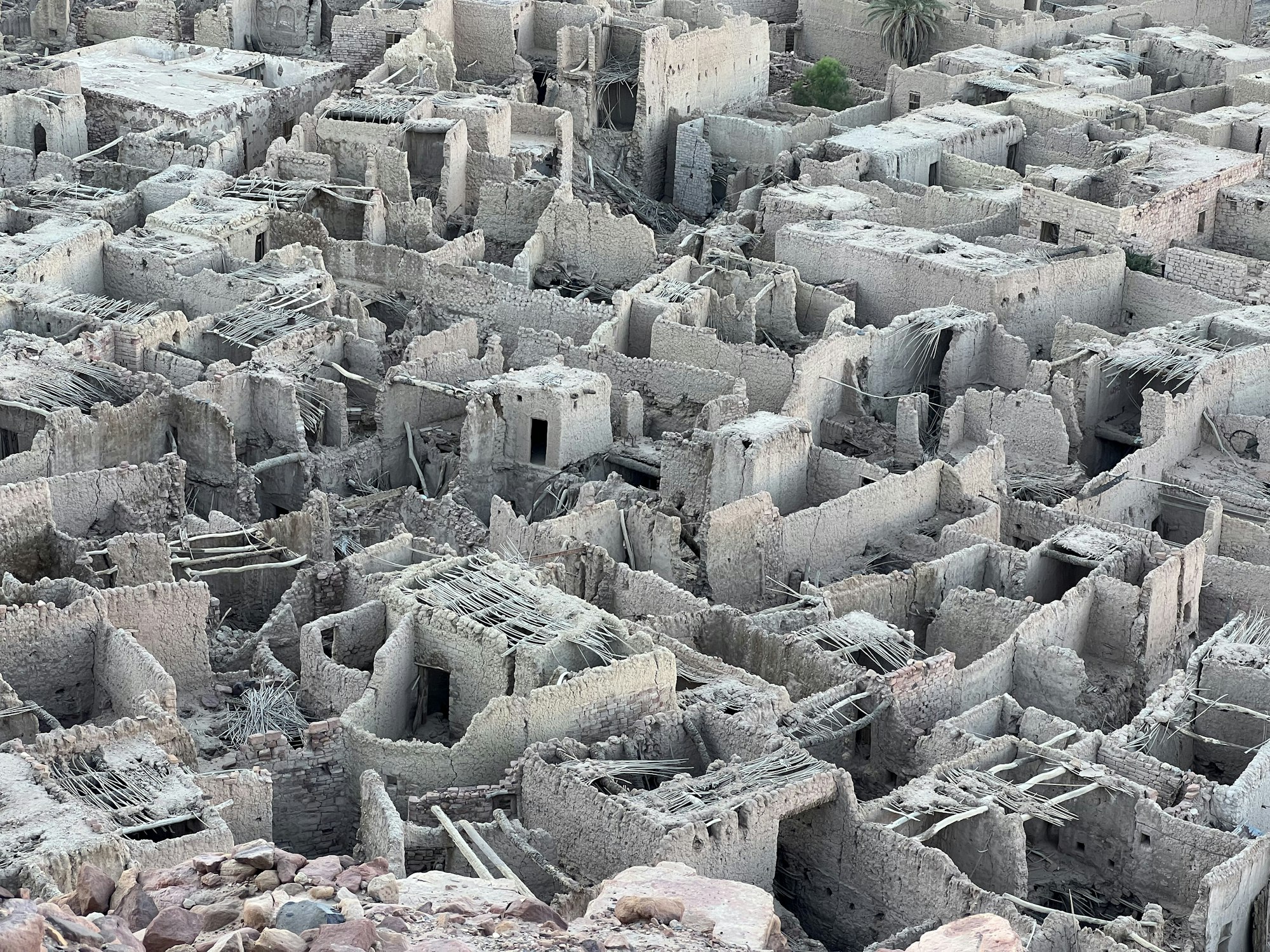
Reaching it is simpler than the remoteness suggests. AlUla International (ULH) sits around thirty minutes by road from the sites, with domestic connections from Riyadh, Jeddah and Dammam. Beds divide between the restored Old Town, where Dar Tantora The House Hotel occupies a run of mudbrick houses lit largely by lantern, and the Ashar Valley corridor to the south, where Banyan Tree AlUla and Our Habitas AlUla sit among the sandstone. The Chedi Hegra, built into the restored Hejaz Railway station inside the heritage property, is the shortest walk to the tombs and the smallest of them.
Hegra After Dark is a separate ticket and a slower proposition: lantern light, staged scenes of Nabataean life, none of the daytime coach's schedule. Visitors who do both tend to rate the night the more atmospheric of the two, which is an argument for adding it rather than swapping it in. The trade at Hegra is plain enough. The custody is real, the ticketed dwell time is shorter than the site deserves, and the good stops are shared with people photographing themselves in front of them. Against that sits a Nabataean city standing in open desert at a fraction of Petra's traffic, with the names of its owners still carved above the doors. Book the late slot, read before you go, and give AlUla the days around it.