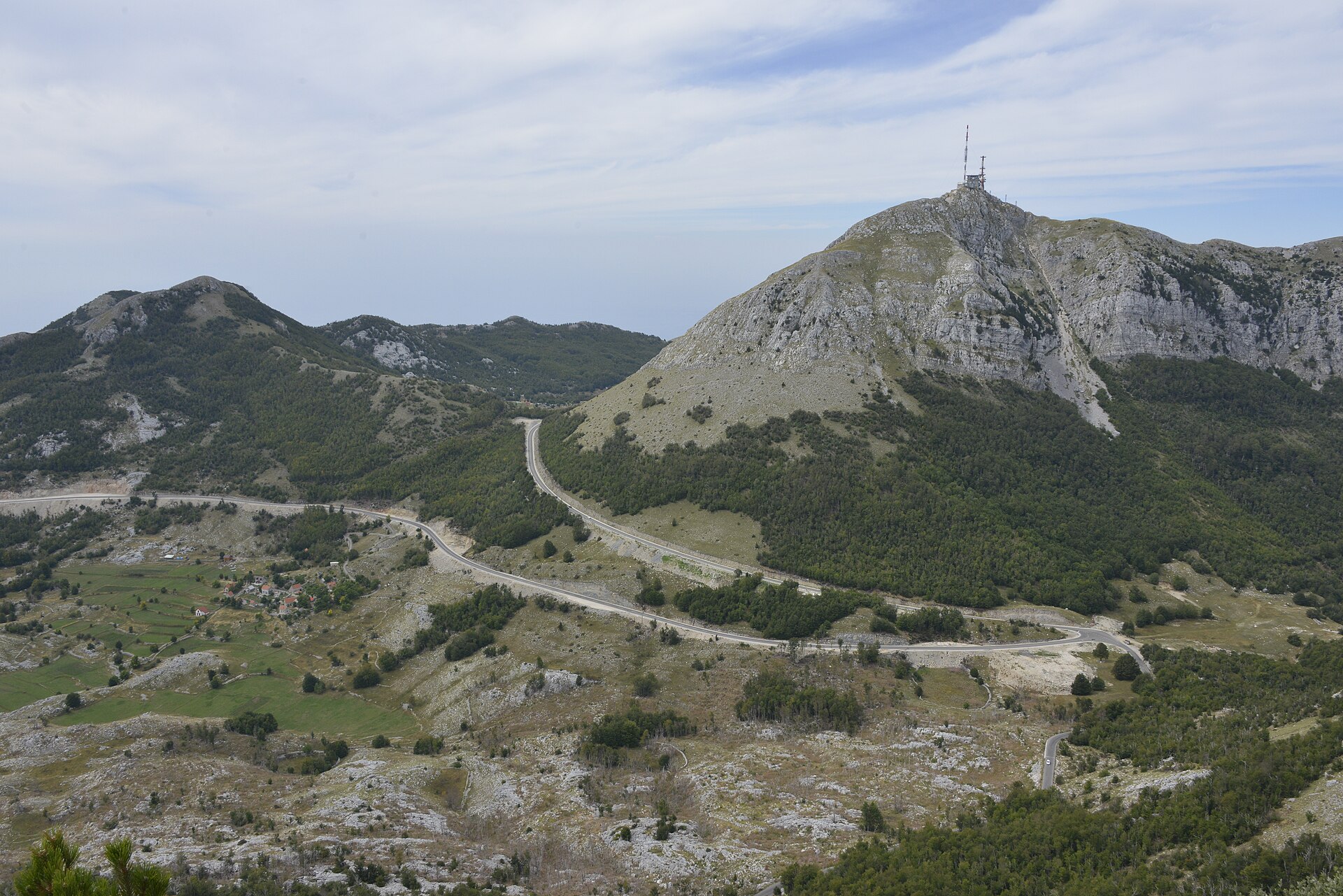
The famous approach is the serpentine from Kotor through Njeguši: twenty-five numbered hairpins, paved the whole way, with knee-high blocks or nothing at all between the tarmac and the drop. An ordinary car and a calm driver are enough, because the hazard is width; in places two vehicles pass by folding their mirrors. In high season the road runs a time-based one-way system, uphill traffic in the morning and downhill in the late afternoon, so the clock decides the direction of travel and, in effect, the shape of the whole day. The Cetinje approach through Ivanova Korita is the second road up, shorter, wider and without the drama, the one to use when what you want is the tomb. Neither route has any public transport, and the Kotor cable car does not close the gap: it tops out at Kuk, around 1,350 metres, a long transfer short of the monument, and it stops without notice in strong wind.
Buy two tickets and carry cash. National park entry is charged per person somewhere on the way up, and where varies by road and by season: sometimes at a barrier on the approach, sometimes only at the summit car park itself, where a uniformed member of staff collects the fee and unlocks the gate. The mausoleum's own admission is separate, collected at the monument by staff of the National Museum of Montenegro, which runs the site from Cetinje and is why a combined Cetinje museum ticket can be worth asking about. Cards are unreliable up the mountain, the café at the top has been reported cash-only, and there is no cash machine near. The car park at the head of the steps holds about ten cars, with overflow strung down the road, and it can fill by mid-morning in July and August. The first hour of the morning is the reliable window, and on the Kotor road the one-way rule pushes a driver into it anyway.
From the car park a tunnel bored through the peak carries the staircase: 461 steps, a count visitors repeat unprompted, partly in the cold of the rock and partly in the open. There is no lift, no shuttle and no other way up, and two separate accounts agree there is no handrail either, which is the fact to weigh before driving up with a grandparent or a small child in the party. Landings break the climb, the tunnel stays mercifully cool in August, and nobody reports the altitude itself as a problem. The cold is another matter. The summit runs about ten degrees below the coast, and the jacket that felt absurd in Kotor gets worn at the top.
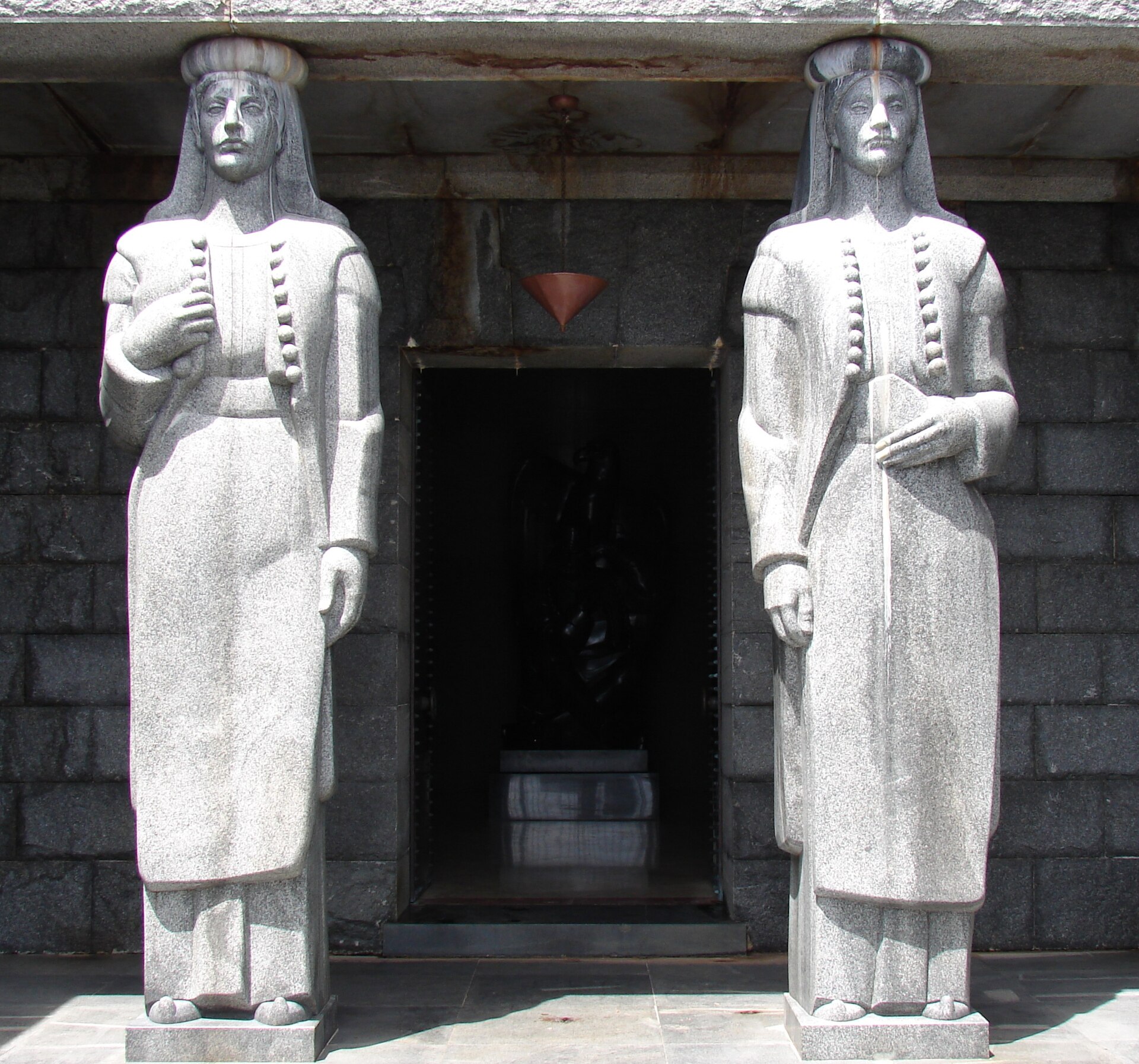
What the steps arrive at is the work of Ivan Meštrović, the great Croatian sculptor of the century, opened in 1974, twelve years after his death, with the carving executed by his student Andrija Krstulović. Two colossal granite women in Montenegrin dress carry the lintel over the door. Travel copy sometimes captions them as the wife and daughter of the man inside, which cannot be right, since he was a celibate Orthodox bishop. Inside, under the gold vault, Njegoš sits with an open book on his lap, twenty-eight tonnes of Jablanica granite cut from a single block and delivered from Split in 1972, an eagle spread above him. A short flight down, in the crypt, the stone over the sarcophagus carries only the name and the years, for the author of the poem Montenegrin and Serbian literature has argued over ever since.
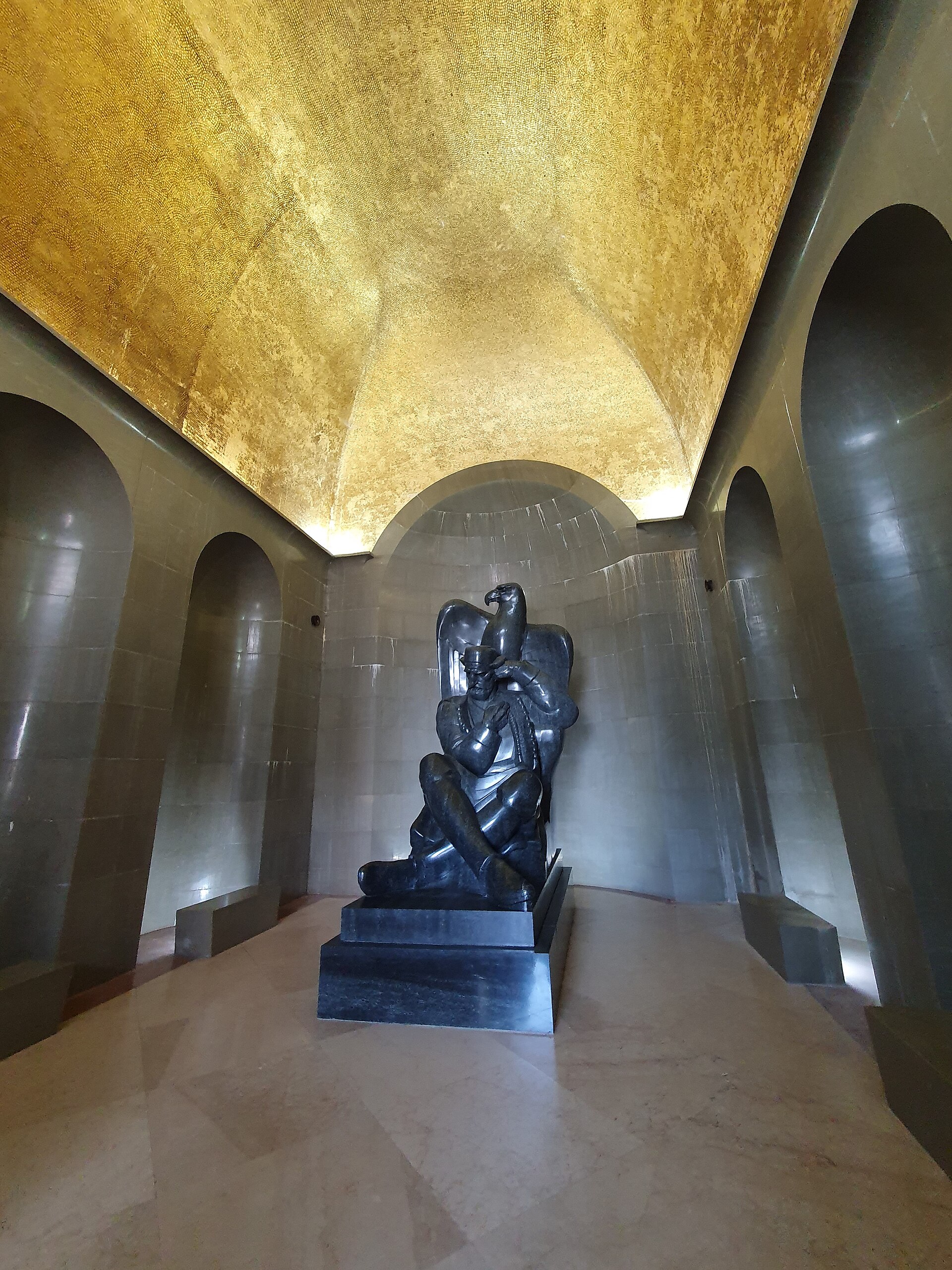
He asked for none of it. Njegoš built a chapel on this summit himself in 1845 and asked to lie there, and he has been moved four times since he died of tuberculosis in 1851, aged thirty-seven. Buried at Cetinje first, because the Ottomans were close enough that a grave on an exposed peak invited desecration, then carried up in 1855, brought down in 1916 on the orders of occupying Austria-Hungary, returned in 1925 under a Yugoslav king into a rebuilt chapel, and moved the last time when that chapel was cleared for the mausoleum, its stones carted down to Ivanova Korita, where they still lie. Whether the chapel should be rebuilt remains a live argument in Montenegrin politics, raised in parliament in 2024, pressed again in an open letter to the government in late 2025, and no closer to a decision. Visitors climb through the middle of the dispute without noticing it.
Head of a church and head of a state at once, buried under a name and two dates.
Past the building a narrow path continues to the guvno, a circular stone platform built to the shape of a traditional threshing floor, and several accounts agree the terrace is the real reward of the climb. What it reliably shows on a clear day: the Bay of Kotor, the grey limestone the Montenegrins call a stone sea, Cetinje directly below, Lake Skadar, Durmitor to the north and the Albanian mountains east. Tourism copy adds the coast of Italy across the Adriatic, a claim the country makes about its own mountain that no first-hand account on record confirms. Haze flattens the view by midday in summer, and cloud can sit on the summit while Kotor lies in full sun, so check the mountain's own forecast before committing to the drive; the coastal one says nothing about the summit, and the view is most of what the drive is for.
The season gates all of it. The monument shuts through the winter because the approach road stays under snow, and it reopens when the clearing is done, usually around the start of May and rarely before the middle of April; outside that window, treat it as closed until confirmed open, though in a clear spell the drive and the lower viewpoints can still repay the fuel. The sensible shape of the day is the easy Cetinje road up in the first hour of the morning and the serpentine down in the late afternoon, when the one-way rule opens the descent. Partway down the eastern side sits Ivanova Korita, at about 1,250 metres, the park's one service hub, with a visitor centre, restaurants, marked walking routes and the only food between the summit café and the towns below. It is also where the stones of Njegoš's demolished summit chapel were carted down when the peak was cleared for the mausoleum, and where they still sit.