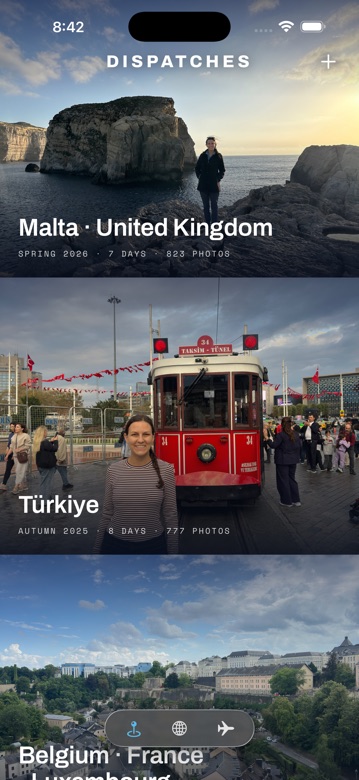
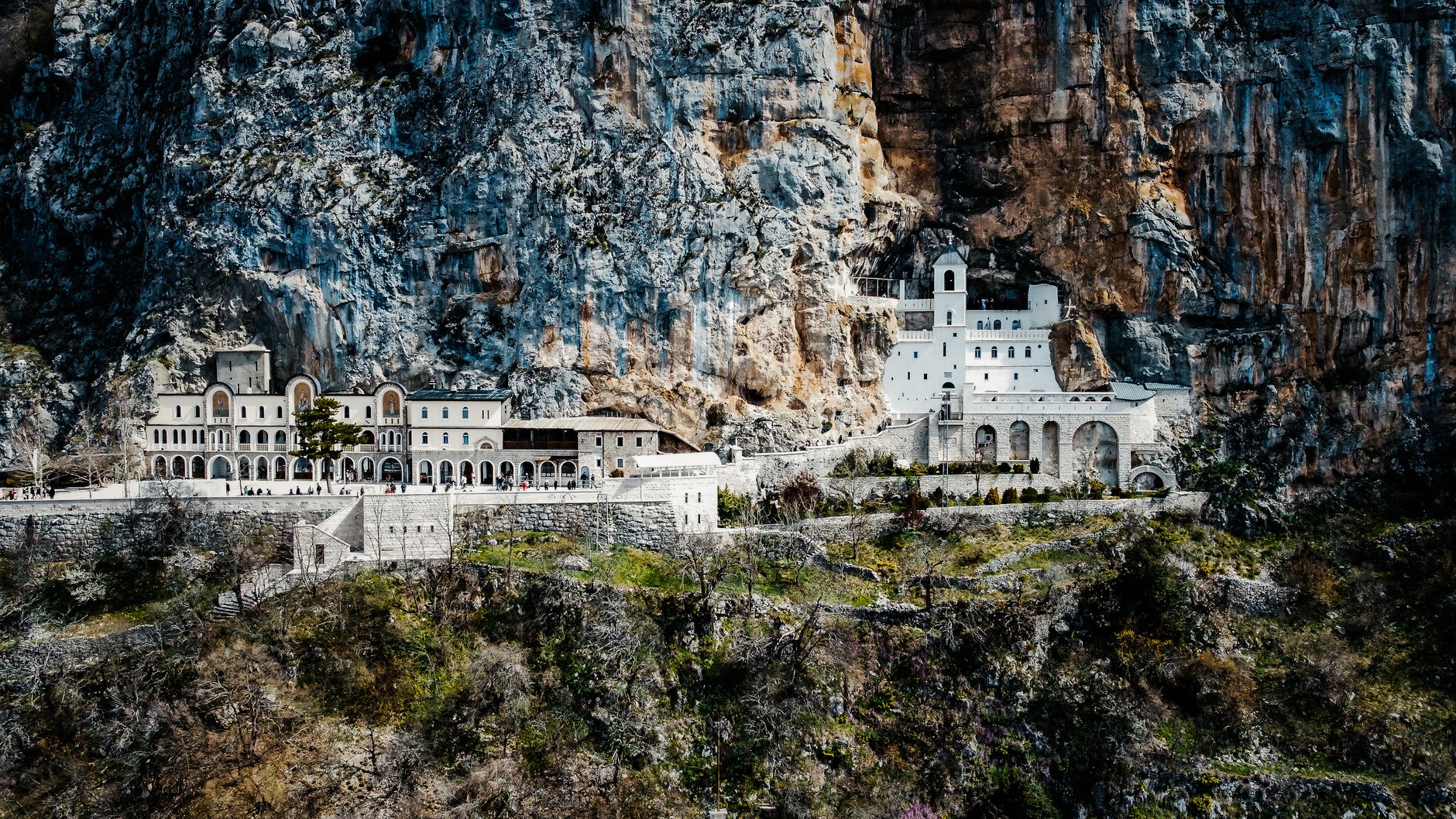
At Ostrog the frescoes sit on the rock. In the upper of the two cave churches the seventeenth-century painter known as master Radul worked onto the stone of the cavity itself and onto the south wall, following the bulges and hollows rather than levelling them first. The images are on living stone, not on a built church. Both doorways are low enough that visitors bow to get through, and the chamber holding the reliquary takes four to six people at a time. The site is two openings in a limestone face, a white front closing them off, a stair, and a terrace narrow enough to queue along in single file.
Almost all of the upper monastery burned on the night of 1 to 2 June 1923. The caves came through, because rock does not burn, and so did the frescoes and the relics inside them. The rebuild ran to 1926, to a design by the Russian emigre architect Vladimir Sukurenko, under the archimandrite Leontije Mitrović and paid for by King Aleksandar Karađorđević and the government of the Kingdom of Serbs, Croats and Slovenes. The whitewashed storeys stacked under the overhang in every photograph of Ostrog date from then. The lower monastery, further down the slope, was untouched.
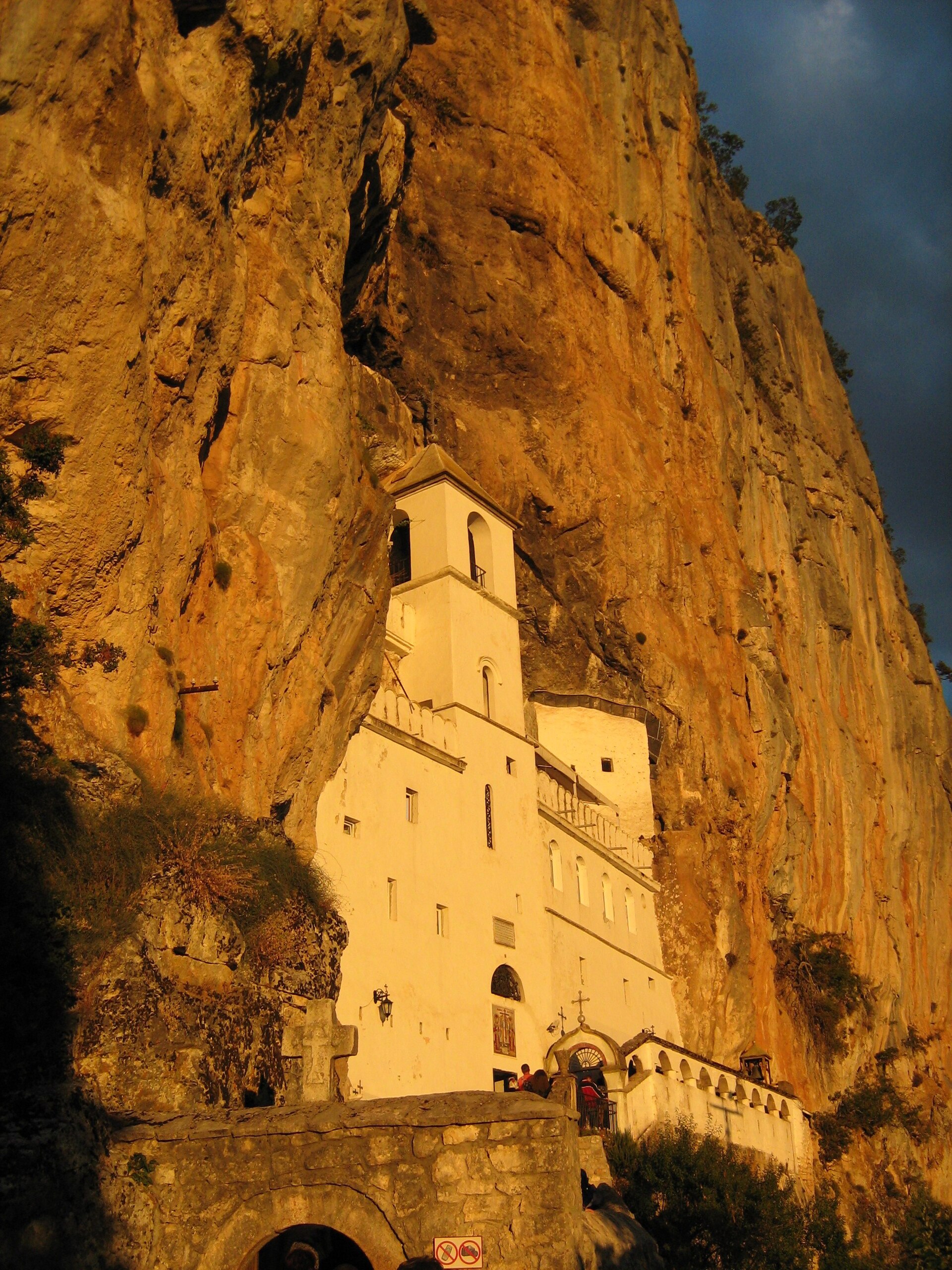
The community is older than the fire by two and a half centuries. Vasilije Jovanović, born at Mrkonjići in Herzegovina in December 1610, served as a bishop in Herzegovina and came to this cliff in the 1660s, where hermits were already using the caves. Serbian tradition puts one of them, Isaiah of Onogošt, in the cavity that became the church of the Presentation of the Theotokos. An inscription over the inner door of the other cave church, the Holy Cross, dates it to 1665 and its completion to 1667, and Radul's frescoes to 1667: St Sava, St Basil, and scenes from the life of Christ, worked around the shape of the rock. Basil died at Ostrog in April 1671 and was venerated as a saint locally, without any dated act of canonisation. His feast falls on 12 May. Both cave churches are in the upper monastery; the lower monastery's church is the Holy Trinity, dated 1824.
The site exists because the rock dissolves. Ostroška greda is a limestone ridge on the western side of the Zeta valley, in the karst country where the Dinaric mountains break towards the Adriatic, and water has spent a long time hollowing cavities and overhangs into its face. The monastery moved into openings that were already there. The upper terrace stands at around 850 metres above sea level, several hundred metres above the floor of the valley, on a ledge with no level ground and no easy approach.
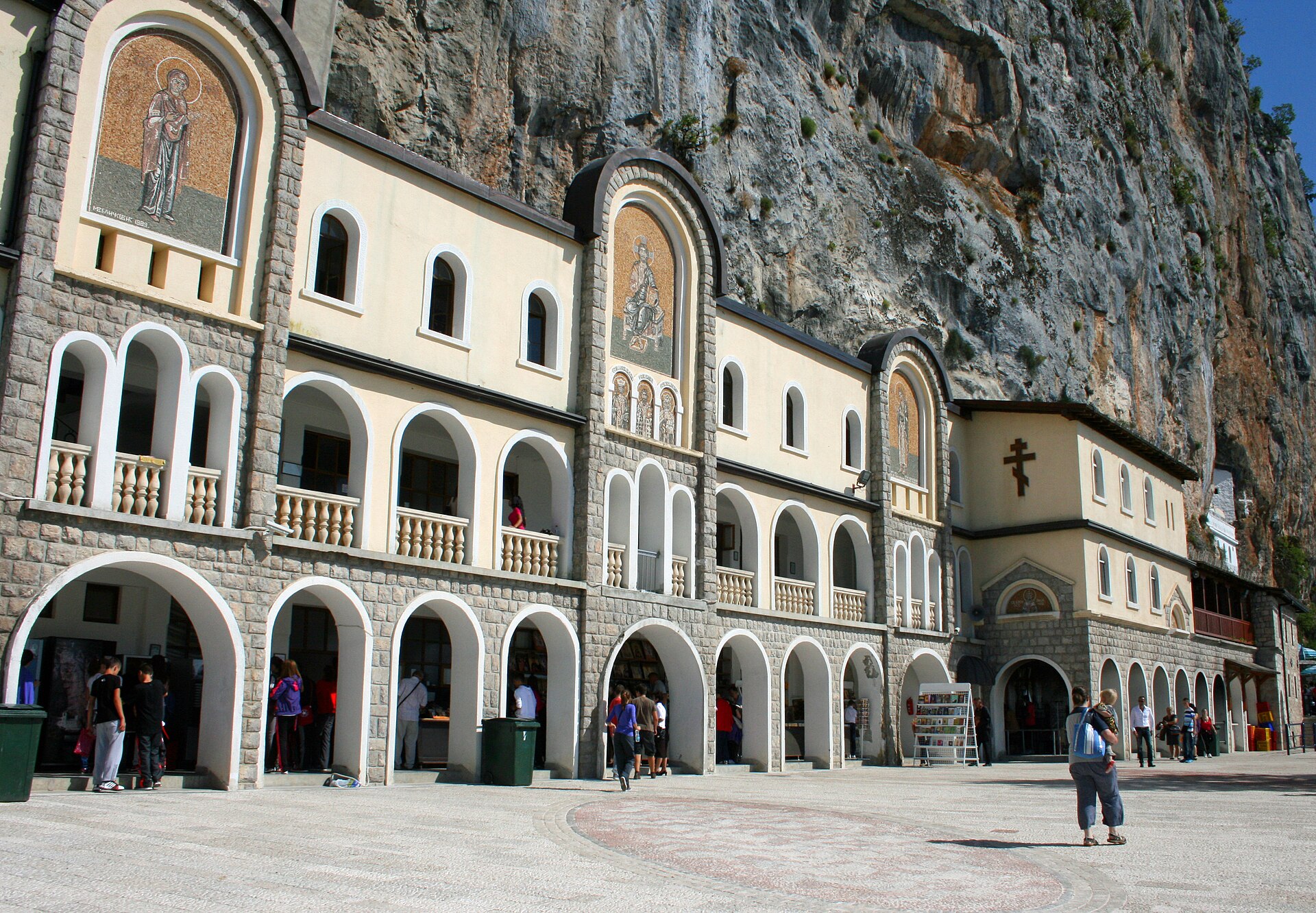
What happens on the ledge is the same sequence every day, and in July it takes an hour. Visitors come up the stair and join a line running along the terrace wall under a rig of blue umbrellas put up for shade. A kiosk sells candles and has a queue of its own. At the entrance to the shrine stand wooden baskets for gifts, and what people leave is practical: food, soap, blankets, folded clothing, notes of money. Most women cover their heads. The line moves through the low door, past a priest who gives a short blessing and holds out a cross to be kissed, to the casket where Basil's body lies under embroidered cloths, and then out again briskly, because the terrace is full behind them. Chanting carries across the stone through loudspeakers. Photography inside both churches is not allowed. In the warm months pilgrims stay overnight, and thin mattresses are laid out in and around the upper courtyard for them.
What people leave in the baskets is food, soap, blankets and folded clothing.
Some pilgrims walk up from the lower monastery, and a few of those cover the last stretch barefoot or on their knees. Serbian devotional sources call this a zavjet, a personal vow, and say plainly that it is not a rule. It is done by a visible minority, mostly around the feast, and the great majority of visitors, Montenegrins included, drive to the upper car park.
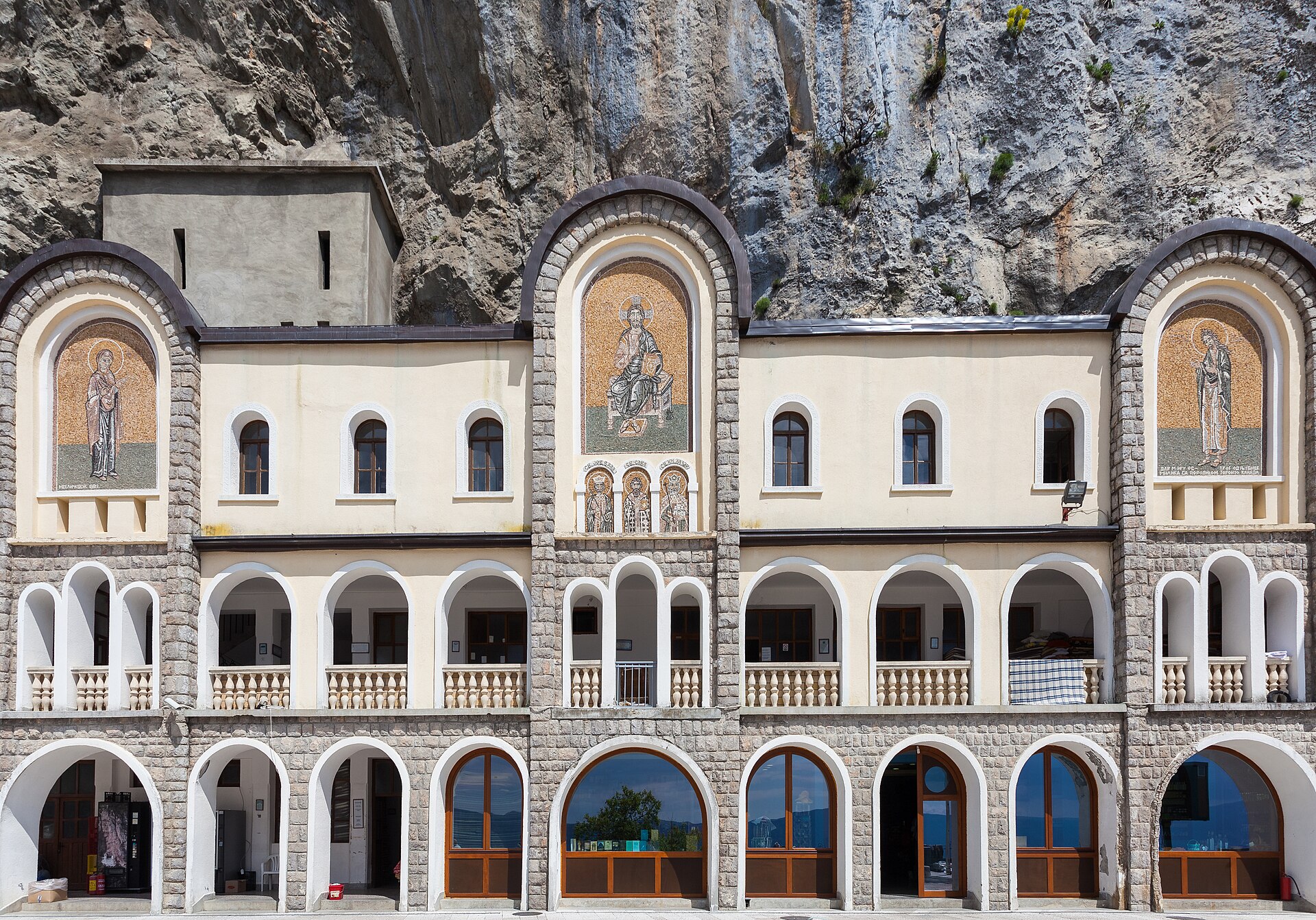
On 12 May the site runs at capacity. Balkan Insight reported around two thousand people setting out from Podgorica two days ahead of the feast to walk roughly forty kilometres, joined overnight and the next day by thousands more from elsewhere in Montenegro and the region. The police reorganise the local road for it: under the 2026 arrangement traffic ran one way only, from the monastery towards Ždrebaonik, from nine in the morning on 11 May until seven in the evening on 12 May. Anyone whose interest in Ostrog is architectural rather than devotional should stay away on those two days. The second patronal feast, the Presentation of the Theotokos, falls on 4 December.
Ostrog is generally described as the most visited pilgrimage site in the Serbian Orthodox Church, though how many people come is not actually known. The figure in circulation is one to 1.2 million a year. It appears to enter the record through a 2013 interview on Radio Skala, reported by Kurir, in which Stevo Vučinić, then deputy chairman of the council of the unrecognised Montenegrin Orthodox Church, said around 1.2 million people came annually and that the Serbian Orthodox Church took more than fifty million euro a year from the site, and argued the revenue should pass to the state. It was an estimate offered by a party to a dispute over church property. Other published figures, none of them audited either, run from over a hundred thousand through six hundred thousand to about a million. No count from the state statistics office or from the church could be found. Orthodox, Catholic and Muslim visitors all come here, a reputation the site has held for a long time, though no survey has quantified the mix.
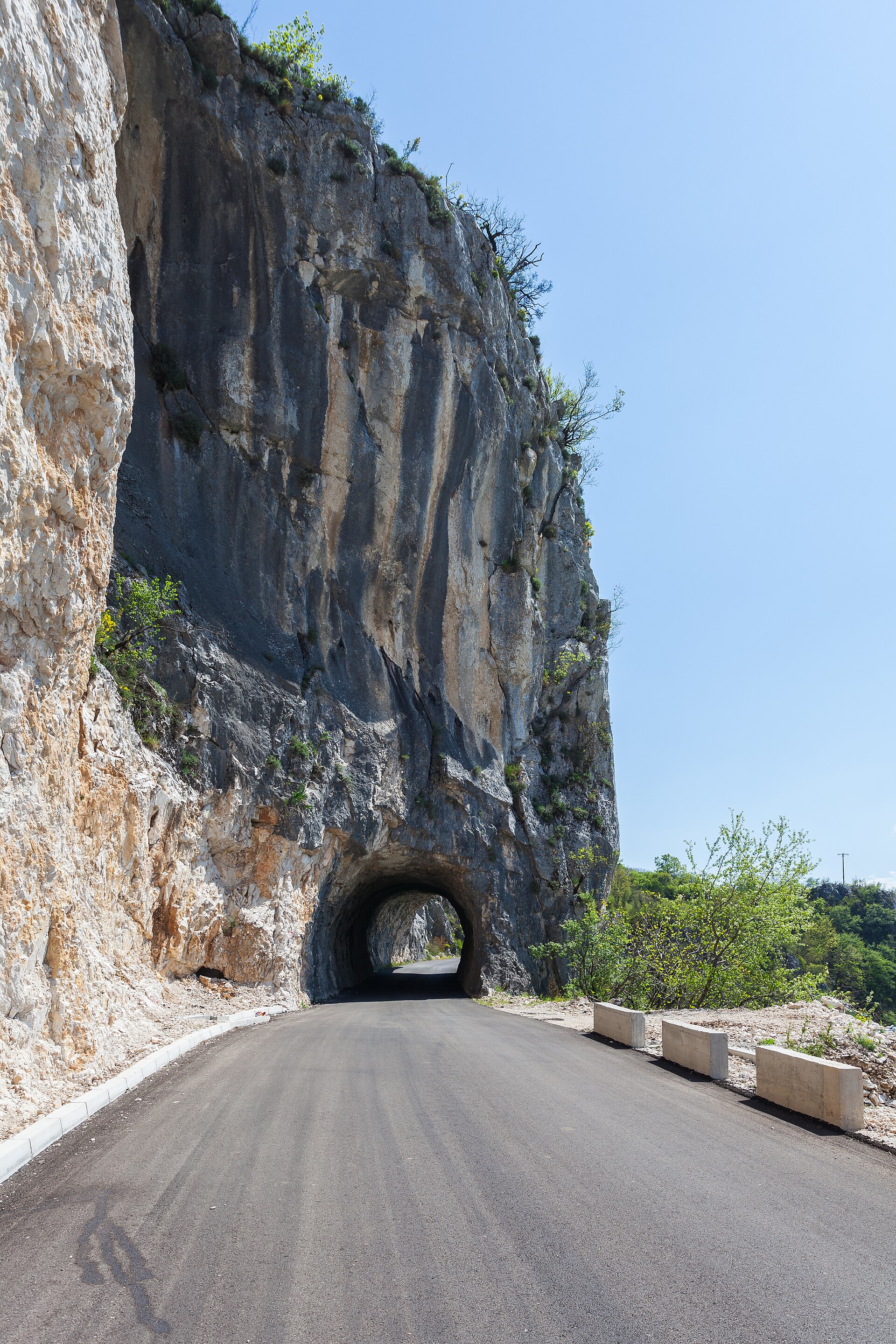
Getting up is the part travellers talk about most. Podgorica is about fifty kilometres away and under an hour by car, and its airport is the obvious arrival; Tivat suits anyone combining Ostrog with the coast. From Budva it is an hour and a half. From Kotor it is two to two and a half hours each way, a long day out for a site that takes one to two hours. The turn is at Bogetići on the M-3 between Podgorica and Nikšić, and from there it is about ten kilometres of switchbacks. The surface is paved and the corners are mostly protected, but width is the issue: there are stretches that take one vehicle, blind bends, and short cuttings through rock that admit a single car. What makes it hard is meeting a coach coming down in July. The road continuing down the Danilovgrad side towards Ždrebaonik is wider and newer, so anyone uneasy about exposure should plan to use it in at least one direction.
Entry is free, and so is parking, which is arranged in tiers; which tier a driver gets depends on the hour. There is a large lot at the lower monastery beside the church of St Stanko the Martyr, built in 2004 and named for a shepherd boy whom tradition holds Ottoman troops killed in 1712 for refusing to say where Basil's relics had been hidden. Above it are an intermediate lot and a small shaded one near the top of the walking path. In summer the top lot is reported full by around ten, after which arrivals are turned back down to walk up. Arriving before nine means five minutes on foot; arriving later can mean three quarters of an hour. Midday in July and August is the worst time to come, for the queue and the heat together, and a weekday morning in May, June, September or October buys the same site with a fraction of the line.
From the lower monastery a shaded, stony footpath climbs two to three kilometres to the upper, taking most people between half an hour and an hour, and it disposes of the parking question; the road between the two levels is about five kilometres. Ostrog also has its own halt on the standard-gauge line between Nikšić and Podgorica. The train from Podgorica takes a little under an hour, and a marked trail climbs from the halt through woods, reaching the lower monastery in an hour or more and the upper in two to two and a half hours, climbing perhaps five hundred metres. The waymarking gives out in places, the halts are usually unstaffed, there are shepherd dogs, and in summer there are snakes on the warm stones. Check the timetable, and give the whole day to it.
Shoulders and knees must be covered, for men, women and children, and it is enforced at the gate. Accounts differ on whether a wrap is handed out there or has to be bought from the stalls lower down, and there is nowhere on site to change, so arrive dressed. There is no restaurant and nothing worth calling a shop, the nearest reliable food is back down on the approach roads, the toilets draw complaints, and water should be carried, particularly by anyone walking up. The lower monastery keeps simple pilgrim dormitories, segregated by sex, for a donation and with an early start, and they will be full around 12 May. Hotel Sokoline sits about 1,500 metres from the lower monastery on the Ždrebaonik road, with terraces facing the cliff. The published opening hours contradict each other. Treat the church interiors as closing in the middle of the afternoon, because arriving later than that means seeing the ledge and the view and not the reliquary.