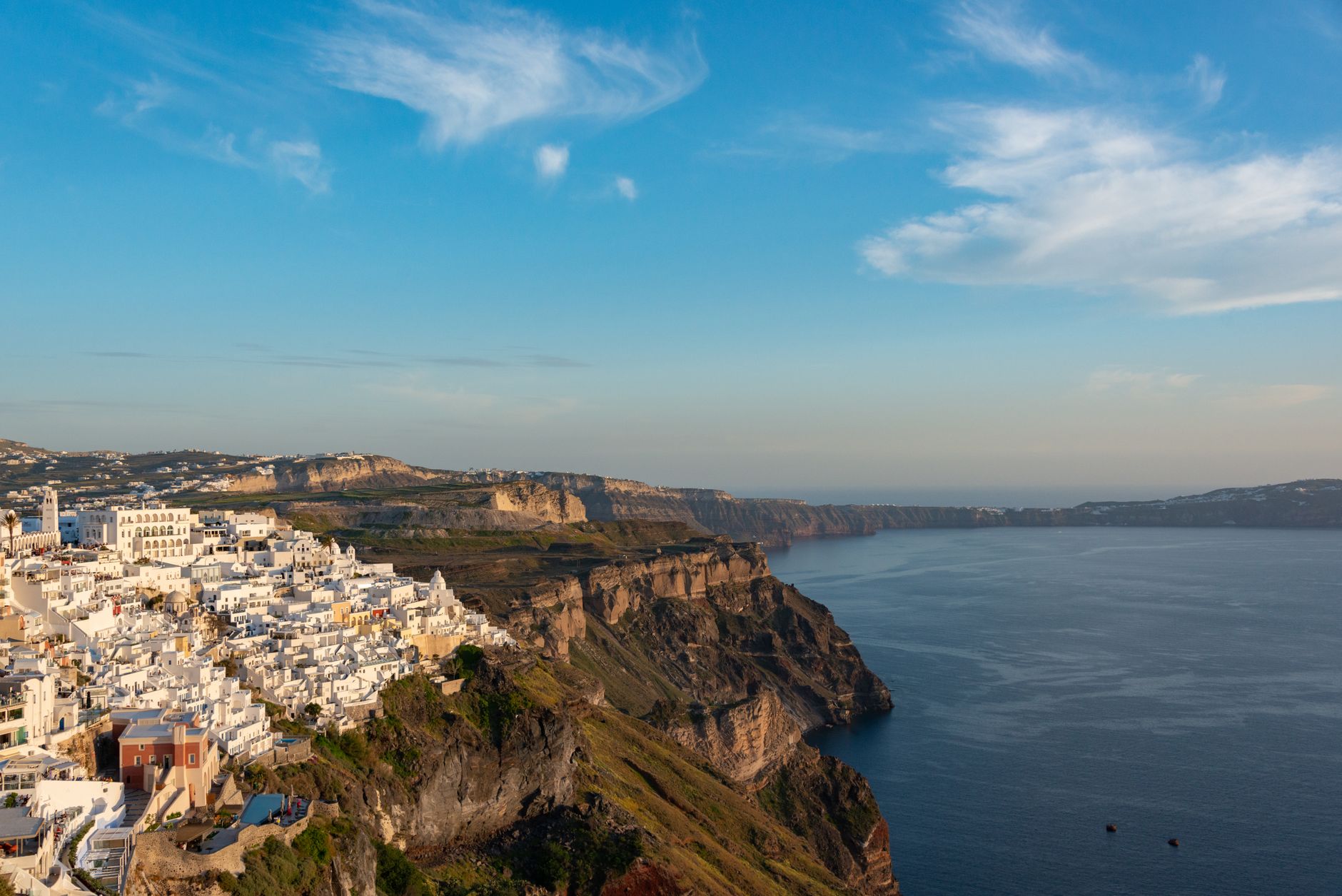
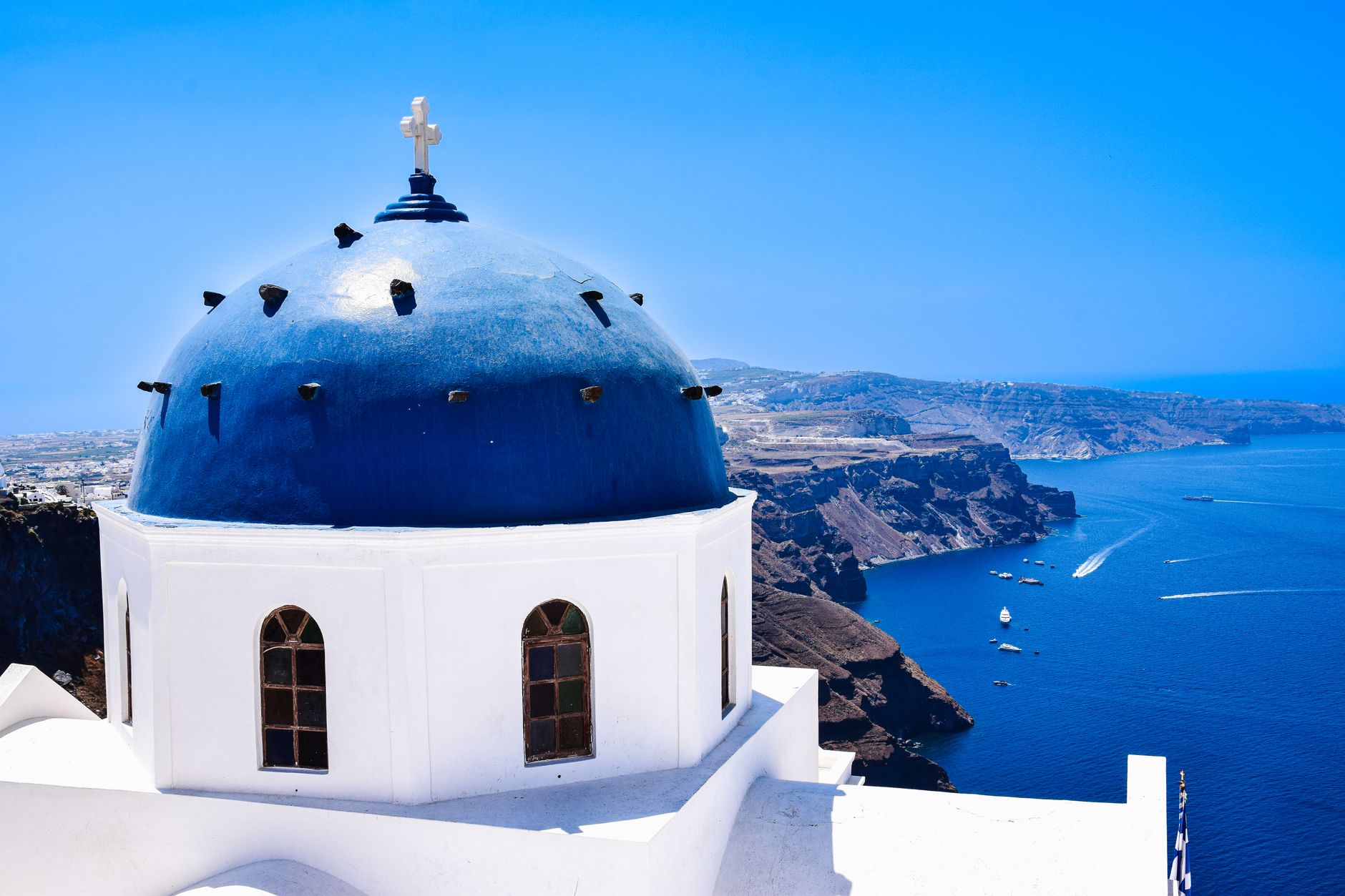
You are standing on the rim of a volcano, though the island does its best to help you forget it. The way to feel that is to come in by sea. Take a slow ferry with an open deck, not the sealed catamaran that keeps you blind below the waterline, and for a long while there is nothing but water. Then the cliffs come up on both sides at once, three hundred metres of them, striped red and black and ash grey, the white towns spilled along the top like snow that had settled and refused to go. When a ferry sounds its horn the sound comes back off the rock a beat later.
The bowl the ferry crosses is the crater. Around 1600 BC this was one round island, and then it went up in one of the largest eruptions in ten thousand years, three times the size of Krakatoa, and blew its own middle into the sky. The sea came in behind the blast and filled the hole in a day or two. What is left is the rim, a crescent of cliff twelve kilometres across, and the tidy blue bay inside it is nearly four hundred metres deep, the drowned throat of the volcano. From the terraces it reads as a view, safely below. It is not a view. It is the scene of the accident, and the whole island is built along the lip of it.
The eruption buried more than the middle of the island. On the southern tip, at Akrotiri, a whole Bronze Age town went under the ash and stayed there three and a half thousand years, and it has been dug back out: lanes you can walk down, houses of two and three storeys, frescoes still on the walls, clay pipes that carried hot and cold water, a stone bathtub, jars that hold the ghost of the oil and fish once in them. It is Pompeii with one difference. They have found no bodies. The ground had shaken for months and the first ash had already fallen, and the people read it correctly and left, taking their animals and what they could carry, before the mountain did the rest. You walk through their rooms knowing they got out, which is the only reassuring thing on an island built inside a blast crater.
The towns hold the top of the wall, Oia at the north end and Fira along the west, white houses folded into every crease of the cliff and domed in the blue of the water below. They are lovely, and they are besieged. On a heavy day seventeen thousand people come off the cruise ships onto an island of fifteen thousand, and by late morning Oia is a single lane of jewellery shops moving at the pace of the slowest phone. A man pouring wine in Fira will tell you, unprompted, that the island has lost the thing it used to be, said without heat, an old fact he has stopped arguing with as he pours the next glass. The answer is the hour. Oia before nine is nearly empty; by ten it belongs to the crowd.
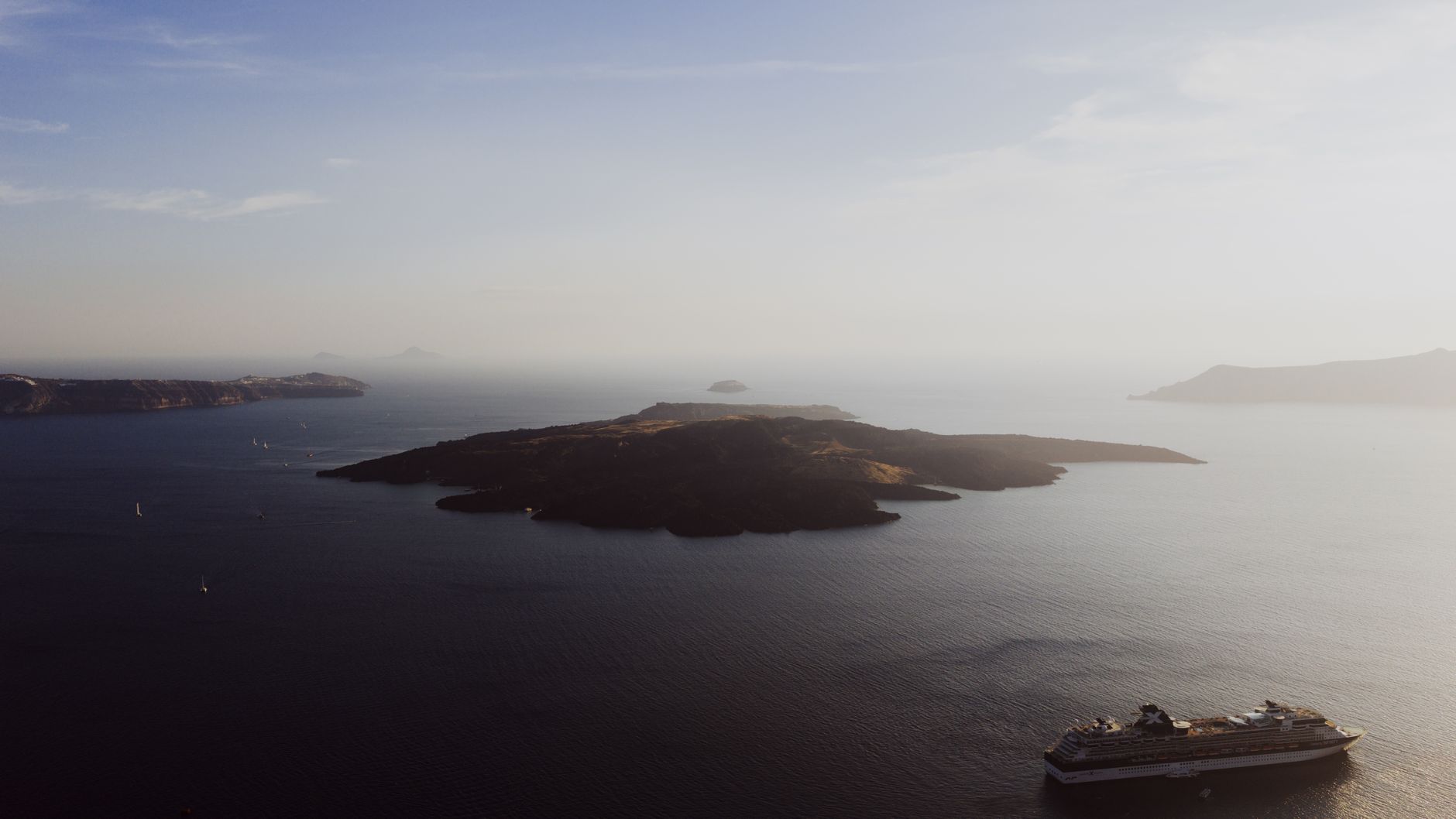
The island is best understood from the water, and a boat runs out into the middle of the caldera. Two low black islands sit there that were not there before the eruption and are still being built, the youngest land in Greece. You can climb the larger one, and Nea Kameni is less a walk than a scramble over loose black rubble with no shade anywhere on it. The surprise is underfoot. The ground is warm, warm enough to feel through the soles of your shoes, and at the vents it gives off steam that smells of struck matches. The crater at the top is a plain grey hollow, and hardly the reason for the climb. The footing itself is what you come for, rock still warm and cooling under your soles, and the white rim seen for once from the inside of the thing that made it.
Below the volcano the boat stops over the hot springs. You slip off the stern into cold, deep, open sea and swim thirty metres to a patch of rust-orange water that is not hot but only less cold, the colour of weak tea, stained by the iron bleeding out of the rock. It clouds the sea a muddy orange, and it marks what you wear: a swimsuit comes out of it a shade it never fully goes back from. The brochures sell it as a spa; it is nothing of the kind. This is the runoff of a living volcano, and it leaves its colour on whoever swims it.
Even the vines grow against the odds. There is almost no rain and a wind that never lets up, so the growers coil each plant low into a basket on the ground, a shape they call kouloura, and the basket shelters the grapes and catches the night mist for them to drink. The vines are ungrafted and very old, spared the plague that killed off most of Europe's, because the volcanic ash will not carry the louse. Out of that ash and fog comes Assyrtiko, a white with a line of salt and struck flint through it that tastes of exactly where it stood. Drunk on a terrace over the caldera, it is the most honest thing on the island, the volcano poured into a glass.
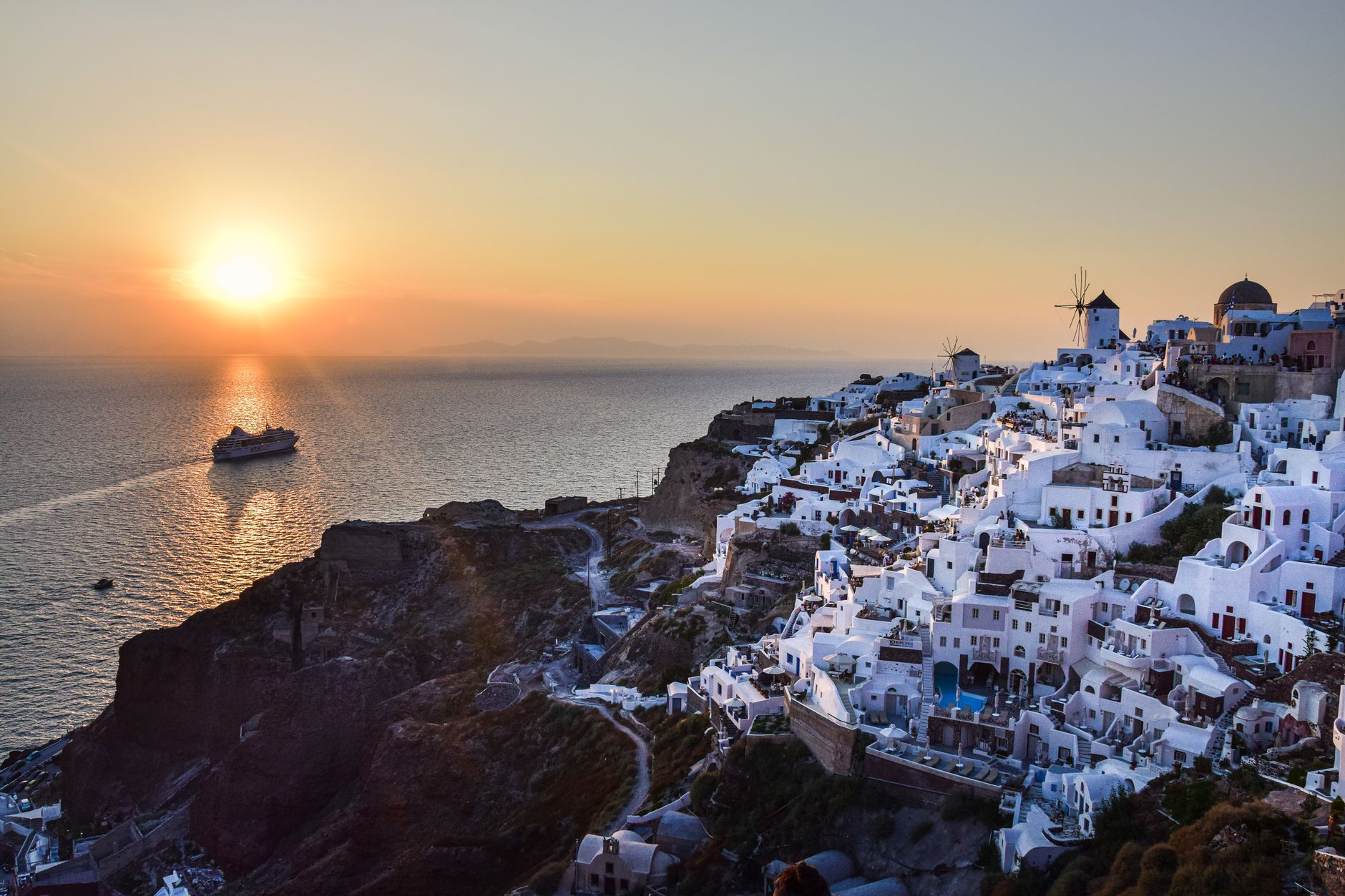
And then there is the light, which is why the crowd packs the north wall of Oia every evening and holds its ground for hours. The crush is avoidable. Imerovigli, a short walk south along the caldera, takes the same sunset with almost none of it, and from a boat on the water below there is no crowd at all. The sun drops into the open sea beyond the rim and the white towns catch the last of it, a colour that will not hold still long enough to name. The sea takes all of it and gives it back doubled. Santorini was made by fire and drowned by the sea, and at the close of every day it hands the light back to the water that once came in and carried the middle of the island away.