The decision is made early, by eye, from the mainland. Peter Cox, an Irish landscape photographer, describes the routine: the boatmen drive over the bridge from Portmagee to Valentia and look at how the sea is breaking on the islands. The reading that counts is the behaviour of the swell eleven and a half kilometres out, which a Portmagee forecast does not give and no app reproduces. The call reaches passengers by phone or text, and it can go the other way: sailings are pulled forward to catch a window, and travellers have been moved from an 08:30 departure to 07:00 on a morning's notice. Anyone booked on a landing needs to be contactable and within easy reach of the pier the night before.
The sea can be settled enough for a boat to make the crossing and still be too lively at the island, where there is one small concrete pier and the swell has to be low enough to hold a boat against it while twelve people step across. Two thresholds, then, and the second is decided out on the rock, where the OPW guides have the final say on whether the pier is workable: parties do sail on a landing ticket, get told at the island that it is off, and come home having circled it instead. Operator-adjacent sources put the shortfall at roughly a third of scheduled landings, a figure that circulates in trade and aggregator content with no official return behind it: no OPW or Met Éireann dataset is published that would let anyone check it. Cancellations bunch at the shoulders of the season, in May and late September, and they run in streaks, one traveller on the Kerry forums arriving to find the ninth consecutive cancelled day in June. Mid-June to August is the steadiest window and the hardest to book. Allow two to three days around Portmagee and treat any single one as a coin toss. Some visitors hold more than one date, which other travellers object to, because 180 seats a day is the whole supply.
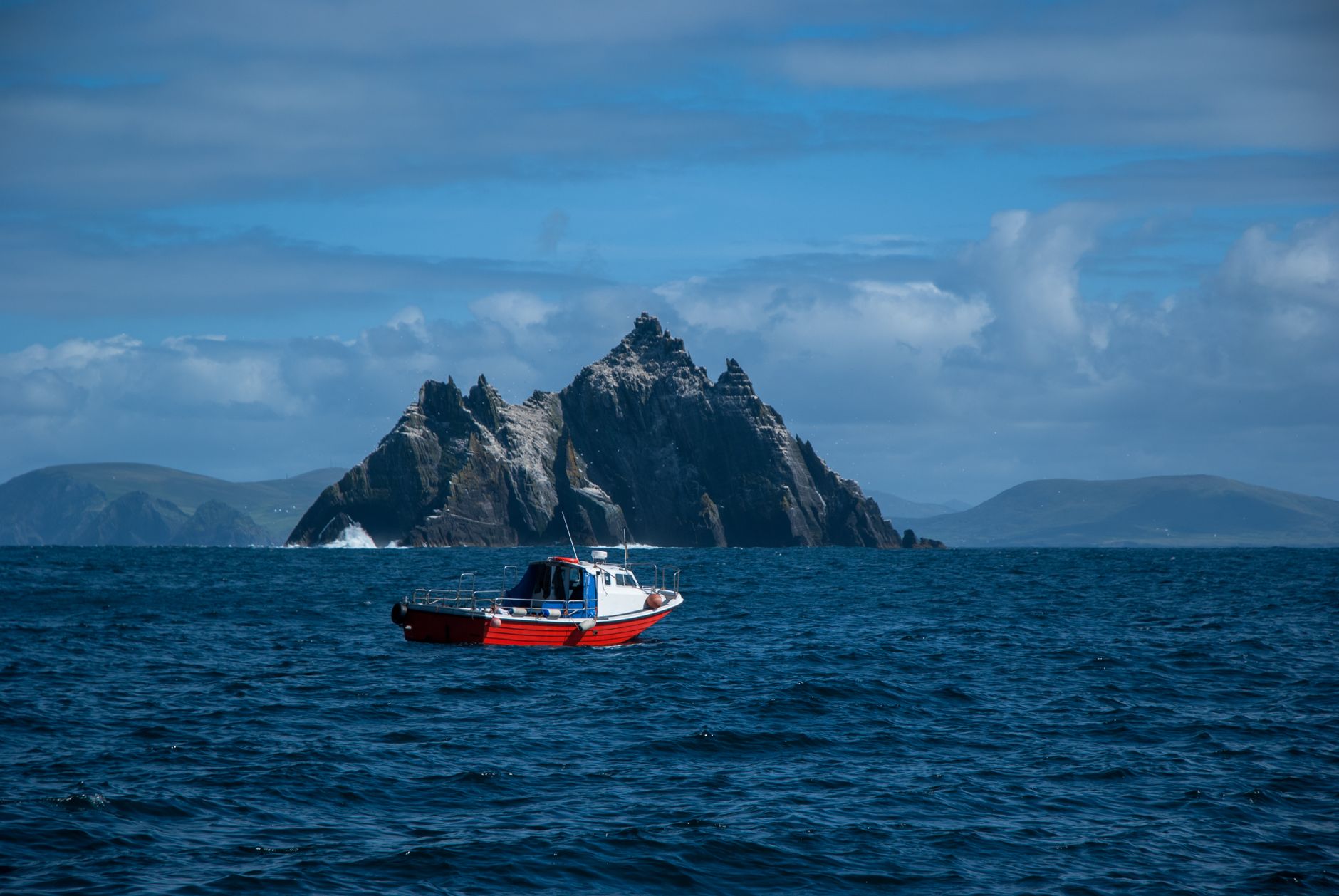
The OPW awards its landing permits by public tender, on five-year terms, and publishes the list, permit holder and boat name, on its own visitor page: fifteen rows for the current season, from Michael B and Kenneth Casey's Skellig Crest to Sandra O'Connor's Diversion. Each may land once a day with a maximum of twelve passengers: fifteen boats, twelve seats, one run, 180 people on the days it happens at all, and that is the entire supply. The island charges nothing; a visitor pays for the boat, and a landing ticket runs to roughly double a non-landing trip. Two films then moved the demand side. Skellig Michael appeared in Star Wars: The Force Awakens in 2015 and The Last Jedi in 2017, one of the permitted boats is now named Force Awakens, and landings rose 16 per cent in 2016 and 33 per cent in 2017, to almost 14,700 that year and 16,792 in 2018, against a management plan figure of around 11,000. Conservation bodies objected at the time; when a major rockfall hit in 2017, experts said the films were not to blame and pointed at weather and geology.
The 2026 season is running. The OPW announced a reopening from 9 May, subject as always to weather and sea conditions, and its own page now gives the season as 12 May to September, the announced Saturday having passed in conditions that kept the boats in. Both dates are the OPW's own, so the two starts a traveller sees advertised are versions of one announcement. By the end of May the first summer visitors were ashore in numbers and the national press was photographing them. Landings run to the end of September. The precedent worth carrying into next year is 2025, when the opening slipped by a month for legal reasons. Two unsuccessful applicants for the new permits began High Court judicial review proceedings in April, triggering an automatic suspension that barred the OPW from issuing any permits. The season, due to open on 10 May, did not. Mr Justice Garrett Simons lifted the suspension on 5 June, guides landed on 9 June and the first visitors on 10 June. On 24 June the two companies withdrew the challenge, the OPW paying their costs, and the case was struck out without going to trial. Simons J recorded that his ruling had entailed no finding whatsoever on whether the tender allows the OPW to confine landing rights to the fifteen successful tenderers for five years: he left that for the trial of the action, and the withdrawal meant it was never argued. An advertised opening date is worth little, then, until the permits have actually issued.
What is left of 2026 is September, the season's poorest shoulder for weather, and seats in it come free as other passengers give up and drive to Killarney, so the way in now is to ring the boats directly. Anyone planning the trip properly is planning 2027. Booking opens once that year's permits are issued, which can be as late as spring, and July and August dates go quickly once they do. Operators handle their own reservations, so there is no central system to work through, and the OPW republishes the permitted list every season with boats changing hands between one and the next, which makes the state's own page the list to book against. Weather cancellations are refunded in full or rescheduled by the operators checked here, while a customer cancellation inside seven days generally is not, and terms vary enough to need confirming with the individual boat at booking. The OPW does not permit children under twelve on a landing, and several operators set their own bar higher at fourteen, so the age limit that applies is the boat's.
The crossing takes 45 minutes to an hour each way in open Atlantic, and longer in a lump. Seasickness is common enough to plan around: a tablet an hour before departure, a light breakfast, and a seat amidships, where the motion is smallest and the stern's pitching is not. On the good days the water is the best part of the trip, with dolphins, grey seals and basking sharks all working it. There are four departure points: Portmagee, the main one, Glen Pier on Valentia Island, Ballinskelligs and Derrynane Harbour. Portmagee is roughly an hour and a half to two hours from Killarney by road and about two and a half hours from Dingle, which is too far to drive on the morning of a 07:00 call.
The crew hold the bow against the landing while the swell lifts and drops it, and passengers time the step across to the top of a wave, one at a time. People have fallen between boat and stonework before. Everyone who lands then gets a mandatory five-minute safety briefing from the OPW guides, and the footwear rule is enforced: hiking boots or closed shoes with tread, with sandals, flip-flops and smooth soles explicitly prohibited. The route runs along the lighthouse road, cut into the cliff in the 1820s, past the helicopter pad, to the foot of the stairs. There are 618 steps, and the number undersells them: drystone, laid without mortar, with no consistent riser or tread and no handrail along long stretches, climbing about 180 metres past the leaning slab called the Wailing Woman and over Christ's Saddle, the grassy dip between the peaks. The descent is harder than the climb. Below Christ's Saddle a good proportion of visitors come down on their backsides, shuffling step to step, which the guides treat as normal.
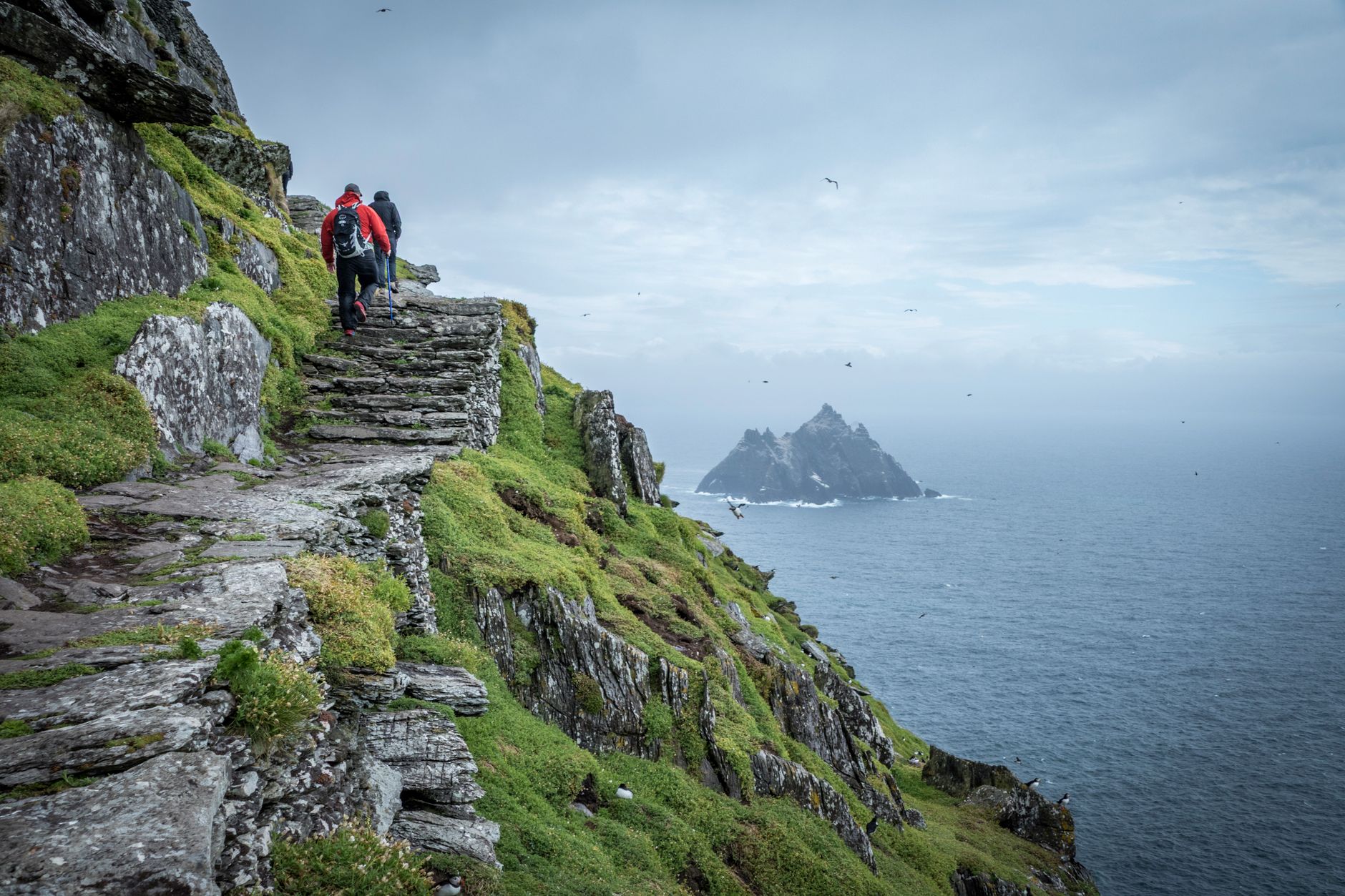
Two people died here in 2009. Joseph Gaughan, 77, fell while descending the lower steps on 3 May, and Christine Spooner, 57, fell while climbing at the same spot on 20 September; both families later sued the state. The safety review the OPW commissioned afterwards from Byrne Ó Cléirigh concluded that visiting Skellig Michael is akin to a mountaineering activity, made 31 recommendations, and identified visitors' own lack of preparedness as a hazard in its own right. What followed was better warning, not a safer stair: steps along the exposed edge were reconfigured, a steel chain went in along one ledge, signage and briefings were added, and guides have been stationed on the island through the season since, three of them in 2025. Time ashore is about two and a half hours, the OPW's own average, on top of the crossing at each end. There is no shop, no cafe and no shelter. Anyone landing should assume there is no toilet either and settle the question at the pier before boarding: the OPW lists toilets among the island's facilities, while first-hand accounts state flatly that there are none. Carry all water and food aboard, and a waterproof.
On a shelf below the north peak stands the largest collection of drystone structures at any site in Ireland: six domed beehive cells, one of them collapsed, two boat-shaped oratories, a later church of mortared stone dedicated to St Michael, a graveyard of crosses and slabs, stone-lined cisterns and two garden terraces.
Nobody can put a date on the founding. Popular accounts give the sixth century and name St Fionan, and the evidence does not support it: the first firm documentary trace of a community here is the recorded death of Suibhini of Skellig in the seventh century, and the excavation-based reading of the standing buildings places them provisionally in the eighth. The monastery is undated, then, and the fabric a visitor walks through at the top of the steps reads as eighth-century work.
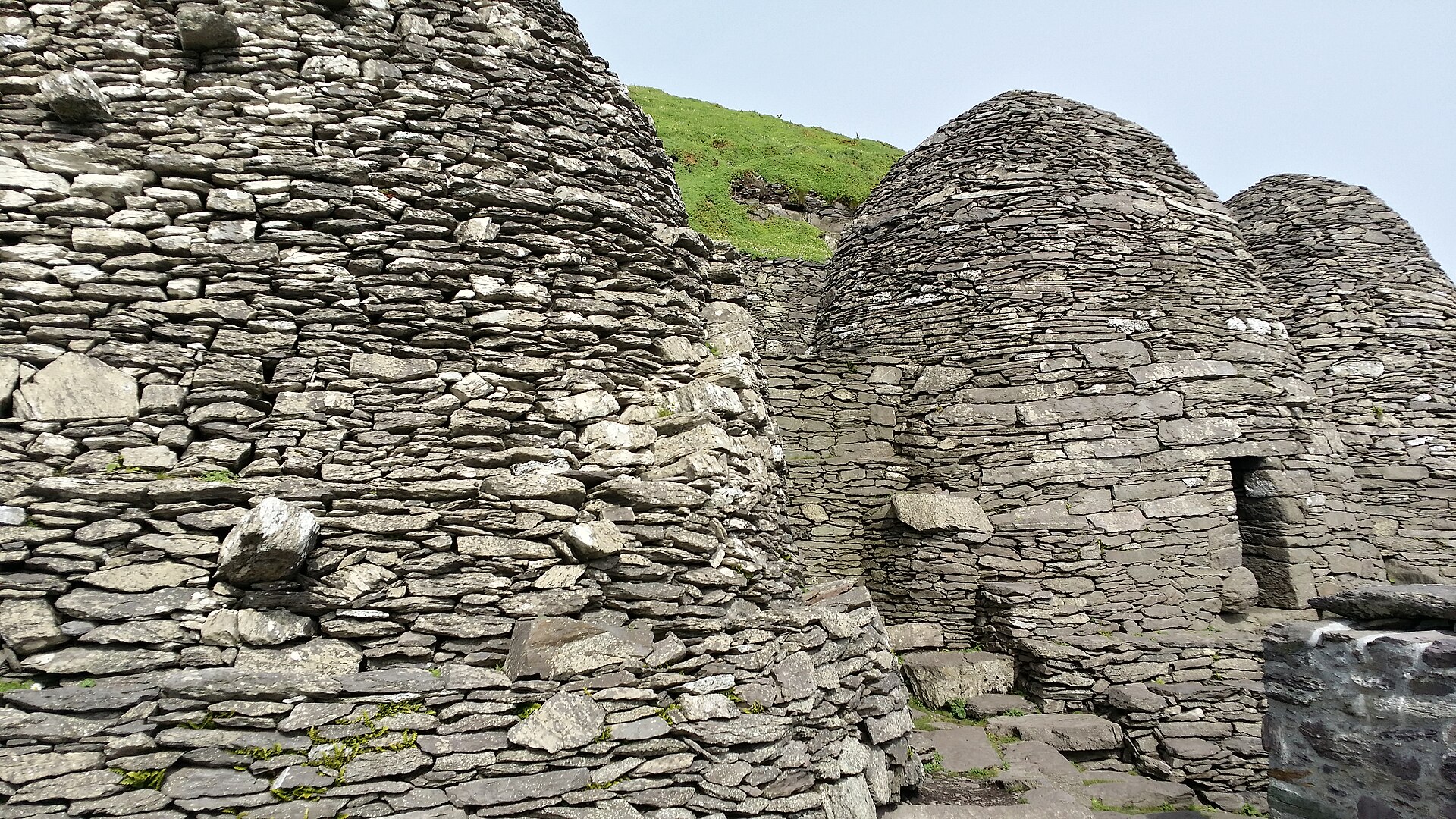
The whole enclosure sits on massive drystone retaining walls that manufacture level ground on a rock that has none, one section five metres high and reckoned unaltered since the eighth century, and that engineering is why any of it is still standing. The huts are corbelled, every course laid slightly inward and pitched outward so that rain runs off the exterior, no mortar anywhere, and on the wettest and windiest rock in Ireland the interiors have stayed dry for more than a thousand years. There is no spring, so rainwater gathered through cut channels into stone-lined cisterns was the entire supply, and the two lower terraces known as the monks' gardens grew barley and oats, fed with seaweed and human waste. Excavated bone shows a diet the ascetic legend does not allow for: goat, sheep, cattle, pig, seal, seven species of fish and seabirds. The stonework is under strain now. A climate vulnerability assessment for the OPW by Carrig Conservation International, published in November 2025, found rockfall and erosion worse than a study ten years earlier: the retaining wall below St Michael's Church has moved five millimetres or more a year since 2018, repeated rockfalls have required a crash deck over part of the route, and storm surge is rated a high risk to access itself.
In 823, or 824 in some reckonings, the Annals of Ulster and Inisfallen record a Viking raid in which Etgal, abbot of Skellig, was carried off and died of hunger in captivity, the one violent date the annals give the island. The community stayed another three or four centuries and then left for the mainland at Ballinskelligs, in the late twelfth or early thirteenth century, under a colder climate and a reorganisation of the Irish church into dioceses and continental orders. Ballinskelligs Priory kept the rock as a summer retreat. The part no visitor sees is the strangest: three terraces cut into the 218-metre south summit as a hermitage, reached historically through the Needle's Eye, a vertical crack of about seven metres, and a fifteen-metre gulley with footholds chiselled out of the stone. Access to the South Peak is prohibited and no tour goes near it.
The visitor cap protects birds as much as archaeology. Storm petrels nest inside the drystone of the South Steps, which is the tourist route.
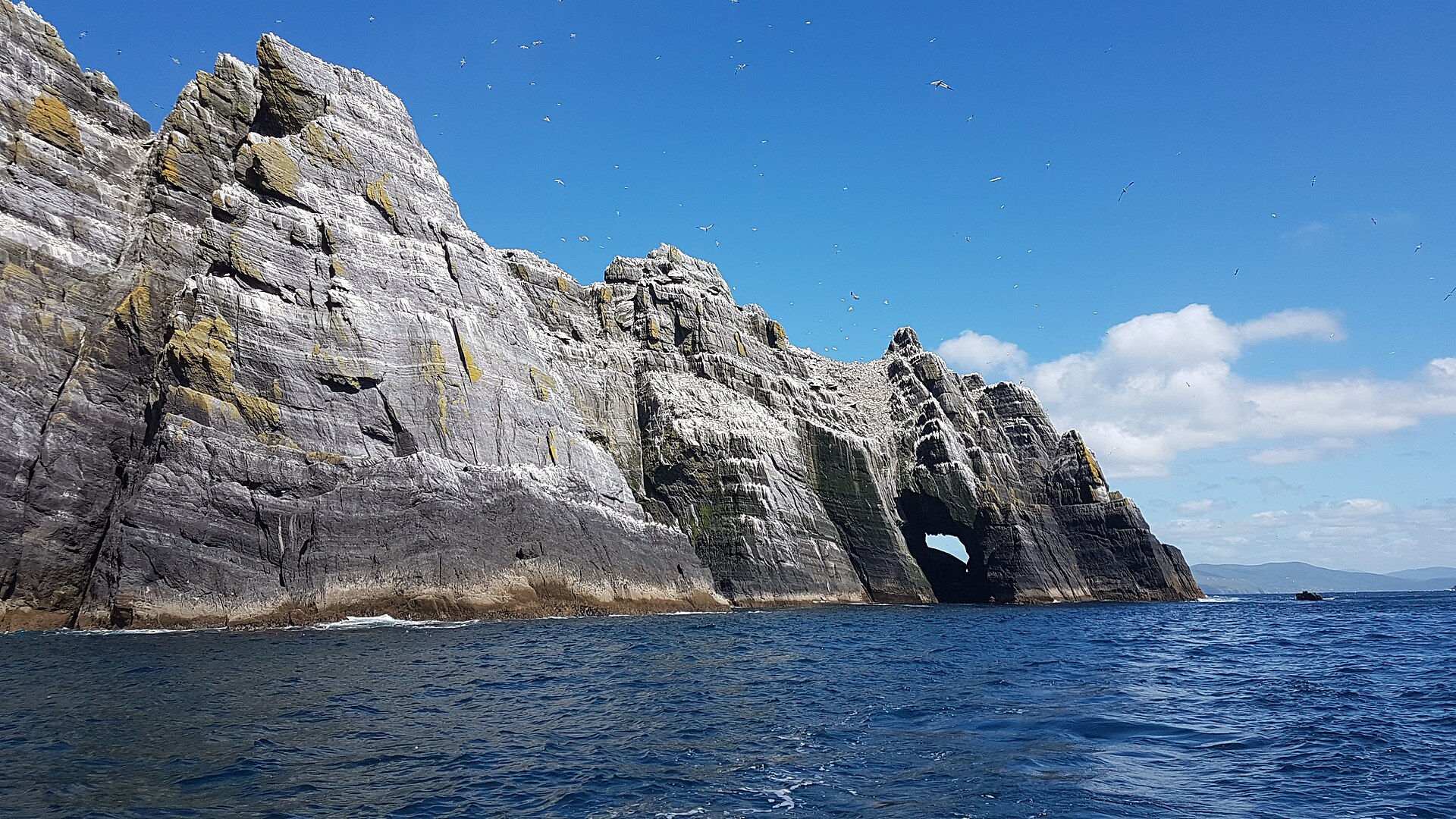
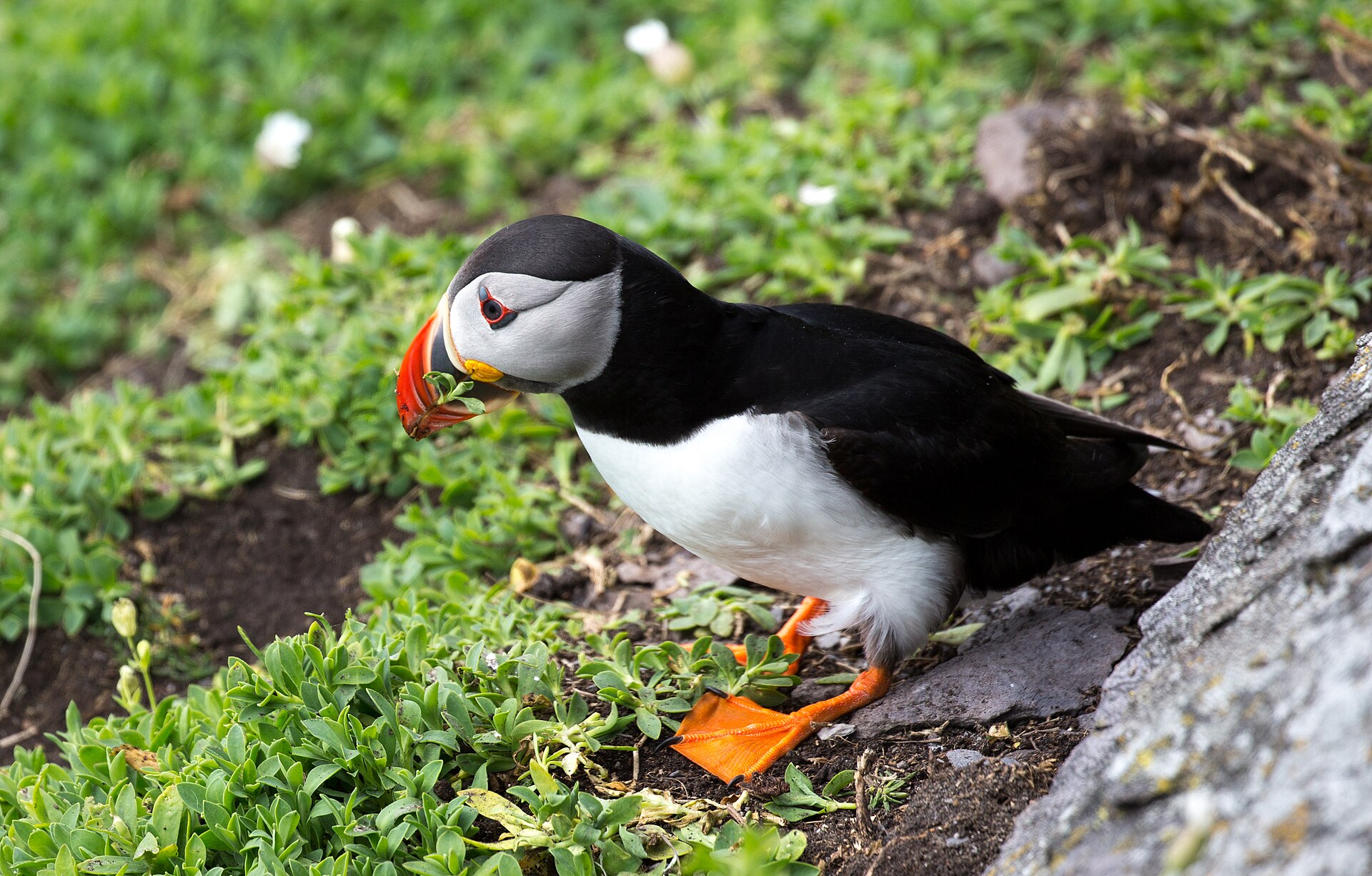
The birds are the other half of the case for keeping numbers down, and the figures come from NPWS monitoring, not from tour pages. Little Skellig still holds one of the largest gannet colonies in the world, about 60 per cent of the Irish population, and it is roughly a quarter smaller than it was: the post-2022 survey counted 26,958 apparently occupied sites, a 24 per cent reduction after avian influenza reached the colony in September 2022. Puffins were counted at about 8,000 individuals over two May evenings in 2023, against 6,808 in 2019 and 4,000 in 1999, on methods too different to make the trend more than indicative. They are ashore from around April to early August and gone by mid-August, so a September landing has none, which is the most commonly mistimed thing about this trip. Manx shearwaters burrow around Christ's Saddle and the monastery, some of them inside the beehive huts, and storm petrels, counted at 7,657 apparently occupied sites and possibly declining, nest in the built heritage itself.
A cancelled morning has plenty to fill it. The Skellig Ring road runs out from Portmagee, and Valentia Island, across the bridge, has the Skellig Experience visitor centre, which keeps seasonal hours. Ballinskelligs Abbey, where the community went when it left the rock, is free to walk into and half an hour south. The Gap of Dunloe is an hour and a half back towards Killarney. The Moorings in Portmagee, thirty seconds from the pier, is open year round and does rooms and food, which keeps a booked passenger in sight of the boat.
For most people the eco tour is the trip that actually happens, and for many it is the better one. It needs no OPW permit, so operators run several departures a day over a longer season of roughly March to November, set no age or fitness bar, and sail in sea states that forbid a landing. Anyone travelling with children under twelve, anyone who cannot face 618 unrailed steps in both directions and anyone with a single day in Kerry should take one. It also goes where the landing boats do not, in under the gannet cliffs of Little Skellig, which nobody may set foot on. No permit rations that part of the Skelligs, and it is the part most visitors actually see.