Globe Countries Cities Dispatches About Get the App
AXP Photography
Jordan  ·  29.53°N 35.42°E

The desert that plays Mars

Written by Meridian Dispatch  ·  22 July 2026

Jordan's southern desert is the location studios hire when a script calls for another planet. Beneath the film credits sit two billion years of rock, twelve thousand years of human marks, and a set of booking decisions that quietly determine whether a visit works.


When a production needs a convincing alien world, it tends to end up in the same 720 square kilometres of southern Jordan. Wadi Rum played Mars in Red Planet and again in The Martian, supplied the desert moons of Rogue One and The Rise of Skywalker, and became Arrakis for both of Denis Villeneuve's Dune films. Ridley Scott put the appeal in terms of absence: a perfection to the simplicity of the environment, and no vegetation. Even that was not bare enough for the camera. His visual effects team found scrub visible from almost every angle on the ground and painted it out shot by shot. So the Mars line is a production decision rather than a tourist board one, made repeatedly, by people with the budget to shoot anywhere.

The geology explains the effect. Under the valley floor lies pre-Cambrian granite roughly two billion years old. Above it stand sandstone massifs, the jebels, which do not slope up from the sand so much as begin at it, lifted and split along near vertical joints by ancient tectonic movement and then worked by wind and winter flood into towers, domes and arches. Iron oxide stains the sand and the lower rock, which is why this corner of Jordan is the reddest. The scale is deceptive from a photograph. Jebel Rum rises to about 1,754 metres above Rum village, and the country's highest ground, Jabal Umm ad Dami, reaches roughly 1,854 metres down near the Saudi border.
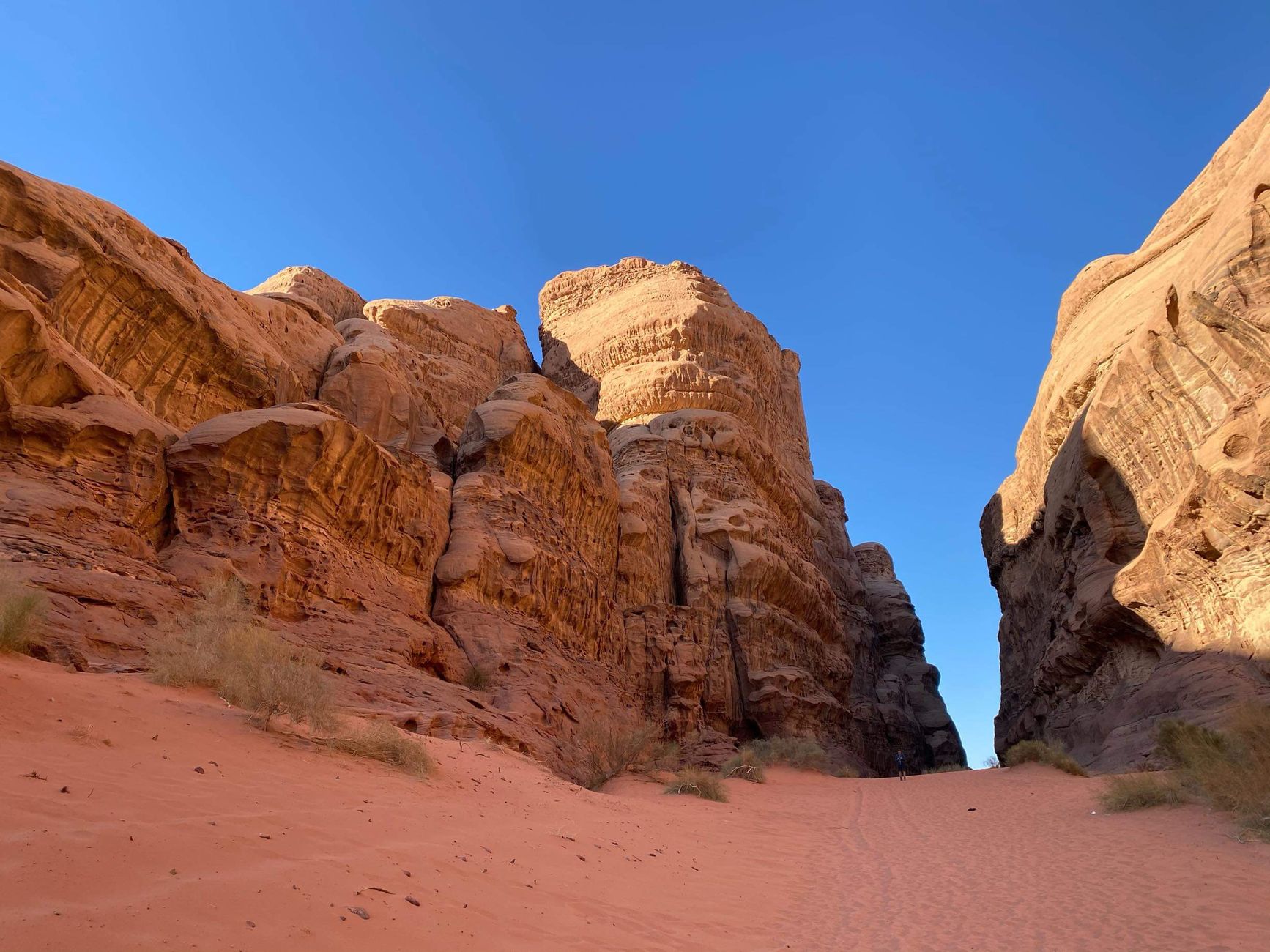
A single walker on red sand in the gap between two sandstone massifs in Wadi Rum
The massifs begin where the sand ends, with no foothills in between. The walker in the gap gives the scale.Ilze Reira

More than 25,000 rock carvings and around 20,000 inscriptions have been documented across these canyons, one of the densest records of ancient human presence anywhere in the region, tracing activity back some 12,000 years. UNESCO inscribed the area in 2011 as a mixed site, listed for both the landscape and the archaeology, which few places manage. The most accessible of it is Khazali Canyon, a slot narrow enough to stay permanently shaded, where Thamudic and Nabataean carvings of ibex, camels, hunters and feet run along the walls at eye height. The walk in and back out takes twenty to thirty minutes and is flat, so it suits almost anyone. The Anfishiyyeh inscriptions, on an open rock face rather than inside a canyon, are the other stop worth asking for by name.

T. E. Lawrence moved through this desert during the Arab Revolt of 1917 and 1918 and it supplied the title of his memoir, which is now attached, somewhat backwards, to the rock formation beside the Visitor Centre. Its older Arabic name is Jabal al-Mazmar. Two other sites carry his name by tradition rather than evidence: Lawrence's Spring, properly Ain Abu Aineh, and Lawrence's House at Al Qsair, a small stone ruin built on a Nabataean footprint and more plausibly an Ottoman-era outpost. Guides will present both with confidence. David Lean's 1962 film, shot partly here, did more than the memoir to fix the desert in the global imagination.


The usable light runs to about ninety minutes at each end of the day. The sandstone only turns the colours people arrive expecting when the sun is low; between roughly ten and four it flattens to a pale, hazy wash that photographs badly and walks worse. This single fact governs the whole trip, because the only reliable way to be present for both dawn and dusk is to sleep inside the reserve. Day trips from Petra, two hours north, routinely deliver visitors into the desert at exactly the hours the desert is least interesting. Where a tour is unavoidable, the fix is to ask for a start at six or seven, take a long rest through the middle of the day, and go back out at four.

The desert keeps banker's hours in reverse: it opens at dawn, closes at ten, and reopens for the last hour of light.
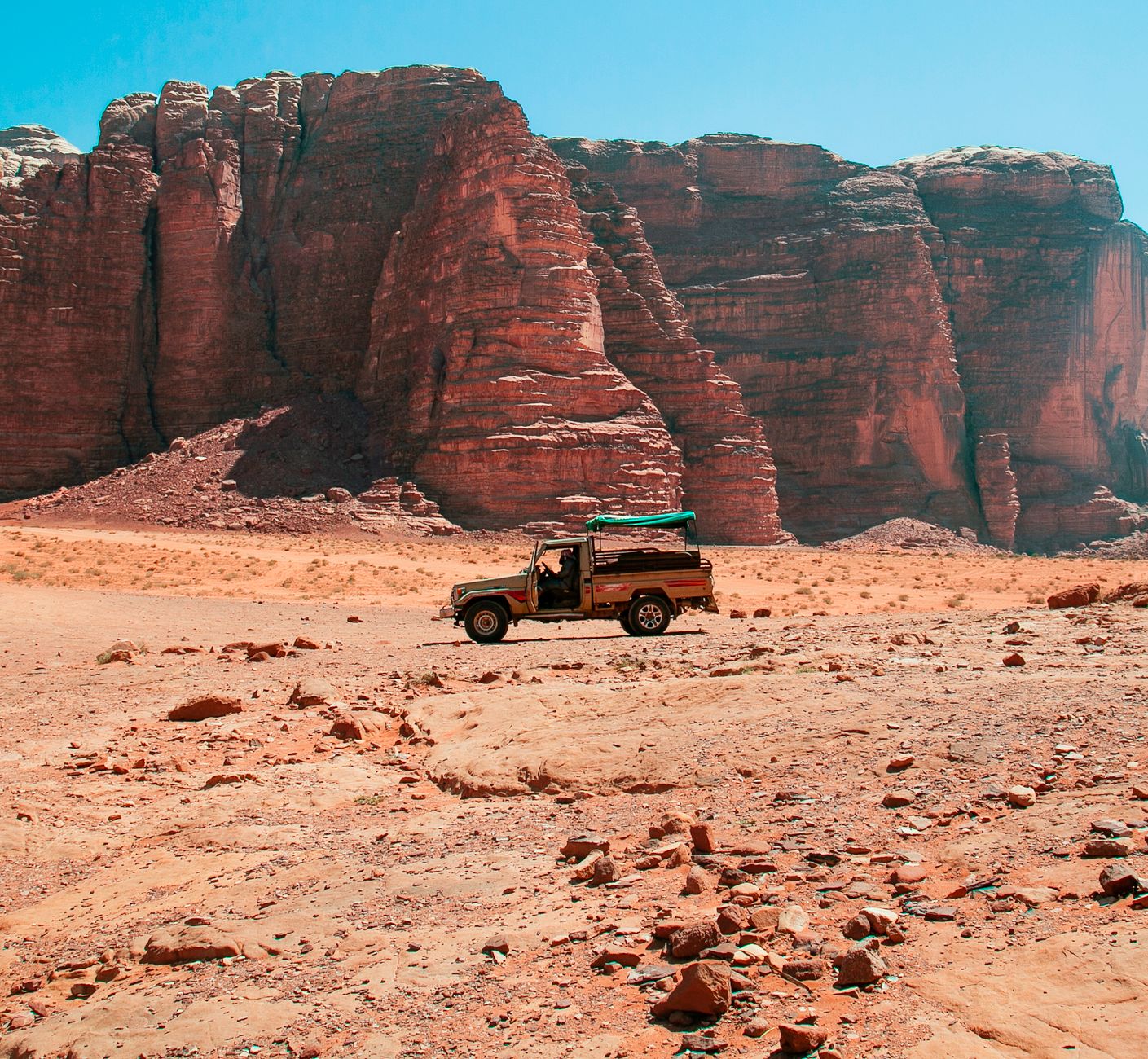
A canopied Toyota pickup with bench seats in the bed, on the desert floor below a sandstone massif in Wadi Rum
Nearly all touring here happens from the bed of a pickup, not on foot.abdullah çadırcı
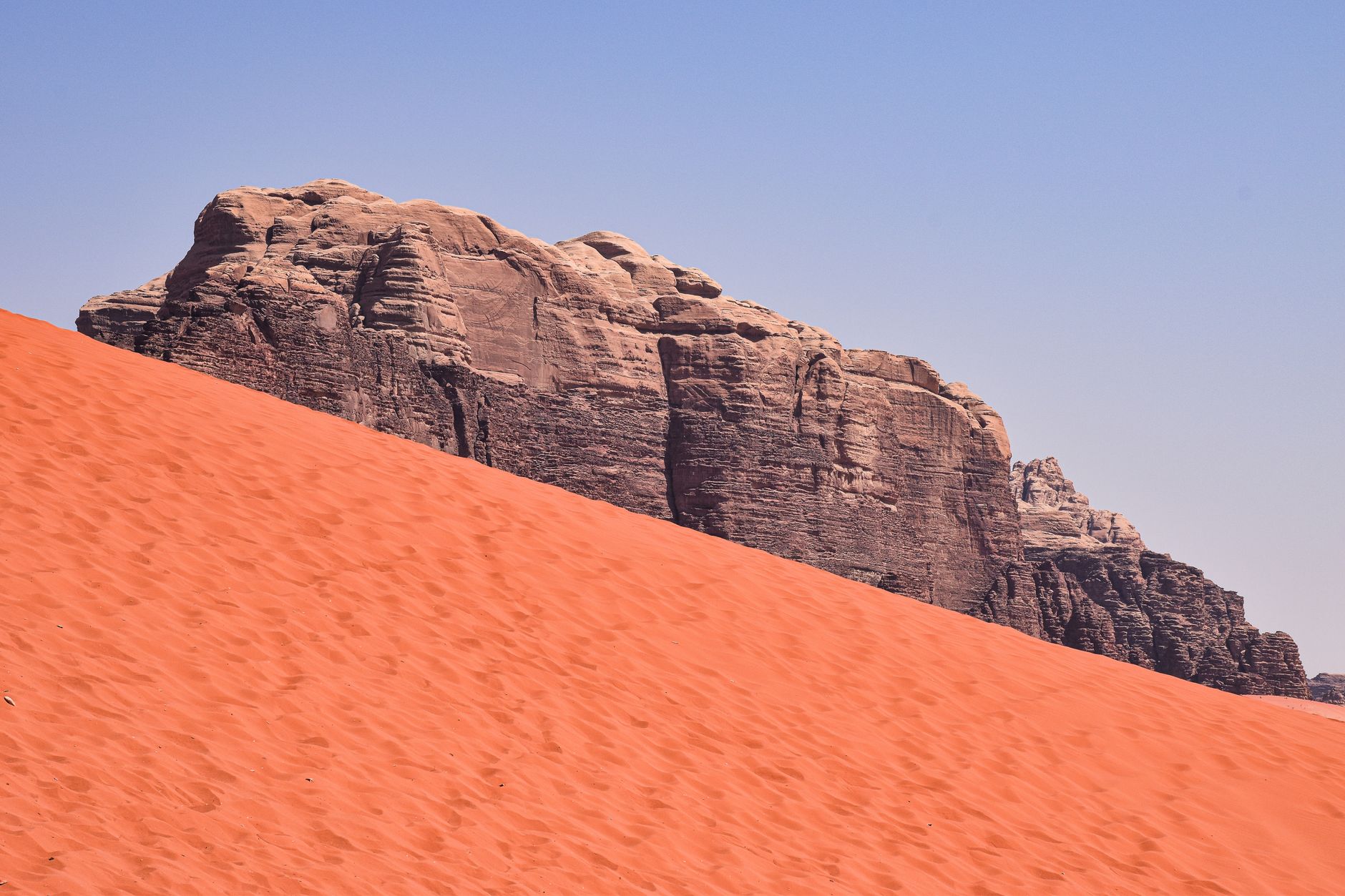
A steep dune of deep red sand meeting a sandstone cliff in Wadi Rum
Iron oxide gives the sand its colour, and stains pale clothing permanently.AXP Photography

Listings use the word hiking loosely, and it produces more complaints than the heat does. A standard tour, whatever it is called in the listing, means sitting in the open bed of a Toyota pickup between stops, with short walks at each one, sometimes along the jeep tracks with the vehicle idling behind. That is a good way to see a lot of ground and a poor way to spend a day if walking was the point. Real walking has to be requested by name and usually costs extra: the scramble to the Burdah rock bridge, an arch of around 35 metres standing free against the sky, or the ascent of Jabal Umm ad Dami, which is about 40 kilometres and an hour of driving from most camps, then two to three hours up and rather less down, with the Red Sea and Saudi Arabia visible from the top on a clear morning. Ask in writing which one a booking includes.
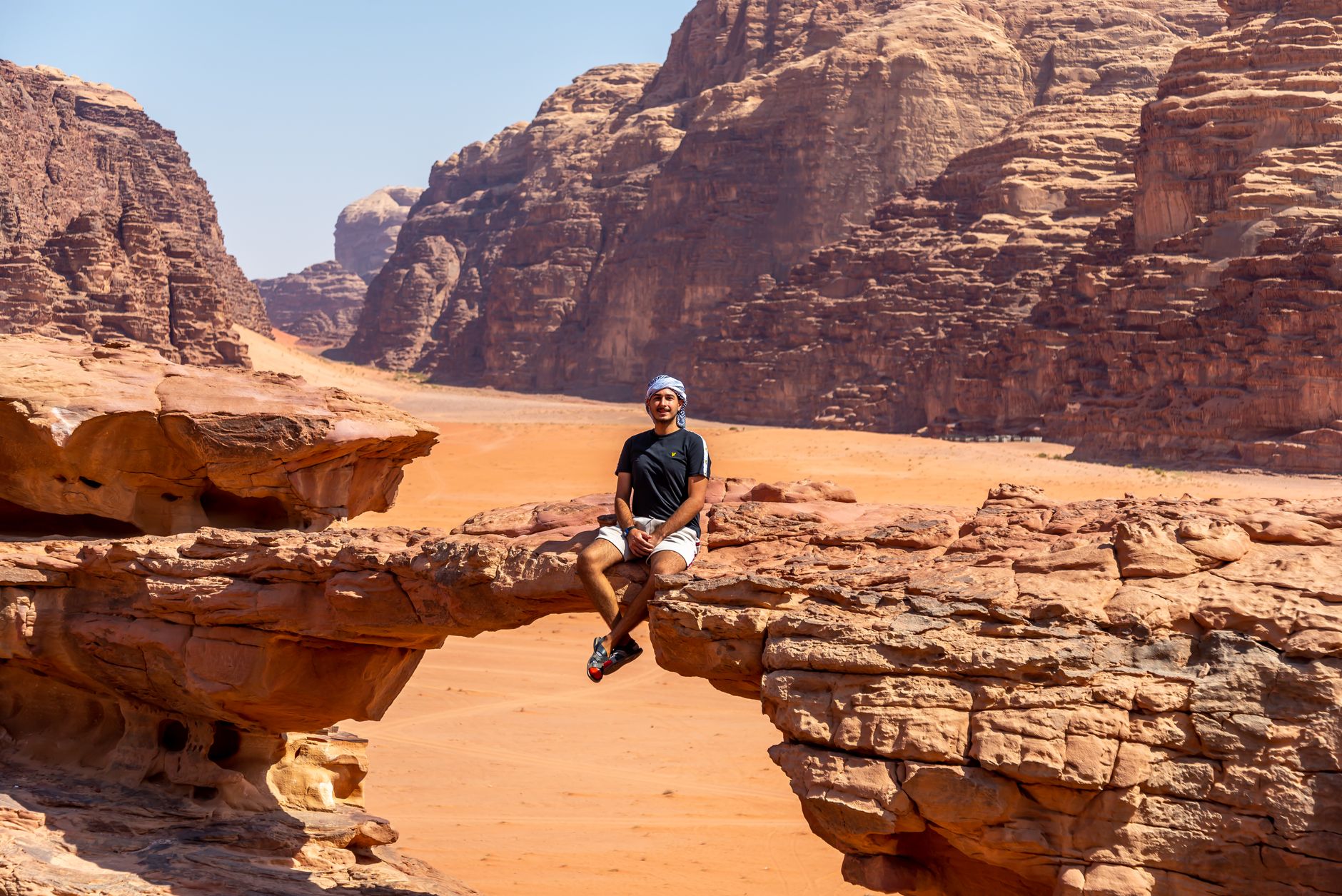
A person sitting on top of a natural sandstone rock bridge in Wadi Rum
The low rock bridges can be walked up unroped, which is why they congest by mid morning in spring.Arda Kaykısız

Camp choice matters more than camp category, and the deciding variable is distance from Wadi Rum Village, ahead of the price of the tent. Camps run from goat hair tents with shared bathrooms to air-conditioned geodesic domes on raised boardwalks, and there are well over a hundred of them inside and around the reserve. A camp within sight of Wadi Rum Village keeps the road noise and the village lights with it. There is effectively no mobile signal in the reserve and little wifi outside the expensive camps. There is also no ATM in the village and most camps do not take cards, so Jordanian dinars have to be carried in. Confirm the tour price and the pickup time over WhatsApp before arriving, and keep the message, because quoted prices have a habit of changing at the gate.
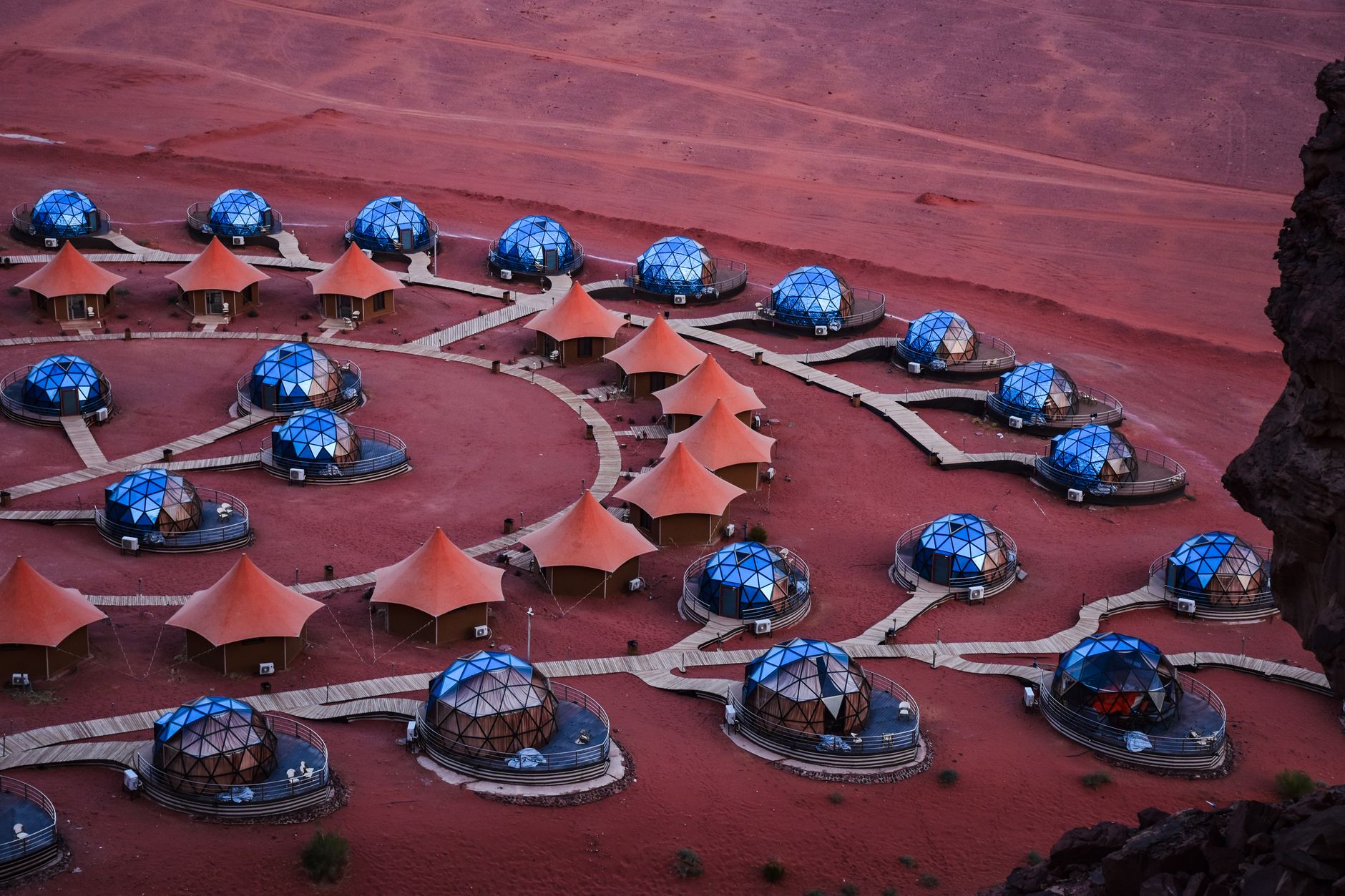
Aerial view of a Wadi Rum camp of blue geodesic domes and peaked tents linked by boardwalks on red sand
The dome camps are the glamping end of the market, air-conditioned and linked by boardwalks. What they are selling is the window, so the sky above them has to be dark.AXP Photography
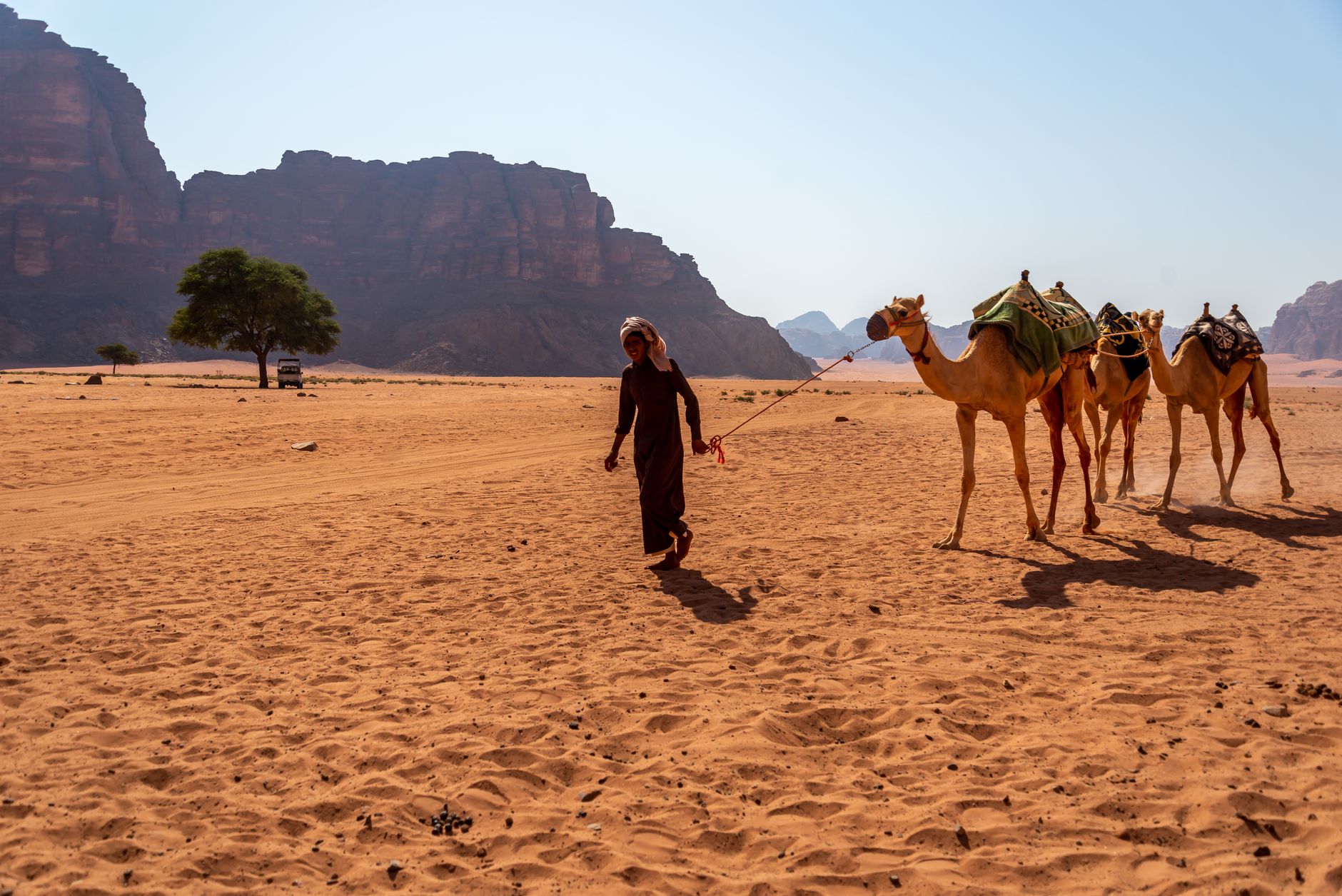
A guide in a white headscarf leading three saddled camels across open sand in Wadi Rum
Camel legs work as a short transfer between camp and a nearby site. An hour is usually enough.Arda Kaykısız
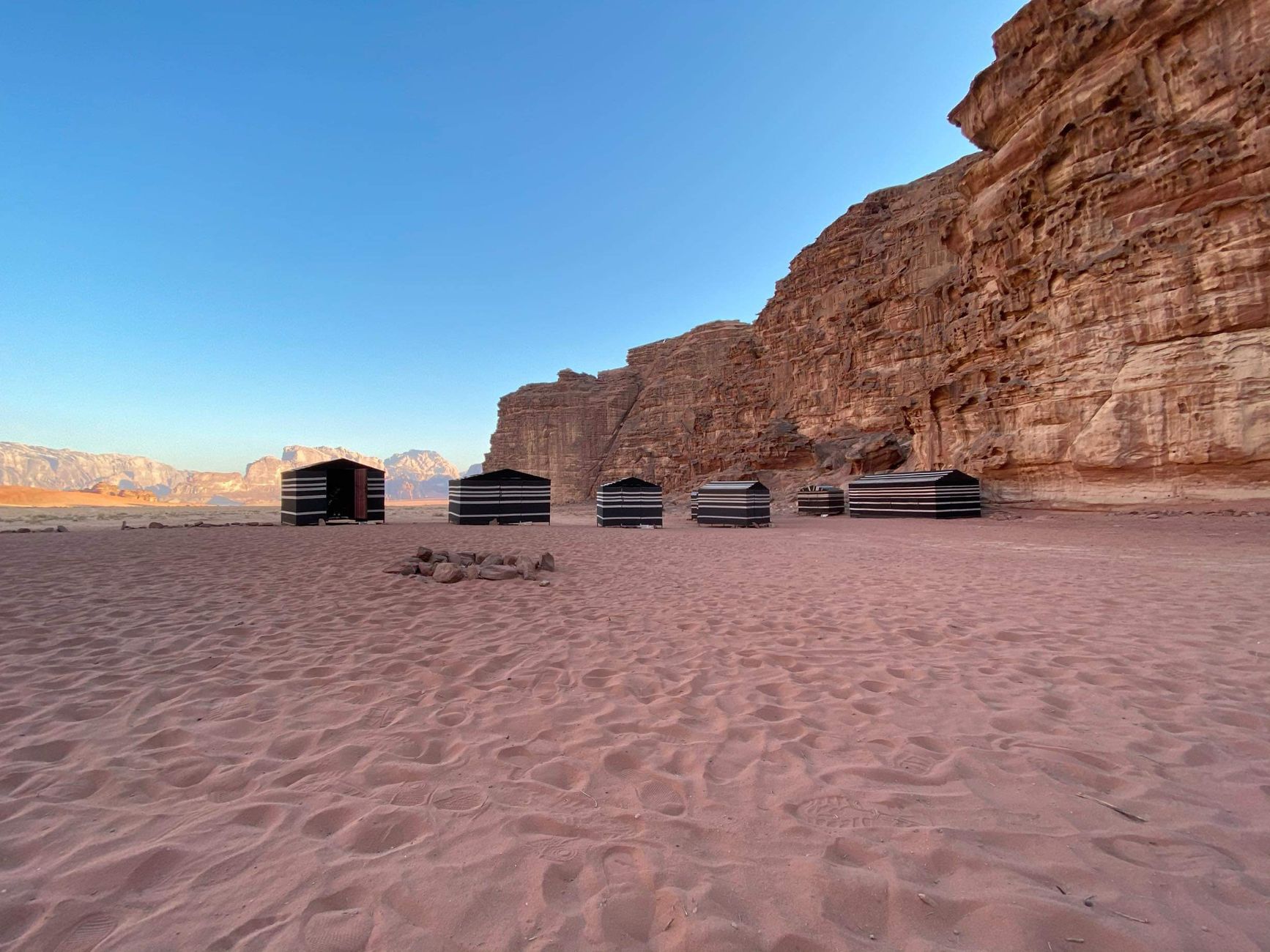
A row of black and white striped Bedouin tents on red sand below a sandstone cliff in Wadi Rum
The traditional camps are still a row of striped tents tucked against a cliff, sited for shelter rather than for the view.Ilze Reira

The temperature swing is severe in every season. Winter nights drop to freezing and below, with reports of minus three, and wind chill on top of that in an open vehicle, which is why camps hand out heavy Bedouin coats and blankets at dusk. July and August reach around forty degrees by day and turn a full tour into an endurance exercise. Sand gets into every bag. It stains light clothing rust red for good. Camel rides hurt more than anyone expects and are best kept to an hour. What consistently lands, against all that, costs almost nothing: zarb, meat and vegetables slow-cooked in a sand oven and dug up at dinner. Tea by a fire. The silence once the engines stop. The reserve is commonly rated Bortle 2 for darkness, which means the Milky Way reads overhead on most clear nights without any help.

March to May and September to November hold the best temperatures and the largest crowds, so both need booking well ahead. Winter is colder than most visitors plan for and quieter than any photograph of the place suggests. On length, two nights is the working minimum, one for the dawn and dusk runs and one to go up something on foot, and a third night buys the summit day without cutting the circuit short. The people who come home unconvinced are almost always the ones who booked a single afternoon, arrived at eleven, and left again before four.
Plan a similar trip

A four-day Wadi Rum plan

Most visitors fly into Queen Alia International in Amman, though King Hussein International at Aqaba is barely an hour from the reserve and worth it on a regional connection. Base yourself inside the protected area at a Bedouin camp well away from Wadi Rum Village rather than in the village itself. Entry is collected at the Visitor Centre and is covered free by the Jordan Pass, which must be bought before arriving in the country and also covers Petra and the visa waiver. Come in the shoulder seasons, March to May or September to November, and plan the days around dawn and dusk.

  1. Day 1

    Register, transfer, first dusk

    Clear the Visitor Centre formalities, leave the car at the Rest House in the village, and go in by camp 4x4 for the last hour of light on the red dunes.

    Travel

    Aqaba to the Visitor Centre about 1 hour by road, or Petra about 2 hours. Park free at the Wadi Rum Rest House and transfer in by camp 4x4, roughly 20 to 40 minutes depending on how deep the camp sits. First of two nights at Memories Aicha Luxury Camp.

    Private cars cannot be driven on the sand without a permit, and the vehicle fee is charged separately at the gate.

  2. Day 2

    The circuit, at the right hours

    Khazali Canyon, the Anfishiyyeh inscriptions, Ain Abu Aineh, Umm Fruth rock bridge and Al Qsair, done as two short runs rather than one long one.

    Around

    Book a half-day jeep circuit from the camp starting at 6 or 7am, break from about 11am to 3.30pm in shade, then a second run to a high dune for sunset. Zarb dinner and stargazing at Memories Aicha Luxury Camp.

    A four to five hour circuit covers the same named sites as a full day without the padded tea stops.

  3. Day 3

    Go up, not across

    Trade the truck for height: either the guided scramble to the Burdah rock bridge or the summit of Jabal Umm ad Dami, Jordan's highest ground.

    Around

    Umm ad Dami is about 40km and an hour of 4x4 from most camps, then 2 to 3 hours up and less coming down, so budget a half day. Camel leg back across the sand in the last hour of light. Move to SunCity Camp for the third and final night to see the dome side of the desert.

    Both are separate excursions that must be requested by name and confirmed in writing before arrival.

  4. Day 4

    Dawn, then out

    A first-light balloon flight gives the fullest sense of the scale for those who want it; otherwise a slow morning on the lower shoulders of Jebel Rum.

    Onward

    Balloon operators collect from camps before dawn and must be booked ahead. Transfer back to the Rest House, then Wadi Rum to Aqaba about 1 hour for the Red Sea and the Hyatt Regency Aqaba Ayla Resort, or 2 hours north to Petra and the Mövenpick Resort Petra at the site gate.

    Balloon flights are wind dependent and cancel at short notice, so keep the morning flexible.

← All dispatches
Keep exploring

More dispatches

Meridian Dispatch for iPhone

A travel journal that
writes itself.

Your best memories, journaled automatically, from the photos already on your phone. The app reads your photo library, finds the international trips you have taken, identifies the venues, writes the prose, and lays it out like a magazine spread. The first time you open it, the last several years of your travel are already there. Every trip after that goes in by itself.

  1. Mapped on a globe

    Your whole world, on one globe.

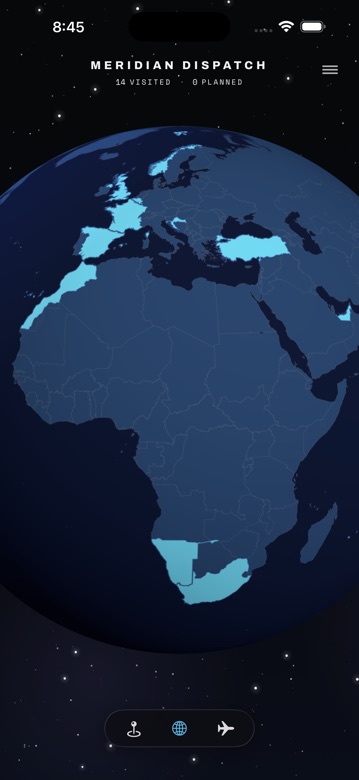
    Every country you've visited, lit on a private 3D globe. Spin it to find a trip and fall straight back into it. The globe is the table of contents for your journal.

    The app's private globe of visited countries.
  2. Detected automatically

    It finds your trips on its own.

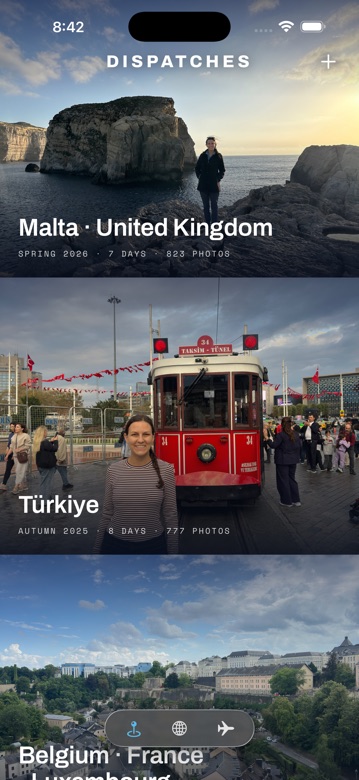
    Your photos cluster by place and time, and each cluster becomes a venue: the museum you spent the morning in, the restaurant you lingered over, the streets you wandered after dinner. No tagging, no prompts, no logbook to keep up.

    The app's archive, every trip a dispatch.
  3. In warm prose

    Each place, written up.

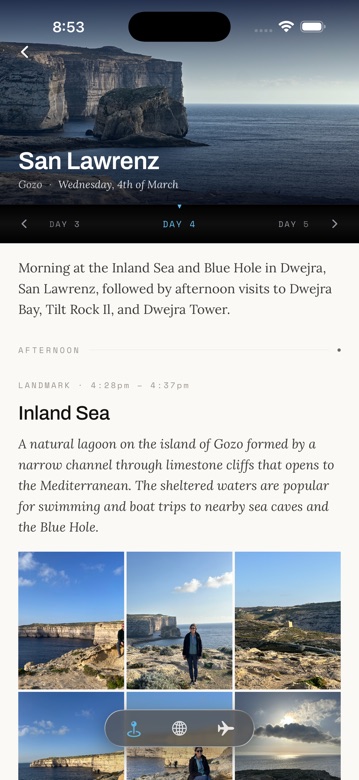
    Every day opens on a hero photograph, and each place you stopped gets its own short entry beside your own photographs, no two days laid out the same. A record of where you've been, kept in real sentences. Edit a line, or regenerate any passage you want fresh.

    A written day in the app, with a place entry and a photo grid.
  4. Yours to keep

    Every trip, as a photobook.

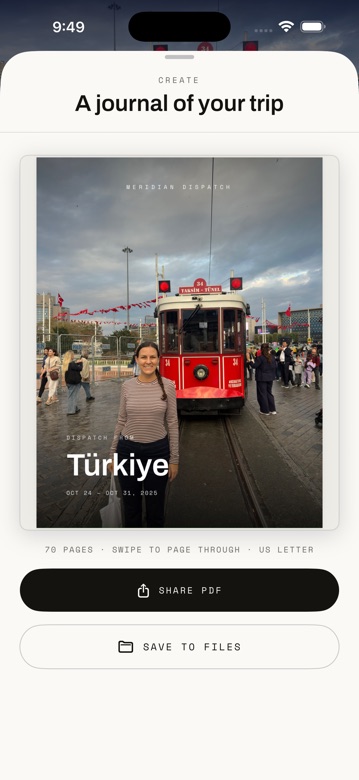
    Download any journal as a clean photobook, send it to whoever was there, or have it printed as a hardback you keep on the shelf. What you read on your phone is exactly what lands on the page.

    The app exporting a trip as a photobook, with Share PDF and Save to Files.