Modernism arrived everywhere with the same instruction: the right angle. Brazil is the one country that read the rule and bent it.
The doctrine travelled well because it travelled light. A flat roof, a free plan, a glass wall: the same rational box could be set down in Helsinki or Chicago or Tokyo and mean the same correct thing, which was efficiency, hygiene, the engineer's victory over ornament. It was a moral position disguised as a geometry. Brazil kept the geometry and refused the morality. Oscar Niemeyer liked to say the straight line had never moved him; what moved him was the curve, the kind he found in a mountain, a river, the path of a winding coast. From that one act of disobedience a whole national architecture follows. What comes below is not a tour but a case, seven pieces of evidence for a single claim: that Brazil's gift to the modern was never a style but a temperament, the conviction that a serious building can also give joy.
National CongressBrasília · Niemeyer · 1960
The case opens where the country chose to start over. On the bare plateau of Brasília, inaugurated in 1960, Niemeyer gave the parliament two slim towers and, on the platform beside them, two shallow domes: one turned up to the sky, one set down like an overturned bowl. The open dish holds the Chamber of Deputies, the closed one the Senate, and the whole reads at a glance, from a moving car, as a single clean sign. It became the world's shorthand for Brazilian architecture because it does what the right angle could not: it represents power without raising a fist, monumental and weightless at once, authority that has decided it need not intimidate to be obeyed.
Cathedral of BrasíliaNiemeyer · completed 1970
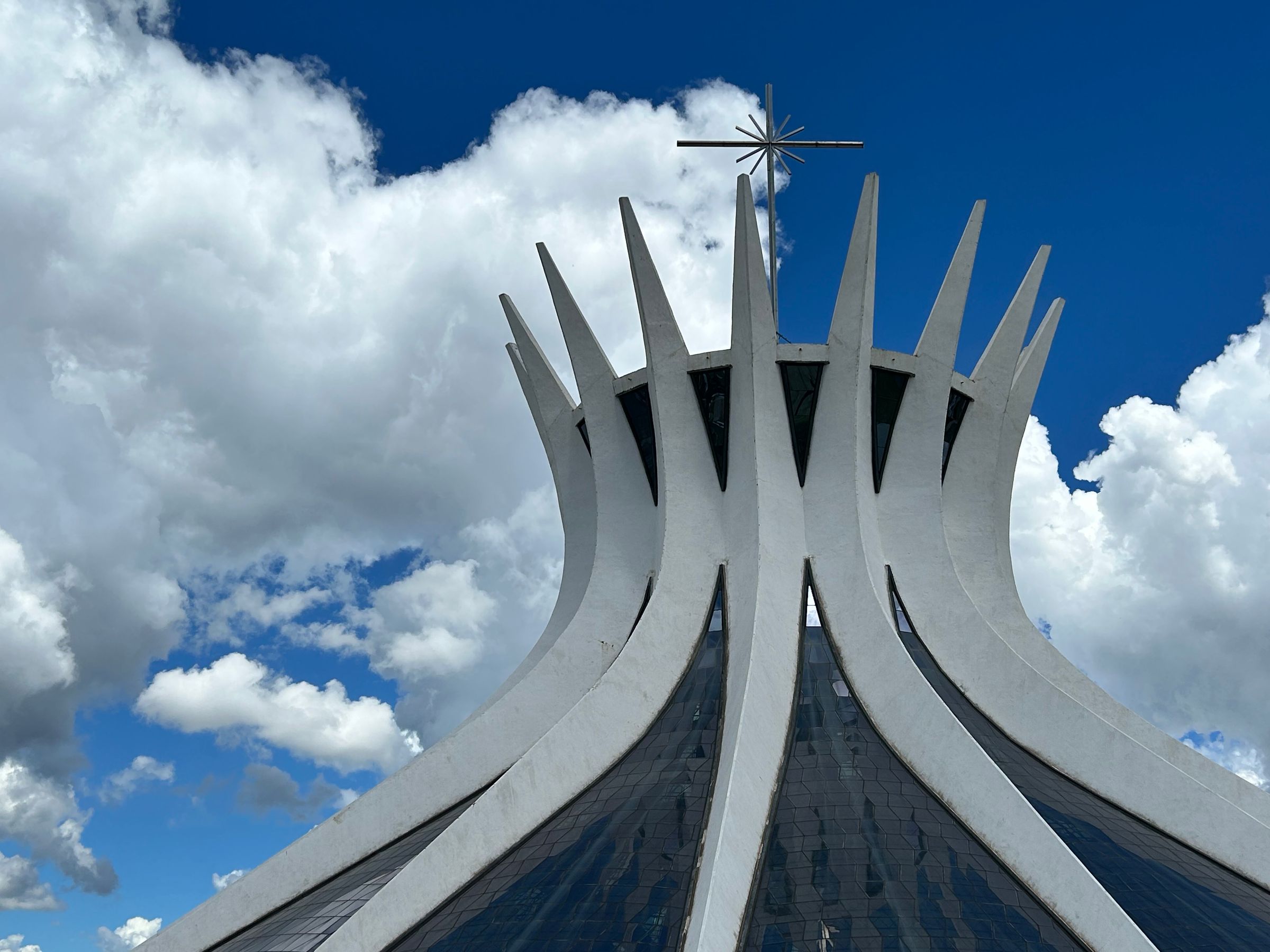
Minutes away, the curve turns sacred. From outside the cathedral is barely a building, sixteen white columns leaning together and flaring open at the top, a crown of thorns laid on the grass. You enter not through a door but down a low dark tunnel beneath the ground, and the gloom is deliberate, because the floor then releases you upward into a ring of glass and the room floods with blue and green light. There was no precedent for it. Niemeyer and the engineer Joaquim Cardozo invented a modern sacred space from nothing, and made reinforced concrete, the most rational of materials, do the old cathedral trick of making stone seem to rise.
MAC NiteróiNiemeyer · 1996
Thirty years on, the same hand set a saucer on a cliff. The contemporary art museum at Niterói faces Rio across the water, a white disc poised on a single stem above Guanabara Bay, reached by a red ramp that coils up off the rock. Here the curve is less a building than an object dropped into the landscape to talk to it; a continuous band of glass hands the bay back as the real exhibit. Niemeyer was nearly ninety when it opened, and it carries the lightness of a very old man's joke, the cheerful flying disc that every imitator since has tried and failed to land.
Itamaraty PalaceBrasília · Niemeyer · completed 1970
Back in Brasília, the curve puts on its diplomatic dress. The foreign ministry stands behind a screen of tall concrete arches that rise straight from a still reflecting pool, so the heavy block above seems to float on its own image. Inside, marble and a staircase that hangs without visible support; outside, Roberto Burle Marx floods the terraces with planting and sets gardens adrift on the water. It is grandeur, plainly, but grandeur talked down from severity by water and leaf and shade. The state receives you here the way a great house receives you, and lets the arch do the bowing.
CopanSão Paulo · Niemeyer · completed 1966
Then the curve comes down off its pedestal and moves in. Copan is one apartment block in central São Paulo bent into a long shallow S, thirty-two storeys wrapped in a horizontal brise-soleil that ripples the façade like a drawn curtain. Eleven hundred and sixty flats stand behind that wave; some five thousand people live there; the building has its own postal code and a whole town's worth of commerce at its feet. This is the hinge of the story, the moment the national gesture stops being reserved for parliaments and cathedrals and becomes the wall of an ordinary life, the country folded into a single concrete curve and let by the month.
MASPSão Paulo · Lina Bo Bardi · completed 1968
Here the argument finds its second voice, because not every Brazilian modernist trusted the curve. On Avenida Paulista, Lina Bo Bardi did something stranger than any dome: she lifted the museum off the ground. The São Paulo Museum of Art is a glass box slung beneath two huge beams, later painted deep red, held clear above an open plaza so the city flows underneath; the best thing she made was the emptiness she left, a public square given back to São Paulo on a street with almost no other open ground. This is Brazil's other modernism, not the curve but the structural dare, monumentality spent on the public instead of the monument. The museum has lately added a new tower alongside, and still the half-century-old floating box commands the avenue.
A serious building, the country decided, answers to more than the engineer.
InhotimBrumadinho, Minas Gerais · opened 2006
The line ends by vanishing. In the hills of Minas Gerais, Inhotim scatters its galleries as low pavilions across a vast botanical garden, and the further you walk the less the architecture insists. A glass shed opens onto a lake; a room hides among palms; the path counts for as much as the wall. After so much learning to bend, the curve finally loosens its own edges and runs out into water and slope and leaf. The building stops performing and becomes landscape, which may be the most Brazilian move of all.
Every structure here refuses the neutral box, and that refusal is the argument entire. Modernism was handed to the century as a rule, the right angle, rational and repeatable and faintly cold, and one country weighed the rule and decided correctness was not enough, that a building owes you delight as surely as it owes you shelter. Niemeyer is gone now, and Lina Bo Bardi, and Roberto Burle Marx who gave the same curve to their gardens; the line the three of them drew has outlived them all. Set against the river and the mountain and the long coast, the right angle never stood a chance.