Things to do
10-
Abanotubani
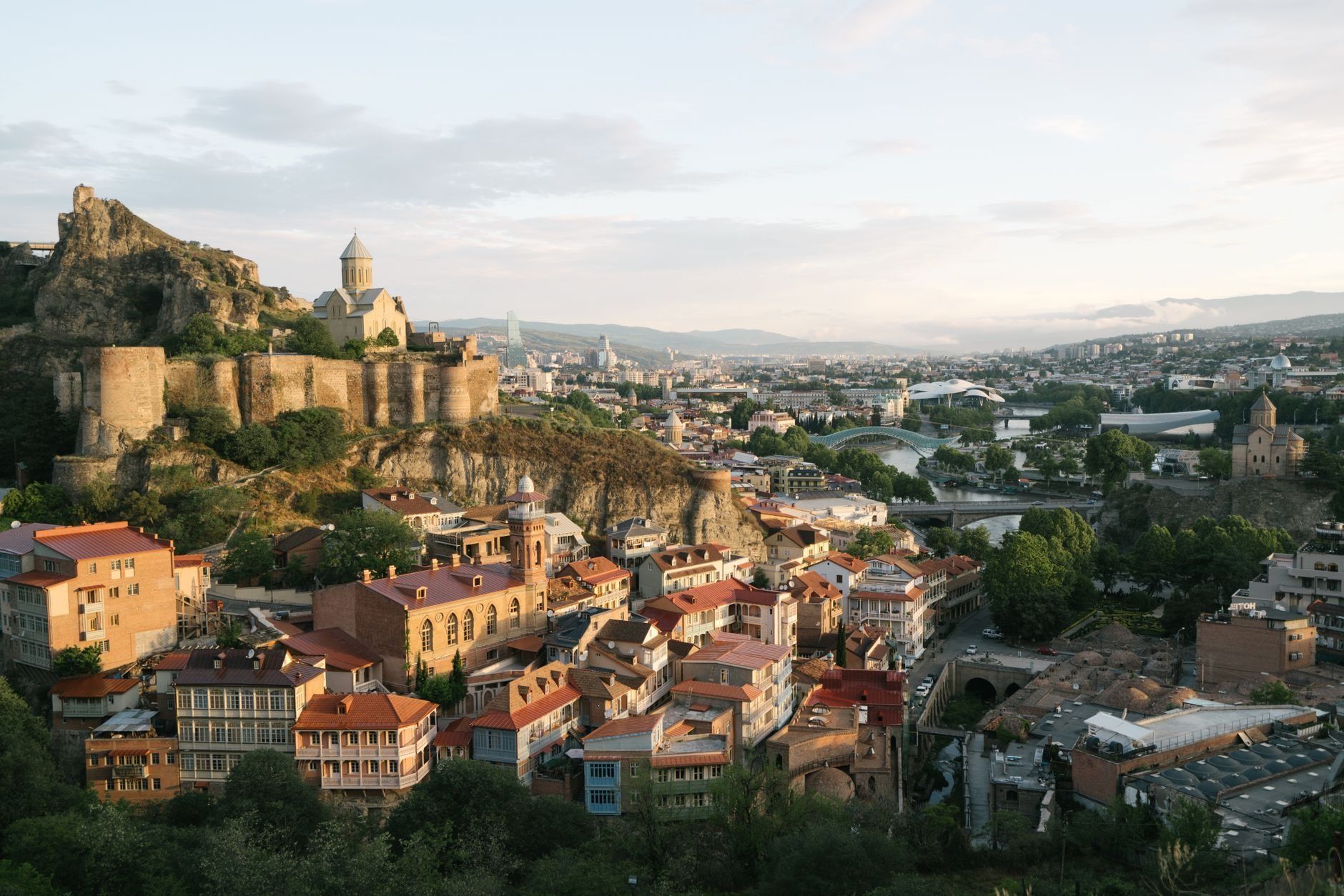
Domed brick roofs at ground level mark the sulphur bathhouses built over hot springs in the gorge below Narikala. Private rooms are rented by the hour and most include a scrub from an attendant, arranged at the desk on arrival. The smell carries down the street, and some baths are men only or women only on set days.
-
Bridge of Peace
Glass and steel curve over the Kura between Rike Park and the old town, lit after dark by a programmed pattern of diodes. The crossing takes a couple of minutes and is the quickest link between the cathedral side and the bath quarter. Reaction to it has been divided since it opened, which is part of the interest.
-
Chronicle of Georgia
Sixteen black columns carved with kings, queens and scenes from the life of Christ stand on a hill above the Tbilisi Sea, north of the centre. Zurab Tsereteli began the monument in the 1980s and it was never finished, which is why the plinths and paving remain raw. Getting there needs a taxi or a long walk uphill from the metro.
-
Dry Bridge Market
Sellers lay out Soviet badges, porcelain, cameras, silverware and old records on tables and blankets beside the Mtkvari, much of it cleared from family flats. Bargaining is expected and nothing carries a fixed label. Trading runs daily in fair weather and thins out in rain, with the fullest tables on weekend mornings.
-
Georgian National Museum
Gold from Colchis burials, some of it worked in the second millennium BC, fills the archaeological treasury in the basement of the Rustaveli Avenue building. Upstairs, the Museum of Soviet Occupation covers the annexation of 1921 and the repressions that followed. Allow half a day for both, and note that the treasury closes earlier than the main galleries.
-
Holy Trinity Cathedral
Sameba, finished in 2004, rises on Elia Hill across the river and is visible from much of the city. Its scale is modern Georgian Orthodox architecture at full stretch, a gold dome above a granite mass, with a wide terrace and a lower church beneath. Shoulders and knees are covered at the door, where headscarves wait in a basket.
-
Jvari Monastery
Perched on the ridge above the Aragvi confluence, the sixth century church gave later Georgian architecture its cross-domed plan and looks straight down on Mtskheta. Little remains inside beyond bare stone and a carved facade, so the visit itself is short. Wind on the outcrop is constant, and the road up is a separate drive from the town.
-
Mtatsminda Park
A funicular climbs the ridge above the city to a small amusement park, a ferris wheel and a restaurant terrace with the valley laid out below. The ride up is part of the appeal, and the lower station sits at the top of Chonkadze Street. Evening is when the view works best, though queues build at weekends.
-
Narikala Fortress
Walls have held the ridge above Old Tbilisi since the fourth century, rebuilt by Persians, Arabs and Georgians in turn and left part ruin, part restored church. A cable car climbs from Rike Park, and the walk back down through the sulphur baths quarter takes about twenty minutes. Footing on the upper ramparts is loose, and the site has no railings in places.
-
Old Tbilisi
Balconied houses on carved wooden props lean over lanes between Freedom Square and the Botanical Garden, with a mosque, a synagogue and Armenian and Georgian churches inside a few hundred metres. Restoration has been uneven, so a polished facade often backs onto a courtyard still held up by scaffolding. Mornings are quiet before the tour groups reach Shardeni Street.