Ninety seconds on National Botanic Garden of Namibia
Worth a morning before you head for the desert, this hillside garden in central Windhoek lets you walk among Namibia's own aloes, quiver trees and succulents before you meet them in the wild.
The Windhoek aloe, Aloe littoralis, is the symbol of the city, and the garden holds one of its densest stands. About 80 plant species grow across roughly twelve hectares of hillside between the city centre and the valley below. The walk among the aloes is the highlight, above all when they are in flower.
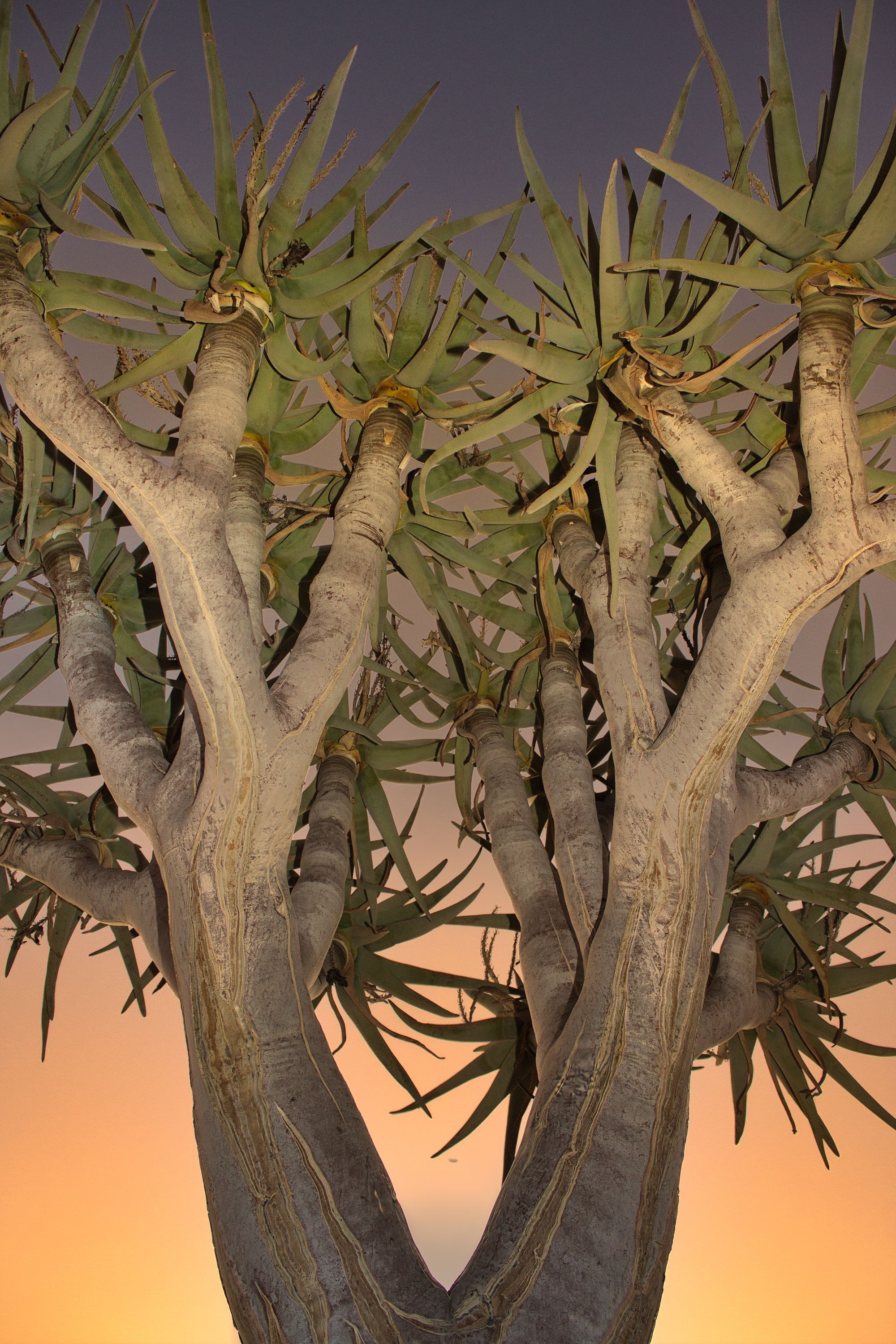
In the western part of the garden stands a sizeable group of quiver trees, Aloe dichotoma, with a bottle tree, Pachypodium lealii, among the other highlights. Seven of Namibia's twenty-four acacia species grow here too.
The rarer plants are the small ones. The Desert House, the rockery and the nursery hold the country's succulents, many of them rare, endangered or found only in Namibia: aloes, euphorbias, crassulas, stapelias and lithops, the stone plants.
Systematic planting only began in 1993, which is why the paths still read as open hillside savanna. At least 75 bird species have been recorded on it.
From 8am on a weekday, reception at the Orban Street entrance keeps a map of the short trails, so collect one before you set off. The walk is a single circular route edged with rocks, with a few branching paths, the odd bench and a scatter of bird baths.
Head for the western side first for the quiver trees, then follow the aloes, the walk the garden is known for. Two viewpoints along the way look out over the city centre and Klein Windhoek. Allow about an hour and a half for the loop and both viewpoints.
Members of the Botanical Society lead a guided walk of about two hours on one Saturday morning a month, usually the first, or the second when the first is a public holiday. It has set off at 8am from the National Botanical Research Institute building on Orban Street, with refreshments after. Ring the institute to confirm the date and time before you go.
Go with a guide if you want the stories behind the plants and someone to ask as you walk; a guided visit can also be arranged in advance. On your own, the weekday paths let you set the pace.
From December to April the rains turn the slope green. Outside that season the savanna fades to brown, beige and russet, and the succulents carry the walk.
Pack binoculars as well as a camera. The birdlife is part of the reason to slow down on this hillside.
Explore the rest of Windhoek
A capital of about half a million sits in a basin in the Khomas Hochland, high enough that the nights are cool through winter. Almost every…

A museum designed and built by a North Korean firm on Robert Mugabe Avenue in central Windhoek, telling Namibia's resistance to colonial…

A craft market in the old brewery buildings on Tal Street, a few minutes on foot from the Christuskirche. Small stalls, many of them run by…