Things to do
15-
Albert Cuyp Market
A street market trading since 1905 along one long road in De Pijp, the former working-class district south of the centre, with some 260 stalls. It sells everything from bicycle locks to bolts of cloth, and is the place to eat raw herring with onion, fresh syrup waffles and Surinamese rolls. It runs Monday to Saturday, and the side streets have good cafés.
-
Anne Frank House
Behind a hinged bookcase in a canal-side warehouse, eight Jews hid for just over two years until their arrest in August 1944. The rooms are kept unfurnished, as her father asked, with her magazine pictures still pasted to the wall. The original diary is displayed. Tickets are released online on Tuesdays for dates six weeks ahead and go quickly. The stairs are very steep.
-
Begijnhof
A hidden courtyard of tall houses around a green, founded in the fourteenth century for a lay Catholic sisterhood and entered through an unmarked door off the Spui. One black timber house, from about 1528, is among the last wooden buildings in the city. A clandestine chapel is concealed behind two house fronts. It is still a residence for single women; visitors are asked for silence.
-
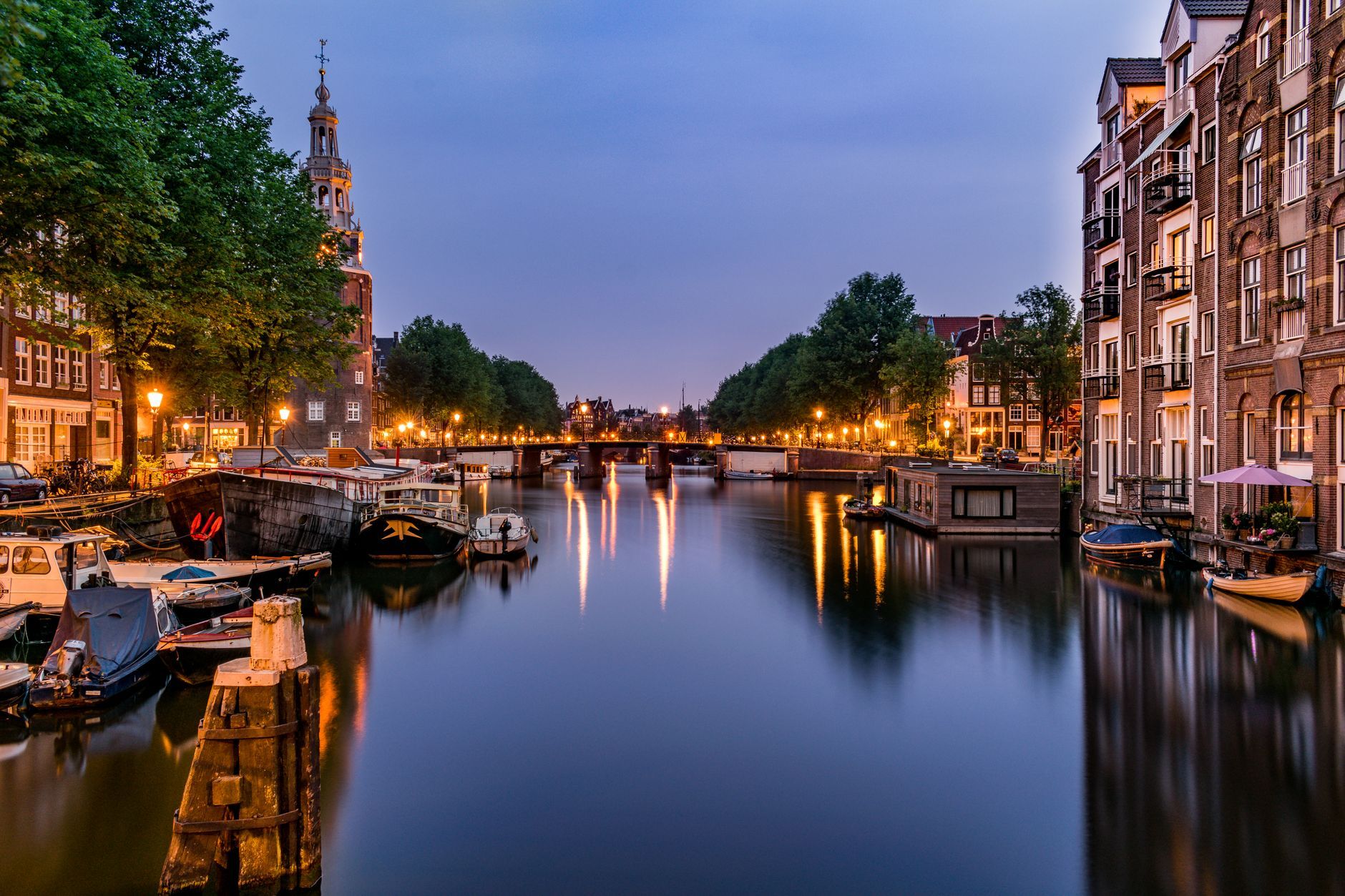
Canals of Amsterdam
The Herengracht, Keizersgracht and Prinsengracht form a half-ring around the old centre, dug from 1613 as one planned extension and listed by UNESCO four centuries later. Gabled merchants' houses lean visibly, some by design to keep hoisted goods off the front. A boat tour gives the low angle the architects intended. The small cross streets between the canals hold the better shops.
-
De Wallen
The medieval heart of the city around its oldest canals is also the red-light district, where licensed sex workers rent windows lit in red. Photographing the windows is forbidden and enforced by the women themselves. The council has banned guided tours here and restricted late drinking. By day it is simply the oldest and one of the prettiest quarters, with the Oude Kerk at its centre.
-
Jordaan
Laid out west of the grand canals for the workers and immigrants who built them, this was a slum within living memory and is now the most sought-after address in the city. Its narrow streets follow old drainage ditches. Behind plain doors are almshouse courtyards, several open to quiet visitors. Brown cafés, a Monday flea market and a Saturday farmers' market keep it local.
-
Keukenhof
A show garden for the Dutch bulb trade near Lisse, planted by hand each autumn with around seven million bulbs and open for only about eight weeks, from late March to mid-May. Tickets are for a dated time slot and the best weeks sell out. Mid-April usually brings the tulip peak. The striped commercial fields around it are free to cycle past.
-
Oude Kerk
The city's oldest building, consecrated in 1306 and stripped bare by Protestant reformers in 1578. It has a vast medieval timber roof and a floor made entirely of gravestones, some 2,500 of them, including that of Rembrandt's wife Saskia. It now works as a venue for contemporary art installations. The tower can be climbed on a guided visit in the warmer months.
-
Rembrandt House Museum
Rembrandt bought this tall house at the height of his fame in 1639 and lost it to bankruptcy nineteen years later. The court inventory drawn up for the sale listed every room's contents, which allowed curators to refurnish it accurately: the studio, the box bed, his cabinet of shells and busts. Staff demonstrate etching and paint-mixing daily. Nearly all his etchings are held here.
-
Rijksmuseum
The national museum, in a brick palace of 1885 with a public cycle path running straight through the middle. The Gallery of Honour leads past Vermeer's Milkmaid and the late Rembrandts to The Night Watch, which is being studied and restored inside a glass chamber in full view. The dolls' houses, Delftware and ship models upstairs are quieter. Book a start time online.
-
Royal Palace
Built in 1655 as the town hall of the richest city in Europe, on more than thirteen thousand wooden piles driven into the mud, and turned into a palace when Napoleon's brother was made king. The central hall has maps of the two hemispheres inlaid in its marble floor, the world laid out for the citizens to walk on. It closes for state functions, so check the calendar.
-
Stedelijk Museum
The municipal museum of modern art and design, next to the Van Gogh Museum under a glossy white extension that locals call the bathtub. The collection is strong where the Dutch were: Mondrian and De Stijl, Malevich, the Cobra group, Rietveld's chairs. It is usually the calmest of the three museums on the square and the easiest to enter without planning.
-
Van Gogh Museum
The artist sold almost nothing in his life, so the work passed to his brother's widow and then to the state, some two hundred paintings and most of the letters. They hang in order, from the dark Dutch peasants through Paris to the last wheatfields, ten years in all. Tickets are sold online for a fixed entry time only, and none at the door.
-
Vondelpark
The city's main park since 1865, a long English-style landscape of ponds, lawns and old trees running south-west from the museum quarter. It doubles as a cycle commuter route, so look both ways on the main path. An open-air theatre stages free performances on summer weekends. On the first warm day of spring most of Amsterdam appears to be lying on the grass.
-
Zaanse Schans
Green timber houses and working windmills gathered from across the Zaan region from 1961 onward and re-erected on one riverbank, in what was the first industrial zone in Europe. The mills still saw timber, press oil and grind pigments, and several admit visitors. The village is free to walk; individual mills and museums are ticketed. Trains reach Zaandijk in under twenty minutes. Arrive before ten.