Things to do
5-
Dadan
Capital of the Dadanite and Lihyanite kingdoms before the Nabataeans, the site keeps lion tombs cut high into a red cliff above the oasis, with excavation still running on the settlement below. Viewing is from a distance on a guided route, so binoculars help. Tours run in the morning and pair naturally with Jabal Ikmah nearby.
-
Elephant Rock
Wind has cut a freestanding sandstone butte into the shape of an elephant with its trunk to the ground, standing some fifty metres above the sand. Sunken lounge pits in the sand around it serve coffee after dark, and floodlights come on at dusk. The site is open and free, and half an hour covers it.
-
Hegra
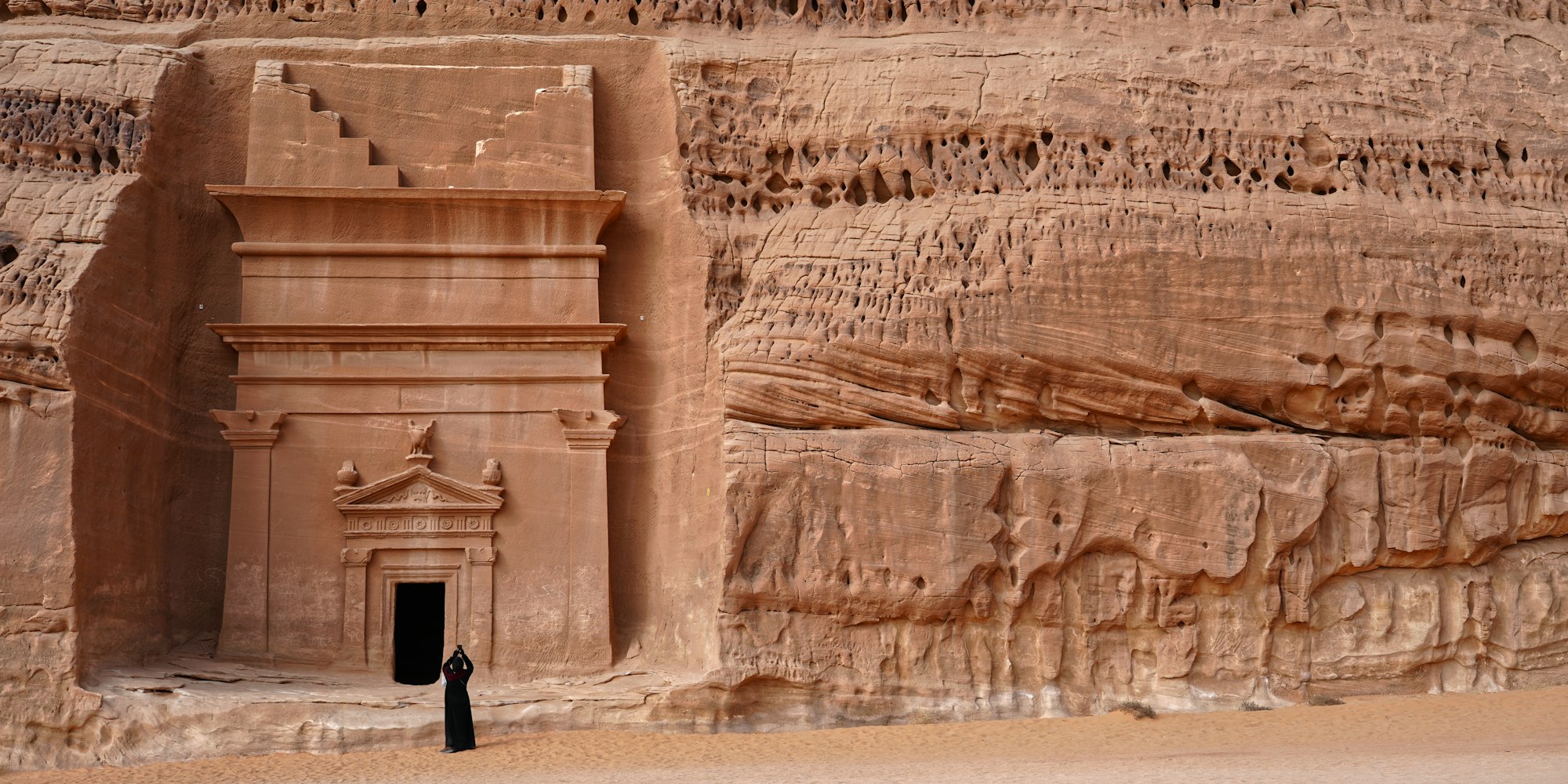
More than a hundred Nabataean tombs stand carved into isolated sandstone outcrops across a desert basin, the southern city of the kingdom that built Petra and the first site in Saudi Arabia inscribed by UNESCO. Facades carry inscriptions naming the owners and the masons. Access is by guided shuttle on a fixed loop, booked ahead, which caps how long any one tomb gets.
-
Jabal Ikmah
A narrow canyon walled with hundreds of inscriptions in Dadanitic, Thamudic, Minaic and Nabataean, carved by travellers and pilgrims over centuries and registered by UNESCO as documentary heritage. Walking the floor of it takes under an hour, on a marked path with panels. Low sun rakes the carvings and makes them legible; midday flattens them.
-
Maraya
Clad entirely in mirrored glass, a concert hall in the Ashar valley reflects the cliffs until the building nearly disappears, and it is recorded as the largest mirrored structure anywhere. Programming comes first, so the interior opens for events and for booked tours. For most visitors it stays a photograph from the approach road, taken in low sun.