Things to do
6-
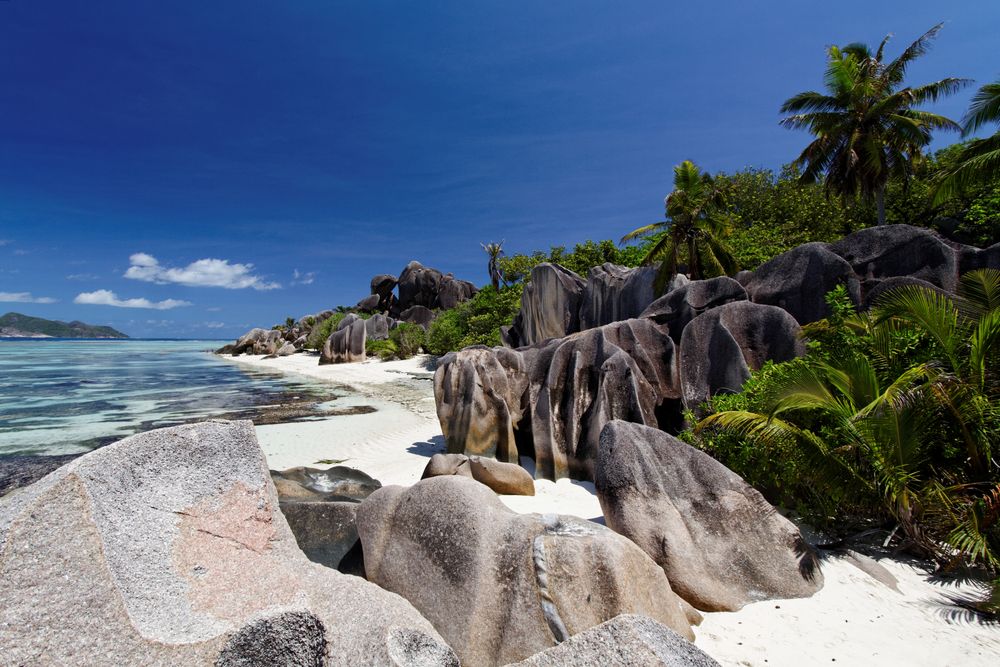
Anse Source d'Argent
You swim between giant granite boulders here, in turquoise water along a chain of small coves of soft white sand on the western side of La Digue.
View more → -
Beach
Anse Cocos
With no road to it, this east coast beach is reached on foot from Grand Anse, over a headland and along Petite Anse, a walk of roughly half an hour on a sandy, rocky path. The open sea is rough for much of the year, but granite boulders at the northern end enclose a natural pool where the water stays calm. Bring water and shade, since nothing is sold on the beach.
-
Beach
Grand Anse
A long, open beach on the southeast coast, reached by bicycle across the island from La Passe on the only road over the hill. No reef breaks the swell here, and the currents are strong enough that swimming is often unsafe, above all during the southeast trades from May to September. A beach café sits behind the sand, and the footpath to Petite Anse and Anse Cocos starts at its northern end.
-
Landmark
L'Union Estate
This former coconut and vanilla plantation fills the flat ground behind the southwest coast, and its paid gate is the only way through to Anse Source d'Argent. Inside are the old plantation house, a colonial cemetery, a copra mill where coconut flesh is still pressed, and a pen of Aldabra giant tortoises. Bicycles can be ridden in, and the path to the beach continues past the great granite outcrop of Giant Union Rock.
-
Viewpoint
Nid d'Aigle
Eagle's Nest is La Digue's highest point, a forested summit above the village of La Passe. A steep concrete road climbs past the Belle Vue area, then a rougher path finishes through the trees to granite slabs looking out over Praslin, Félicité and the smaller outer islands. Allow two to three hours on foot there and back.
-
Park
Veuve Nature Reserve
A small patch of coastal woodland at La Réunion, set aside for the Seychelles paradise flycatcher, known locally as the veuve, or widow, after the male's long black tail feathers. La Digue holds nearly all of the world's population. Short shaded trails loop through takamaka and badamier trees, and early morning is when the birds are most active and easiest to hear.