Things to do
7-
Afrasiyab Museum
Ancient Samarkand stood on the mounds just north of the modern city until Genghis Khan destroyed it in 1220. The museum built over the site holds the excavated finds, chief among them a seventh-century wall painting of an ambassadorial procession that runs the length of a room. Labels are thin in English, and the mounds themselves are walkable afterwards.
-
Bibi-Khanym Mosque
Timur ordered a congregational mosque on a scale his builders could not sustain, and much of what stands today was rebuilt in the Soviet period after centuries of collapse. The courtyard holds a marble Quran stand the size of a table. Forty-five minutes covers the site, and the neighbouring bazaar makes the obvious next stop.
-
Gur-e-Amir
Under a ribbed turquoise dome lie Timur, two sons and his grandson Ulugh Beg, in a chamber whose gilded interior became the model for later Mughal tombs. The building is compact and the visit short. Light through the grilles is best in late afternoon, and the exterior is floodlit once dark.
-
Registan
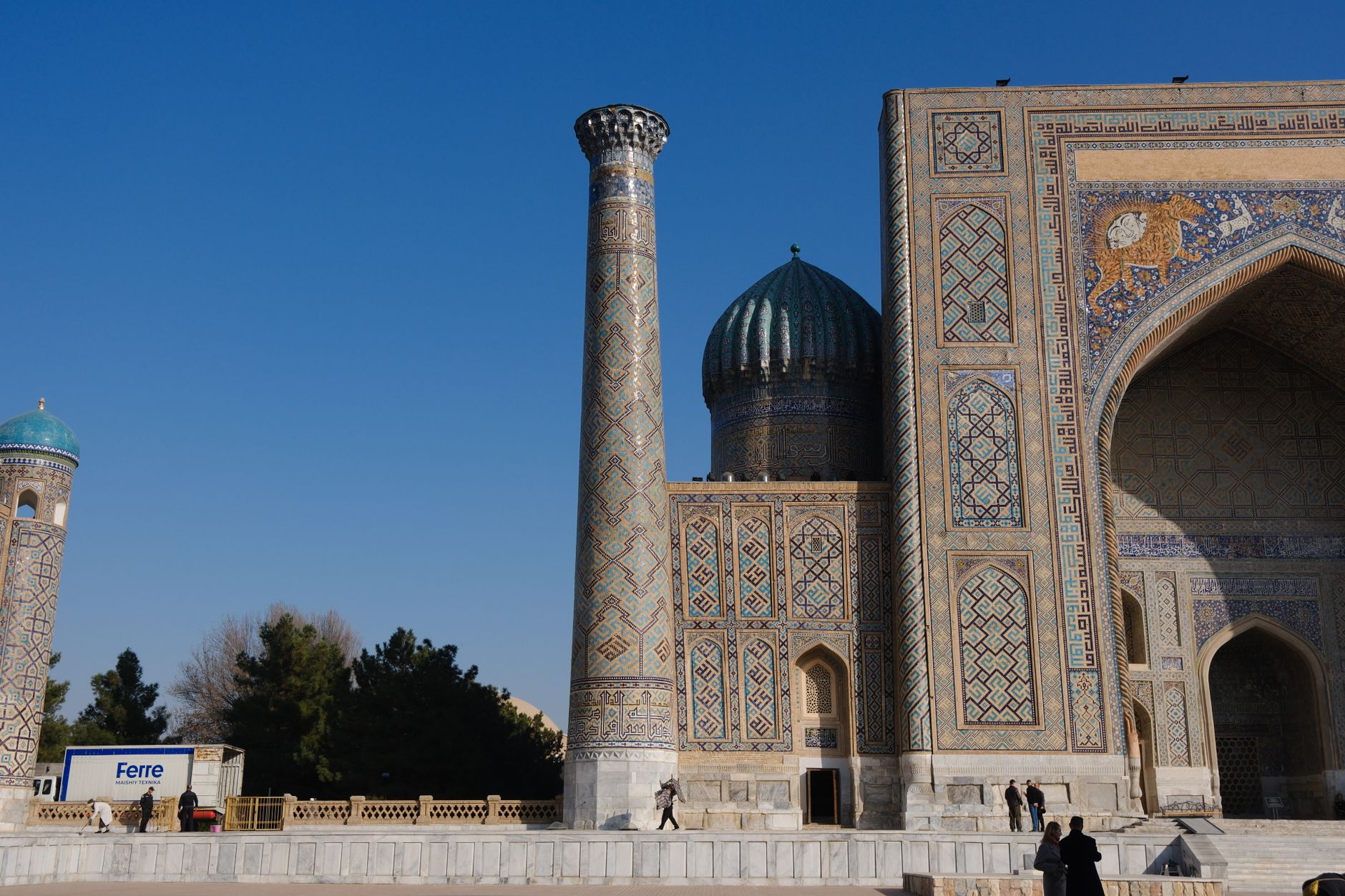
Three madrasas stand shoulder to shoulder around a public square, their portals tiled in the blue that Timurid patrons made the signature of the city. The ensemble took two centuries to finish and each building sits at a slightly different angle. Crowds thin in the early evening, and the square is lit after dark, which is when the tilework reads best.
-
Shah-i-Zinda
A narrow lane of tombs climbs a hillside above the old town, each doorway faced in tile by a different workshop over three centuries. The effect is cumulative, colour on both sides, corridor after corridor. It remains a working pilgrimage site as well as a monument, so modest dress helps and early morning avoids both the heat and the tour groups.
-
Siyob Bazaar
Samarkand's produce market sits beside Bibi-Khanym, under long sheds of fruit, nuts and the round flatbread the city stamps with a patterned seal. Traders press samples on passing visitors and expect a short conversation with it. Mornings are when the bread comes out of the ovens, and by mid-afternoon the stalls are thinning.
-
Ulugh Beg Observatory
On a hill at the edge of town, a curved marble trench is what remains of the sextant Ulugh Beg used to fix the length of the year to within a minute. The rest of the observatory was pulled down after his death and excavated in 1908. A small museum beside it explains the instruments, and the whole stop takes under an hour.