
Stand on a cliff above the Southern Ocean and look along a line of limestone stacks left standing in the surf. Late in the day the yellow rock turns red and orange.
Landmark, Melbourne. Meridian Dispatch.
Yes, at twelveapostles.org.au. Since 16 October 2026 every visitor needs one for the lookouts, the centre and the car park, including walkers on the Great Ocean Walk. Arrivals without one can try at the gate, but may have to wait if parking is full.
Yes, until April 2027. Reservations cost nothing until then, and an entry fee is planned after that. Loch Ard Gorge, the next stop west, is free.
In November 2026 the visitor centre is open every day from 8am to 8pm, with the last arrival at 7pm. The car park is open from 6am to 9pm, and cars can drive out at any time.
Seven can be counted to the west from the main platform. Others are out of sight behind headlands and nearer pillars, and some 30 rock formations stand along this stretch of coast.
Yes, there are more than 950 spaces, and the reservation includes one. Coaches and minibuses have their own gate. Gibson Steps has a small car park that often fills, and stopping beside a solid yellow line is illegal.
Yes, but it is a long day: 275 km, about four hours each way by the coast. Without a car, a V/Line coach from Apollo Bay stops for half an hour on Mondays, Wednesdays and Fridays. Seats need a reservation and the site needs its own booking. The stop is too short for Gibson Steps.
No. Dogs are banned in this part of the national park. Assistance dogs are welcome on the trails and in the centre if the handler carries proof. Drones and kites are prohibited too, along with bicycles and scooters.
Yes, in November 2026. The booking rule names the visitor centre, the Twelve Apostles and their car park, not the steps. The beach cannot be reached in all conditions. The small car park above has an accessible space.
The official site of Twelve Apostles is twelveapostles.org.au.
twelveapostles.org.au →The stacks rise straight out of the water just off the cliffs. From the main platform the line runs away to the west, and the farther stacks drop out of sight behind the nearer ones.
They started as the mainland. Waves carved the limestone into caves, then arches, then the pillars that stand today. Two of the stacks have come down since 2005, and the cliffs still lose about 2 cm a year.
The viewing area is new. It has wide paths, platforms that hang out over the edge and a boardwalk that looks across Gibson Steps beach. The traditional owners led the design, and its colours come from the sulphur-crested and red-tailed black cockatoos, totems of the Eastern Maar.
The Keerray Woorroong Visitor Centre opened in October 2026 with a rooftop lookout, a café and displays on the geology, the shipwrecks and Keerray Woorroong culture. At dusk you may see little penguins crossing the sand far below.
Cars turn off the Great Ocean Road at Booringa Road and go through a boom gate to the parking. Leave the car and walk to the visitor centre, where the displays and the rooftop lookout come before the coast.
About 600 m of sealed path leads on to the viewing areas. At the main one, follow the signs down to the lower platform, which prams and wheelchairs can also reach, then walk back the same way.
For the view from the sand, take the Great Ocean Walk 1.1 km to Gibson Steps. It passes under the road and comes out at a lookout over Gog and Magog, two separate stacks that are not counted among the Apostles.
Allow 60 to 80 minutes to the clifftop and back. From there, 86 steps and a ramp lead down to the beach.
Farther west, Loch Ard Gorge has an hour or more of short trails to Thunder Cave, the Razorback and Island Arch.
In late November the sun sets close to 8.30pm, after the centre has shut. Ask staff on arrival how long the lookouts stay open.
There is little shade, so bring a hat, sunglasses and sunscreen. Wear closed shoes; the ground is uneven in places.
Stay the night in Port Campbell, 7 km west, if you want both evening light and the gorge. It is the closest town to stay in.
Explore the rest of Melbourne
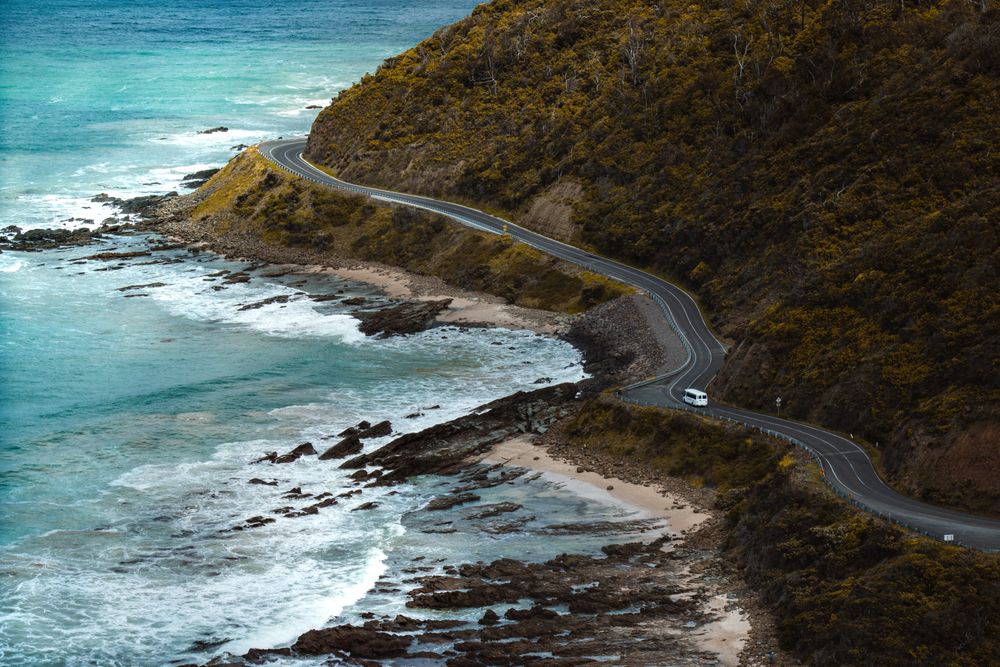
Built by returned soldiers between 1919 and 1932, this coastal highway runs southwest from Torquay past surf breaks, rainforest and…
Second city of Australia, set at the head of Port Phillip Bay on a flat grid of lanes, arcades and tram lines, with the Yarra cutting…




Save Twelve Apostles to your Australia trip in the Meridian Dispatch app and build the day around it, with the best of Melbourne pinned on one map.
Download on the App StoreLast updated