Things to do
14-
798 Art Zone
Joint Factory 718 made military electronics from 1957 in sawtooth halls that East German architects designed for daylight, and artists began taking the empty workshops in the mid-nineties. Galleries, studios and cafes now fill the lanes, with the UCCA at the centre and Maoist slogans still on some of the beams. Most galleries close on Mondays, and shows change often enough to check before travelling out.
-
Badaling Great Wall
Built in 1504 and opened to visitors in 1957, this was the first section restored for tourism and remains the busiest, roughly eighty kilometres northwest of the centre. High-speed trains from Beijing North reach an underground station at the foot of the climb in under an hour. The north towers rise to just over a thousand metres; arriving at opening time is the way to beat the coaches.
-
Beihai Park
An imperial lake garden west of the Forbidden City, laid out over centuries and opened to the public in 1925. The White Dagoba of 1651 crowns Jade Flowery Islet in the middle of the lake, reached by a stone bridge or by rowing boat in summer. The Nine Dragon Screen and the round city sit on the quieter northern and southern edges.
-
Forbidden City
Twenty-four emperors ruled from this walled palace between 1420 and 1912, and its courtyards run almost a kilometre from the Meridian Gate to the north exit. Tickets are sold online only, capped daily and tied to a passport, so booking well ahead matters. The route is one way, northward; the side halls and the clock collection are quieter than the central axis.
-
Jingshan Park
Raised from the spoil dug out of the Forbidden City moat, this hill carries the Wanchun Pavilion on its crest and the view straight down the palace's golden roofs. The climb takes about fifteen minutes on stepped paths, and haze decides the result, so a clear day after wind or rain repays the wait. The last Ming emperor died on its slope in 1644.
-
Jinshanling Great Wall
Ming builders raised this stretch from 1570, and at 125 kilometres northeast of Beijing, over the Hebei border, it has been left largely as it weathered. Sixty-seven towers run along ten and a half kilometres of ridge, restored at the western end and rough underfoot towards Simatai. A full traverse takes most of a day, and the bus out makes it a long one.
-
Ming Tombs
Thirteen Ming emperors lie under the hills 42 kilometres north of the city, each tomb set in its own walled precinct. Three are open: Changling, with its great hall of nanmu columns; Dingling, whose underground chambers were dug out in the fifties; and Zhaoling. The Spirit Way approaches through stone officials and mythical beasts, a level walk worth doing before the tour buses arrive.
-
Mutianyu Great Wall
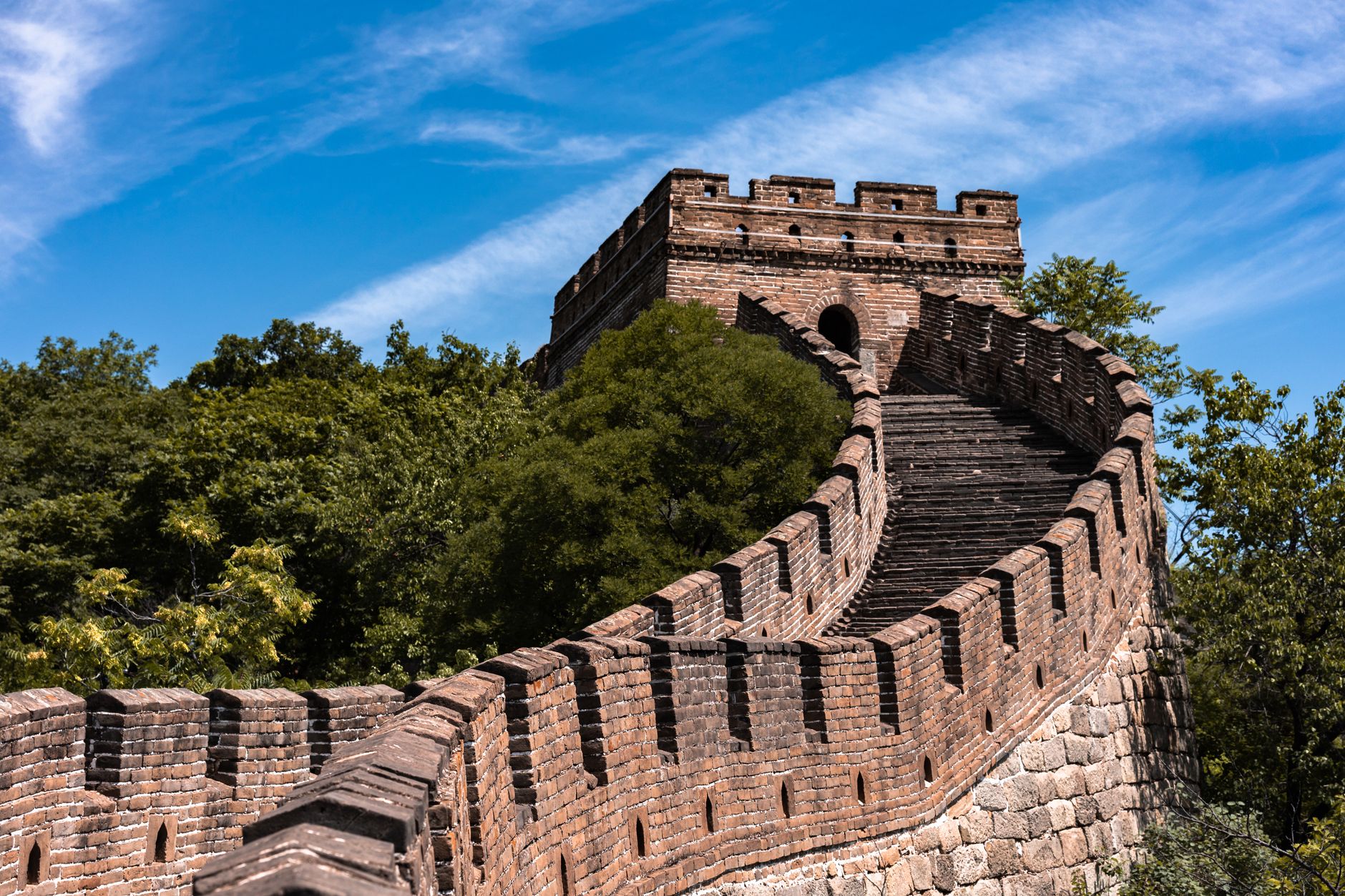
Seventy kilometres northeast of the centre, a granite stretch of Ming wall carries twenty-two watchtowers over about two kilometres of restored rampart, with forest on both sides of the ridge. A chairlift and a gondola climb from the car park, and a metal toboggan track runs back down. Crowds thin past the far towers, where the steps steepen sharply.
-
Nanluoguxiang
A lane of the Yuan grid running eight hundred metres north to south, with eight hutongs off each side in a fishbone plan that has survived seven centuries of rebuilding. The lane itself is now snack stalls and souvenir shops, busy from late morning. The side hutongs hold courtyard houses, bicycle repairmen and a quiet that returns within a few steps.
-
National Museum of China
On the eastern flank of Tiananmen Square, formed in 2003 from the merger of two older museums and rebuilt behind its colonnade into one of the largest exhibition buildings in the world. Ancient China, in the basement, runs from Peking Man to the Qing and is the reason to come. Entry is free but capped, booked online with a passport, and closed on Mondays.
-
Summer Palace
Kunming Lake covers three quarters of this imperial garden northwest of the centre, with Longevity Hill and its temple terraces rising behind. The painted Long Corridor runs more than seven hundred metres along the shore, and the marble boat sits at its western end. The grounds take half a day at an unhurried pace, and each subway exit still leaves a walk to a gate.
-
Temple of Heaven
Ming and Qing emperors came here to pray for the harvest, and the round Hall of Prayer for Good Harvests, rebuilt after an 1889 fire, stands on three marble terraces with no beams or nails in its frame. The surrounding park opens at dawn, hours before the monuments, and fills with card games, choirs and exercise groups; morning is when it is worth the trip.
-
Tiananmen Square
A vast paved rectangle on the old imperial axis, bounded by the Gate of Heavenly Peace to the north, the national museum to the east, and Mao's mausoleum standing in its southern half. Entry requires a passport, an advance booking and a security check at the perimeter. The flag ceremony at sunrise draws the earliest queues, and the square empties quickly after dark.
-
Yonghe Temple
Begun in 1694 as a princely residence and converted to a Gelug monastery in 1744, this is a working Tibetan Buddhist temple as well as a monument. In the rear pavilion stands an eighteen metre Maitreya carved from a single white sandalwood trunk, a gift from the seventh Dalai Lama. Five halls follow the central axis, and an hour is enough for the walk through.