Things to do
14-
Buda Castle
Thirteenth-century foundations lie under a baroque palace rebuilt twice after sieges, most recently from ruins after 1945. The wings now hold the Hungarian National Gallery and the Budapest History Museum, with medieval cellars and a gothic hall surviving below ground. Reaching the hill takes a funicular from Clark Ádám Square, a bus, or a steep twenty-minute walk.
-
Dohány Street Synagogue
Moorish Revival towers on the edge of the old Pest ghetto hold the largest synagogue in Europe, consecrated in 1859 and seating about three thousand. The complex takes in the Hungarian Jewish Museum, a memorial garden with Imre Varga's metal willow, and a courtyard cemetery holding the dead of the ghetto winter. Visits run Sunday to Friday; heads are covered inside.
-
Fisherman's Bastion
Seven white turrets stand for the seven Magyar tribes that settled the Carpathian Basin. Frigyes Schulek built the terrace between 1895 and 1902 as a lookout over the Danube, never as a fortification. Tickets apply to the upper walkway during the day in season; before nine in the morning the whole thing is free and quiet.
-
Gellért Hill
A dolomite bluff on the Buda bank carries the Citadella, which the Habsburgs built to cover the city after 1848, and the Liberty Statue raised in 1947. The fortress reopened in spring 2026 after eleven years closed, with terraces, gardens and an exhibition. A cave church run by Pauline monks is cut into the rock near the Gellért bridgehead, where the marked path up begins.
-
Great Market Hall
Samu Pecz's iron and brick hall opened in 1897 with a Zsolnay tiled roof and three working floors: produce, paprika and salami at street level, fish and pickles in the basement, hot food and embroidery on the gallery. Trading starts at six in the morning and stops at three on Saturday, and the doors stay shut on Sunday.
-
Heroes' Square
At the far end of Andrássy Avenue, a colonnade of Hungarian rulers and statesmen curves around a column carrying the archangel Gabriel, raised for the millennium of the Magyar conquest in 1896. The Museum of Fine Arts and the Kunsthalle face each other across the paving. The square is open at all hours and the metro line beneath it, the first underground railway on the European mainland, surfaces at the corner.
-
House of Terror
Andrássy út 60 was the headquarters of the Arrow Cross and then of the communist secret police, and the museum opened there in 2002 ends in the reconstructed cells of its own basement. Upstairs the treatment is theatrical: a tank in the atrium, walls of portraits, a slow lift down with recorded testimony. Closed on Mondays; printed room sheets carry the English text.
-
Hungarian Parliament Building
Imre Steindl's neo-Gothic parliament was finished in 1902 and still houses the National Assembly, so the interior opens only on a timed guided tour. The route covers the grand staircase, the old upper house chamber and the domed hall where the Holy Crown of Hungary sits under guard. English-language tours sell out weeks ahead in summer, so booking early matters.
-
Margaret Island
Two and a half kilometres of parkland fill the Danube between Margaret and Árpád bridges, closed to private cars and reached by tram or on foot from either end. Ruins of a Dominican convent stand mid-island, where the king's daughter the island is named for lived as a nun. A rubberised running track rings the whole shore, and a musical fountain plays at the southern tip.
-
Matthias Church
Ottoman rule turned the Gothic church on Castle Hill into a mosque for a century and a half, and the Habsburg coronations of 1867 and 1916 were both held here afterwards. Frigyes Schulek's nineteenth-century rebuild gave it the diamond-patterned Zsolnay roof and the painted interior. A small museum and the crypt sit behind the sanctuary, and the organ is used for evening concerts.
-
Shoes on the Danube Bank
Sixty pairs of iron shoes, cast in the styles of the nineteen-forties and bolted to the stone embankment south of the parliament, mark where Arrow Cross militiamen shot Jewish victims into the river in the winter of 1944. Gyula Pauer and Can Togay set the memorial in place in 2005. Candles and stones left in the shoes are replaced constantly; the riverside walk is open at all hours.
-
St. Stephen's Basilica
Fifty-four years of building, a collapsed dome in 1868 and three architects produced the neoclassical basilica that shares the city's ceiling height of ninety-six metres with the parliament dome. A side chapel holds the Holy Right, the mummified hand of Hungary's founding king, lit by a coin-operated lamp. The lookout gallery under the dome is reached by lift or stairs and stays open into the evening.
-
Széchenyi Chain Bridge
Hungary's first permanent Danube crossing opened in 1849 to a design by William Tierney Clark, supervised on site by the unrelated Adam Clark, and was rebuilt after retreating German troops blew it up in the siege. Stone lions by János Marschalkó sit at both ends. Walking across takes ten minutes, and the Buda end lands at Clark Ádám Square beside the funicular up to the castle.
-
Széchenyi Thermal Bath
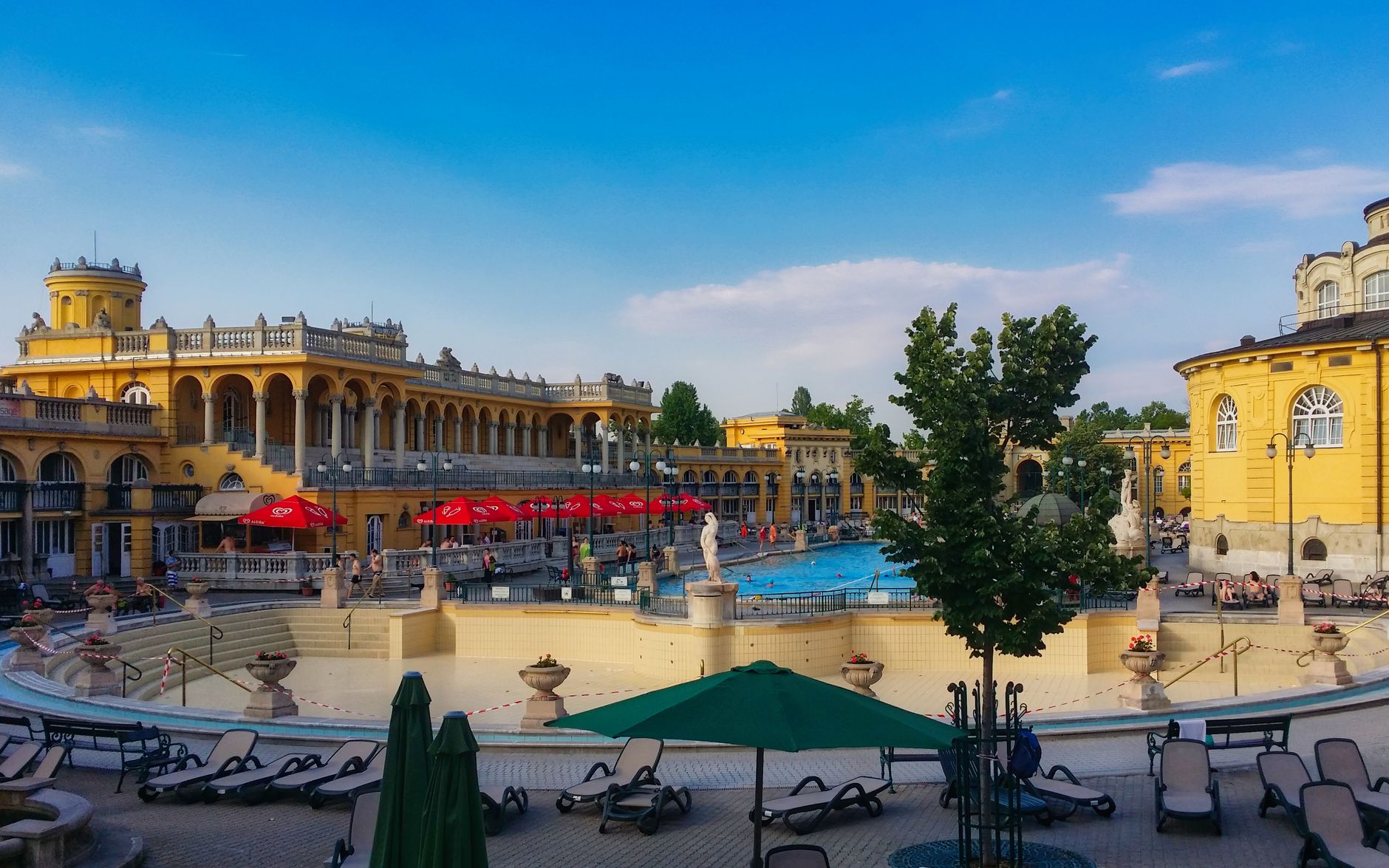
Neo-baroque halls in City Park opened in 1913 over a thermal well sunk more than a kilometre into the rock. Eighteen pools run from cool plunges to soaks at thirty-eight degrees, three of them outdoors and open through winter, when steam hides the chess players at their floating boards. A cap is required in the lap pool; towels and flip-flops are worth bringing.