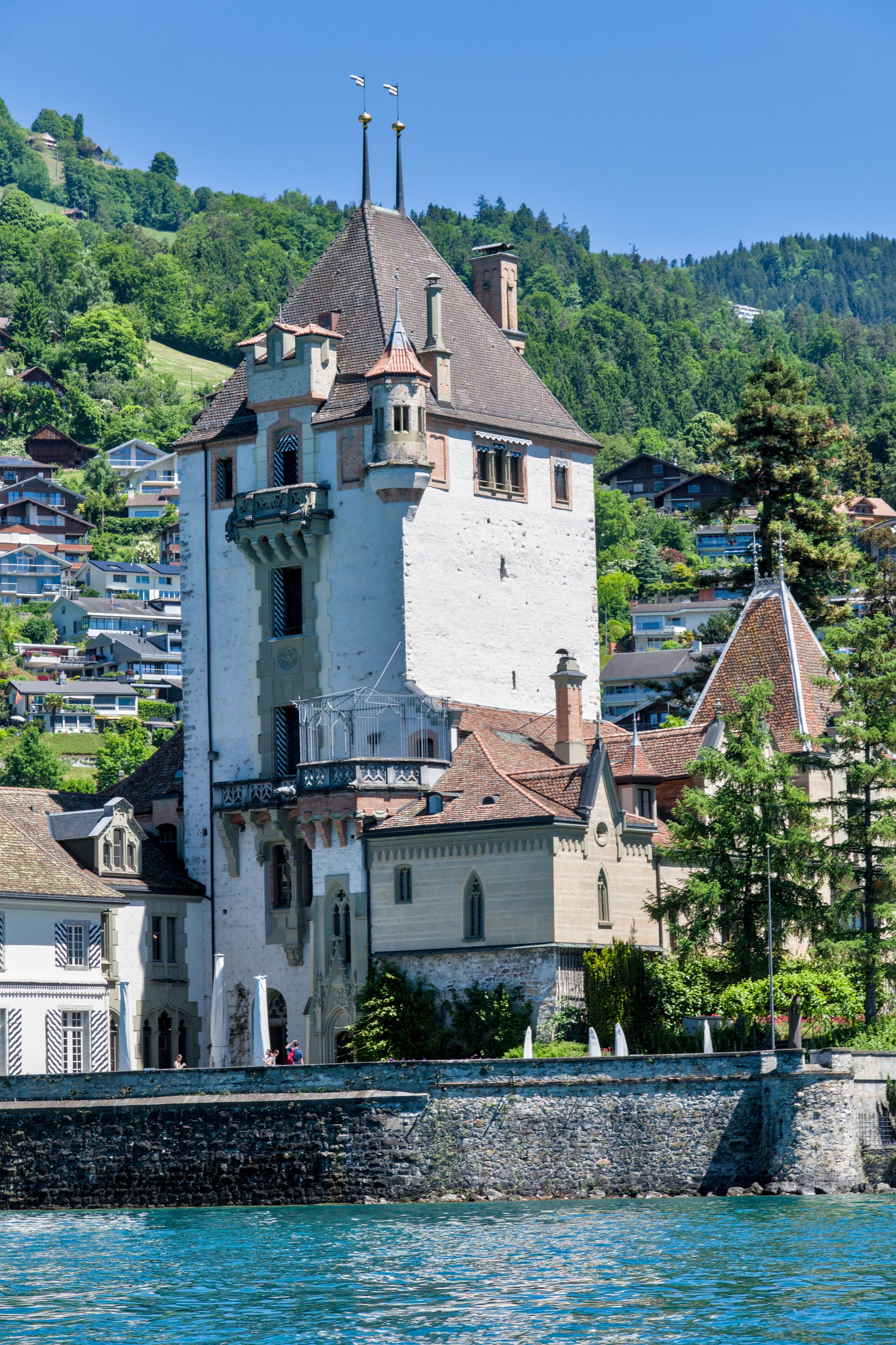
Ninety seconds on Spiez Castle
Climb the castle tower at Spiez for the lake, the vineyards and the Bernese Alps in one turn, then cross the courtyard to a Romanesque church with a painted choir.
The castle church is a well-preserved early Romanesque building, and its choir paintings rank with the best in Switzerland. Look up at the vault over the choir: Christ sits in an almond-shaped halo on a rainbow, hands raised, carried upward by four angels.
Inside the castle, the rooms are furnished as the homes of the families who once lived there. The medieval keep stages the home of Heinrich von Strättlingen, with jousting knights and minstrels. In the Gothic parlour rooms, Adrian von Bubenberg sits on his warhorse.
The second floor belongs to Franz Ludwig von Erlach, his two wives and 37 children. His Baroque ballroom, made from the old great hall in 1614, is the room to look for.
On the upper walls of the tower, look for knights and horses scratched into the stone around 1300. The narrow windows on the way up were built for defence.
Two halves make up a visit: the castle museum with its tower, and the church and park around it. Show your ticket or pass at the museum entrance, then take the floors one by one.
Plaques on the walls of every room, the kitchen included, explain what you are looking at. Climb the wooden staircases into the tower for the view over the church, bay and vineyards.
Back in the courtyard, the castle café in the Bubenberghalle has tables outside. Cross to the church next, then end on the chestnut terrace in the park, where Bubenberg's statue stands and benches face the lake.
You don't need a guide, because the wall plaques tell the story. If you want one, the castle runs its own one-hour highlights tour by reservation, and private guides may not lead groups inside the castle.
Show your Swiss Travel Pass or Swiss Museum Pass at the desk for free museum entry, and ask at the desk what your regional card covers. The castle toilets are for museum and café guests, so plan a stop in town before a park-only visit.
The church closes to visitors during weddings and other events. The walk from the station is downhill on the way in, which means uphill on the way back. Climbing on walls, balustrades, fountains or sculptures is not allowed anywhere in the grounds.
Explore the rest of Thun
Strung for 340 metres between the villages of Sigriswil and Aeschlen, this footbridge hangs about 180 metres above the Gummischlucht gorge,…
Marquard Wocher's circular painting of Thun around 1810, about thirty-eight metres long, is the oldest panorama painting to survive…
Interlaken sits on the flat alluvial strip between Lake Thun and Lake Brienz, the name meaning simply between the lakes. It began as an…