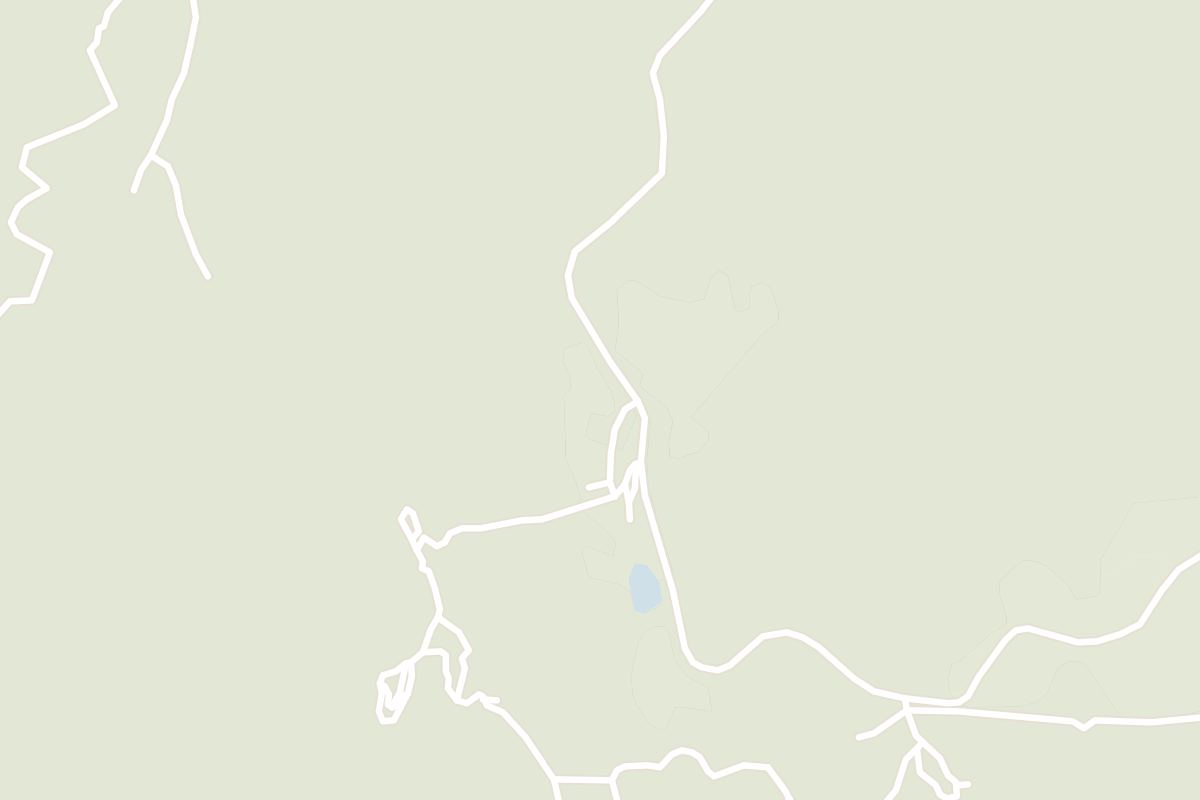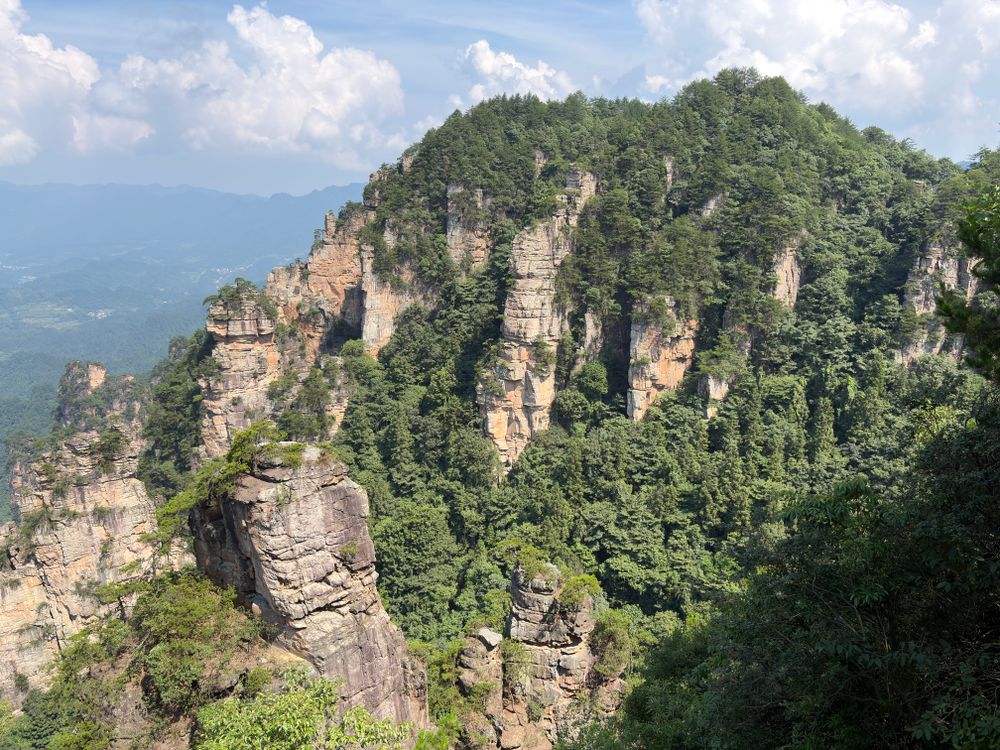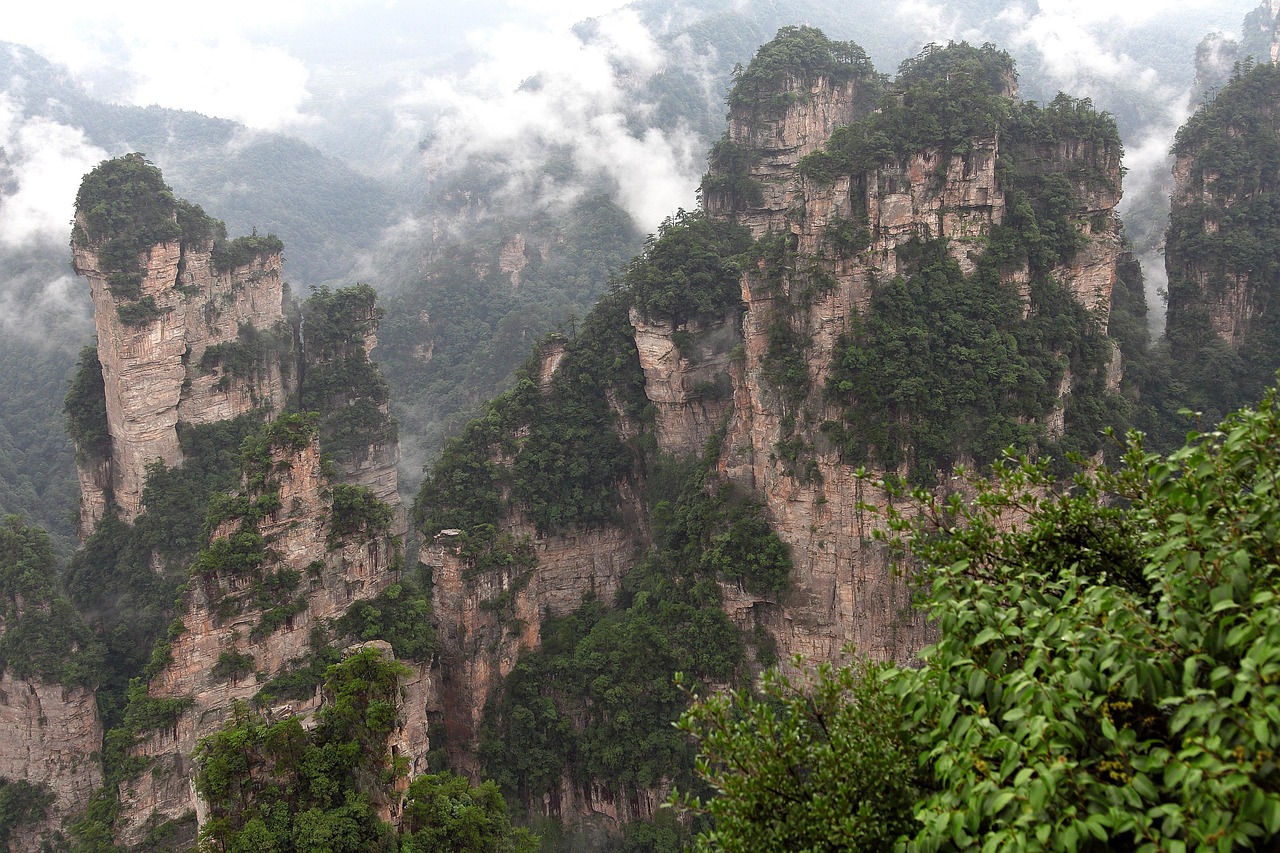
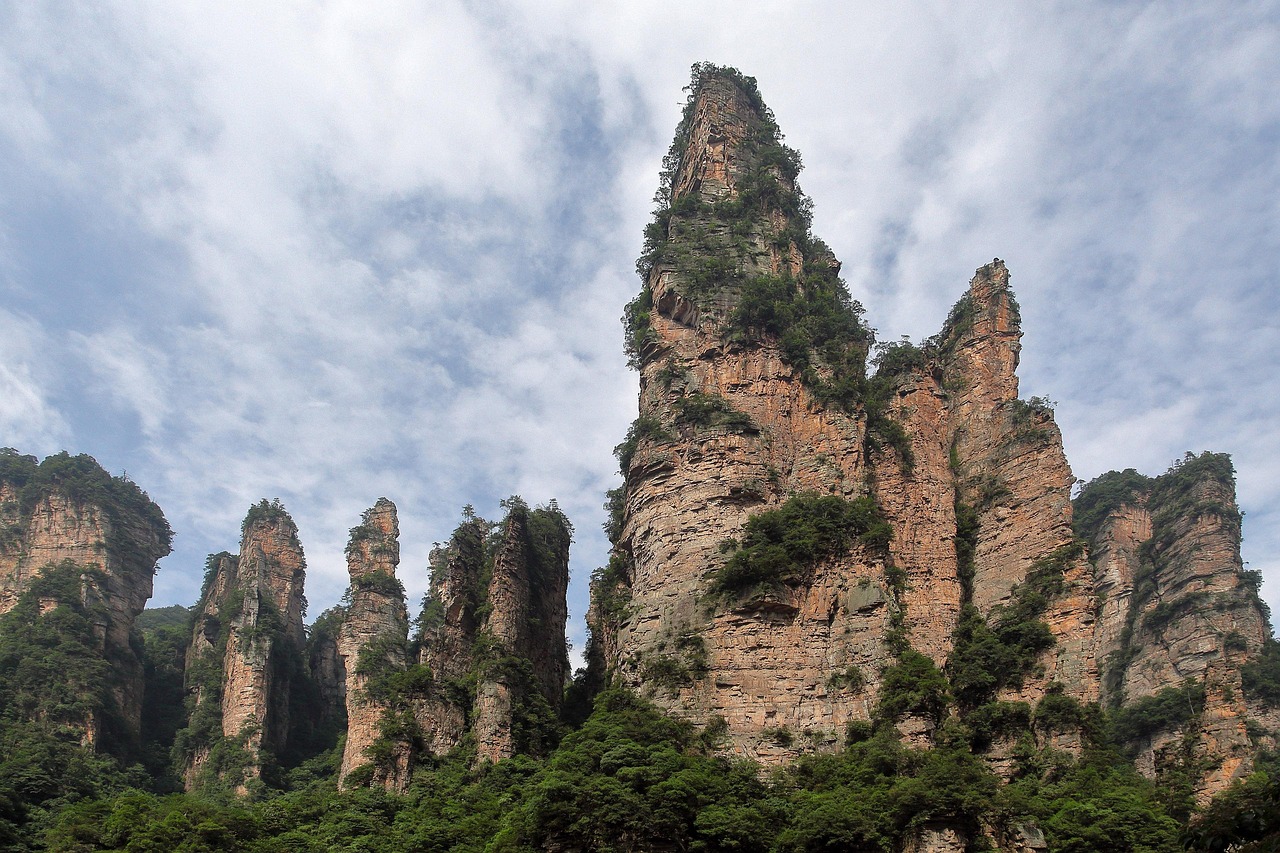
The rock standing in the Wulingyuan Scenic Area of northwestern Hunan is quartz sandstone, and nothing dissolved it. Guilin's limestone towers were eaten out from within by slightly acidic water. These thousands of grey-green spires were cut from the outside, mechanically, by rain, by running water, and by ice expanding in a crack. That difference is visible from any viewpoint in the park. The columns look sliced, their corners holding sharp geometric edges where dissolved limestone would round into humps, and a single pillar can run a hundred metres at very nearly true vertical.
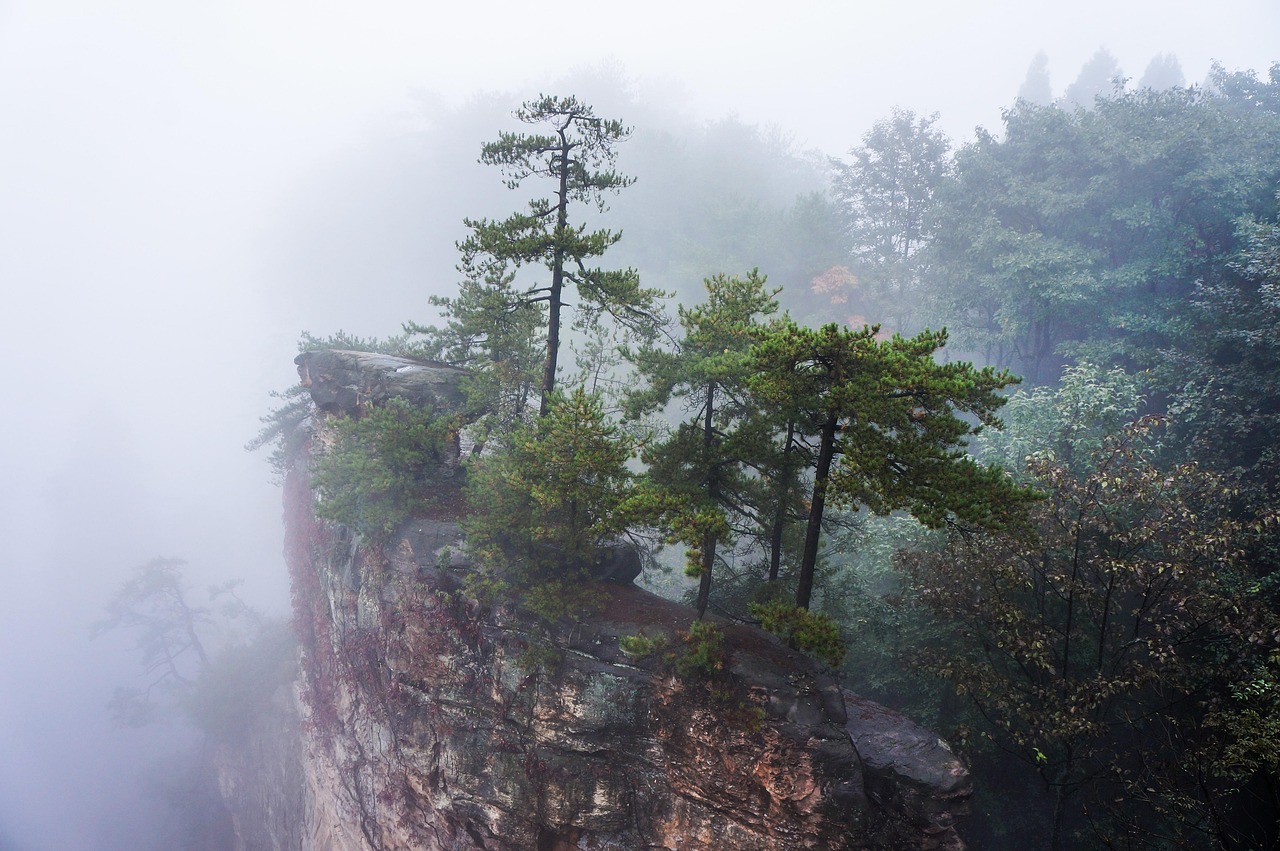
The sequence runs like this. Tectonic uplift, part of the vast crustal shuffle set off by India driving into Eurasia, raised a horizontal plate of hard quartz sandstone. That plate came pre-scored with vertical joints. Water found the joints, froze in them, widened them. Softer siltstone layers interbedded with the hard sandstone gave way first, undercutting the columns above until whole slabs sheared off clean. What remained was carved down from plateau to mesa to wall to freestanding pillar. Wuling pines then rooted directly in the fissures, and their roots work as slow wedges, prising the cracks wider each year. The pines are doing the same job as the frost, only slower. Wulingyuan holds more than three thousand of these pillars, many above two hundred metres, and every one of them is still eroding.
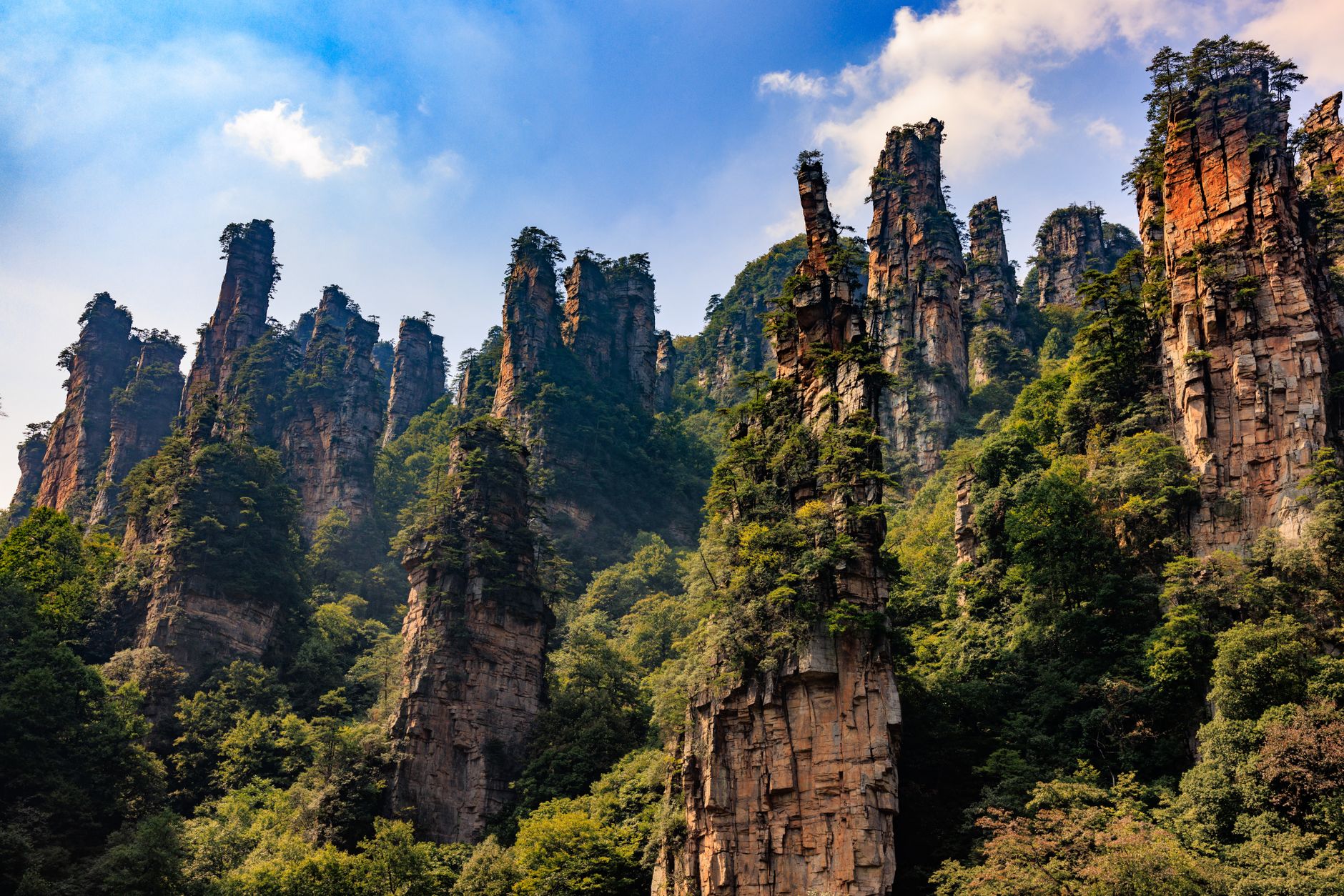
The famous name arrived late and from outside. Avatar opened in December 2009. On 25 January 2010, local officials held a ceremony to rename the Southern Sky Column, a spire in the Yuanjiajie area whose summit stands around 1,080 metres above sea level, as Avatar Hallelujah Mountain. Slogans followed, including the memorable line that Pandora is far but Zhangjiajie is near. The rebrand was contested at once. Chinese internet polls ran heavily against it, and the film's own team pushed back on the claim that this particular pillar had been the model, noting that the art department had drawn on several landscapes, Huangshan and Guilin among them. None of that has dented the signage. Visitors should simply know what they are looking at: a genuine geological wonder wearing a sixteen-year-old marketing label.
The rock is millions of years old. The name is from 2010.
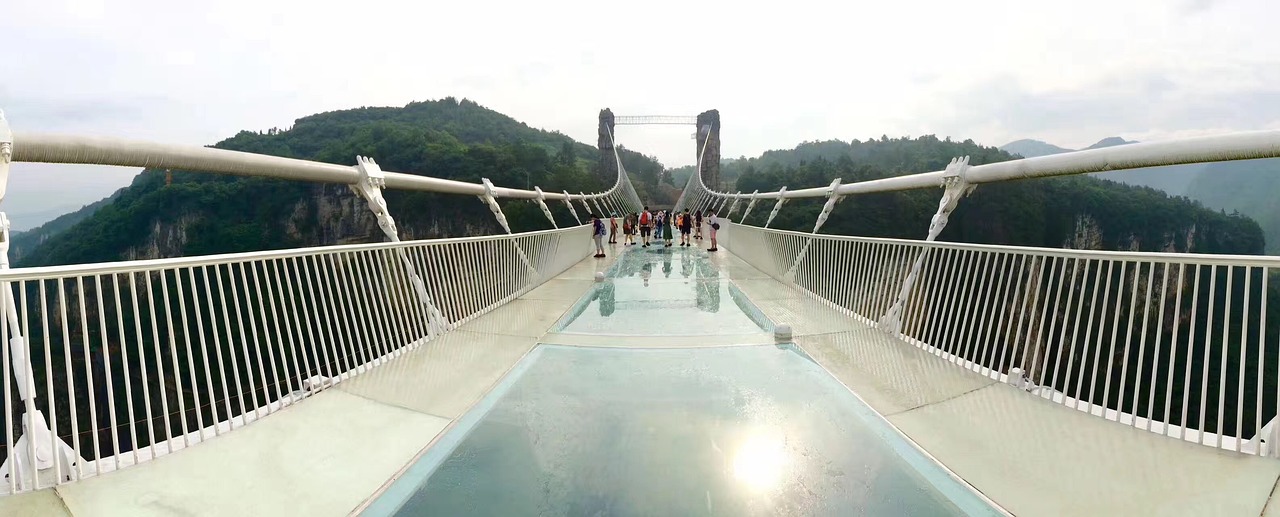
Three separate ticketed sites share the Zhangjiajie name and very little else, and the conflation is what costs visitors a day. Zhangjiajie National Forest Park, designated in 1982 as China's first and covering some 4,810 hectares inside the 397.5 square kilometre Wulingyuan area, holds the pillars. Tianmen Mountain, with its cave arch and cliff walkways, sits directly above Zhangjiajie city and is a separate mountain on a separate ticket. The Grand Canyon Glass Bridge is a third site again, roughly thirty kilometres away in Cili County. Travellers routinely arrive with two days budgeted for what needs four. Allow two to three full days for the forest park alone, a further full day for Tianmen, and treat the glass bridge as optional.
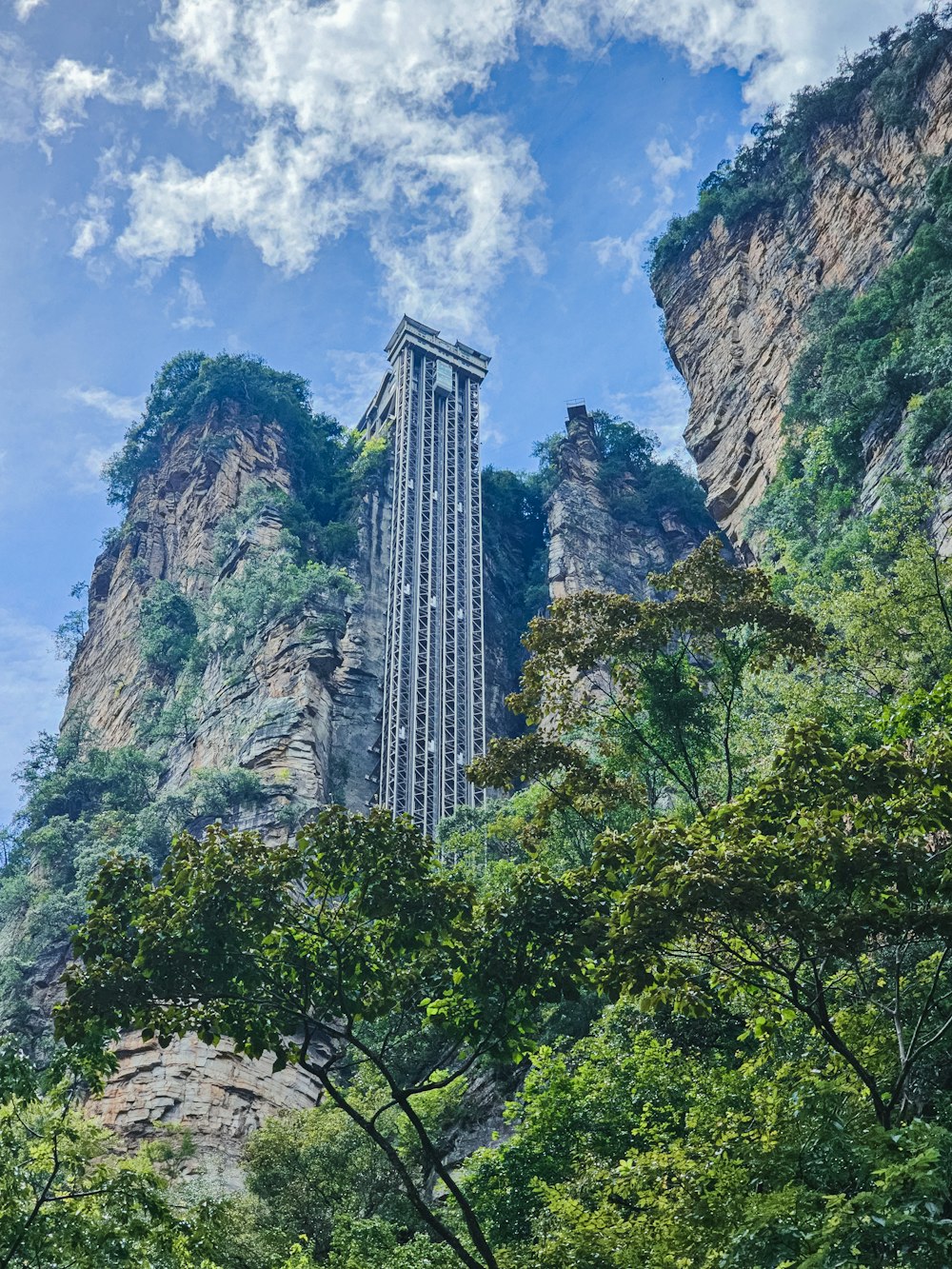
Inside the forest park, the single decision that shapes a visit is which gate you use. Enter at the standard eastern gate and the day funnels into the Bailong Elevator, the glass-and-steel double-decker lift bolted to a quartzite cliff between 1999 and 2002. It climbs 326 metres, roughly half of that inside the rock, in about a minute since its 2015 upgrade, and Guinness recognised it that July as the world's tallest outdoor lift. It is also the park's worst bottleneck.
Queues of one to two hours are ordinary in season, longer at weekends, and arriving at eight in the morning is no guarantee, since the machines do not always all run. Enter instead at the Yangjiajie gate on the western side and the morning opens quietly, with the marquee viewpoints reached before the coaches. That quiet has a price: the western gate sits out at Zhonghu, well beyond the hotel cluster in Wulingyuan town, so it means an earlier alarm and a longer transfer at both ends of the day. Gates open around seven, and the park pass is typically valid four days, which covers entry and the internal shuttles but not always the lift and cable cars.
The other reliable trick is to invert the standard flow. Tour groups ride up and ride down, which means the descent trails stay comparatively empty even in high summer. The Golden Whip Stream follows a clear creek along the valley floor for roughly seven and a half kilometres beneath the pillars, two to three hours at a walking pace, and visitors report near solitude on it. Yangjiajie rewards the same logic: Tianbo Mansion is reached through a narrow rock passage and up near-vertical iron ladders, which filters out most of the traffic and rules the place out entirely for anyone uneasy with heights or exposure.
Budget properly. A full Yuanjiajie and Yangjiajie loop on foot runs nine or ten hours. Note too that the internal shuttle buses are signed by number rather than by destination, so first-time visitors lose time simply working out which bus goes where. Download AMap or Baidu Maps before arrival, since Google Maps does not function here, set up Alipay or WeChat Pay in advance, and carry a passport for every ticket scan.
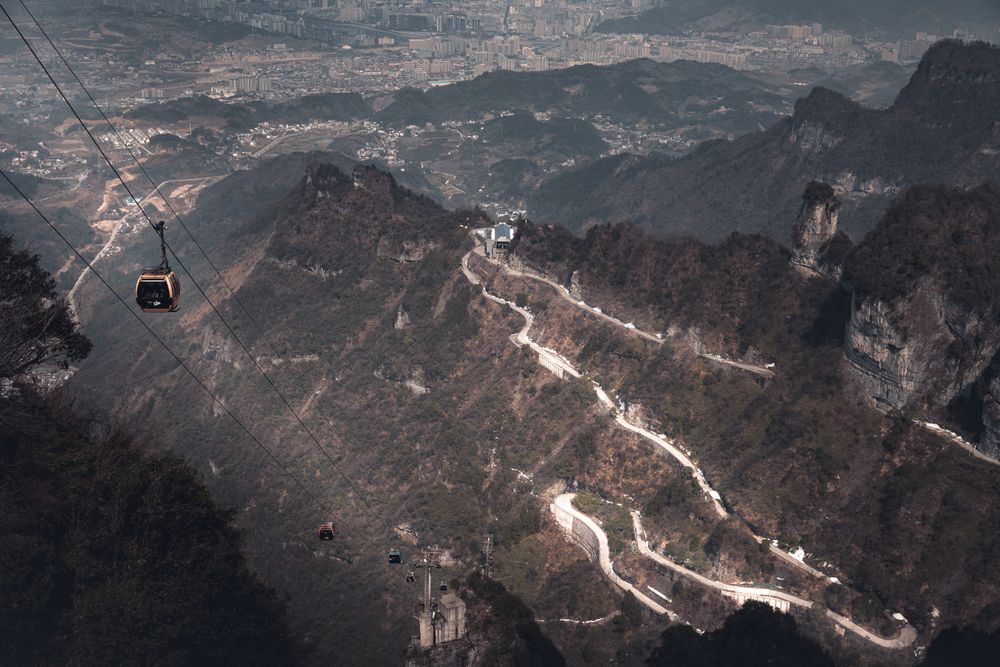
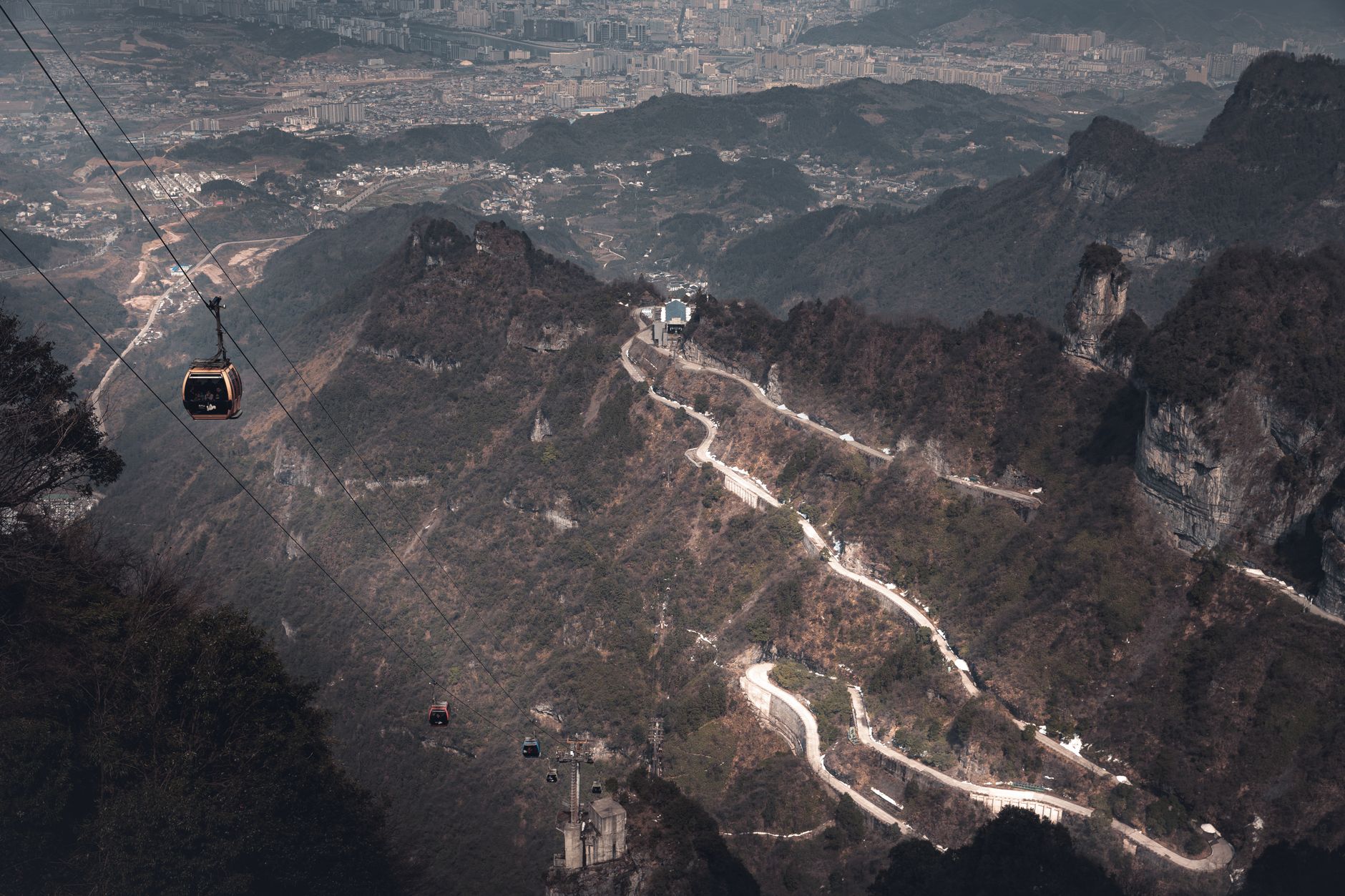
Tianmen Mountain runs on a different rhythm and needs a full day of its own. A squeezed afternoon will miss most of it. The cableway from the edge of Zhangjiajie city is about 7,455 metres long and climbs some 1,279 metres, which takes twenty-five to thirty minutes and is itself among the longest passenger cable car rides anywhere.
At the top, cliff-edge glass walkways demand a small shoe-cover rental and reward patience, the eastern path being consistently less crowded than the western. Tianmen Cave, billed as the world's tallest natural mountain-penetrating arch at around 131.5 metres, is reached by 999 steps that take most people twenty to forty minutes up, with an escalator alternative for those who would rather not. The site sells fixed routes, and in peak season entry is by timed slot, so the route may be assigned at the gate. Expect a queue near an hour for the scenic cableway down, and plan on six to eight hours in total.
Weather is the part no itinerary can fix. The floating effect that made these mountains famous requires a specific and uncommon condition: thin mist pooling at the pillar bases while the summits stay clear. A cloudless day gives sharp rock and no float. A saturated one gives grey, and travellers regularly burn a Tianmen ticket on a mountain they cannot see. The window that most often delivers partial mist is the morning after rain has cleared.
Autumn, from late September into mid-November, brings the driest air and the best visibility; late March through May is mild and green. July and August combine heat, humidity and the heaviest crowds. The Golden Week around 1 October and Chinese New Year are worse again. Winter is beautiful on the pillars but ice can close staircases and the Tianmen glass paths. Build a spare day into any trip here and treat it as insurance rather than slack.
There is a cost to visiting a landscape this thoroughly engineered. The Bailong lift is a steel scar on a World Heritage cliff, the viewing platforms are crowded and barricaded, and the pinch points can feel genuinely unsafe when a holiday surge hits. The same engineering is what puts the place within reach of anyone who cannot walk for nine hours, which is the argument its defenders make and it is not a weak one. The region belongs to Tujia, Miao and Bai communities, and Tujia heritage, the stilt-built diaojiaolou, brocade weaving, the hand dance, sits underneath the tourism economy rather than beside it. A spare afternoon in a Tujia village is better spent than a third glass walkway, and it is the one part of a Zhangjiajie itinerary with no queue attached to it.