
Shipwrecks you can swim through, close together on one reef: a nineteenth-century steamer reduced to its bare iron frame, and a freighter with its cargo of Italian floor tiles still in the holds, a long day's boat ride from Hurghada.
Other, Hurghada. Meridian Dispatch.
By dive boat with a Hurghada dive centre, either on a day trip with nights spent in a hotel or on a liveaboard safari boat. Hurghada's dive centres are registered with the Chamber of Diving and Watersports and licensed by the Ministry of Tourism and Antiquities, and that registration is worth checking at booking.
The Chrisoula K, which runs from 4 to 27 metres: a novice can swim above it in relatively shallow water while experienced divers go inside. The upper parts of the Giannis D also suit a newer diver with a guide, since its A-frame mast rises to within 4 metres of the surface and its deepest point is 24 metres.
Advanced Open Water or a deep specialty is recommended, since several of the wrecks lie deeper than 18 metres. The Carnatic sits at 17 to 27 metres, and any penetration or a dive on the Kimon M calls for Advanced Open Water, ideally with the wreck diver specialty.
The wider Hurghada marine area is protected, and dive centres there operate under environmental procedures, with mooring buoys kept at the dive sites. Crews are supposed to give an environmental briefing at the start of the boat trip and again before entering the water. Which protected-area rules apply at the reef itself is a question for the operator at booking.
March to May and September to November are the best months, with comfortable water and the clearest conditions. Visibility on the wrecks typically runs from 15 to 30 metres, helped by the reef's open-water position away from harbour silt.
About 22°C in winter, rising to about 29°C in summer. A full 5 mm wetsuit is the recommended suit, and current runs from moderate to strong depending on the day.
Sha'ab Abu Nuhas is a triangular coral reef north of Shadwan Island, lying just under the surface at the edge of one of the northern Red Sea's busiest shipping lanes. Four wrecks rest along its northern side: the Giannis D, the Carnatic, the Chrisoula K and the Kimon M. Each one is normally a separate dive.
The Giannis D is the most popular, broken into bow, amidships and stern. Most divers head for the stern, canted over at about 45 degrees, where the funnel still stands and a skylight beside it leads into the engine room, about 13 metres down and full of glassfish.
The Carnatic is the oldest, a passenger steamer that struck the reef and broke in two after two days aground. Its wooden decks have rotted away, so you swim between the iron cross-members of the hull. Further aft, a row of seven square windows sits above the rudder and a very large propeller on the sand.
The Chrisoula K is the tile wreck: its No 1 and No 2 holds stand open with the cargo still in place. The Kimon M went down with bagged lentils and now lies on its starboard side, its midships largely collapsed. Its exposed position catches the current, which makes it the richest in fish of the four.
A day trip from Hurghada is a long one. The cruise runs roughly two to two and a half hours each way, so most of the day is spent at sea.
Boats moor on the calm south side of the reef, and the group crosses to the wrecks on the north face. The plan is two dives on two different wrecks, with a shallow mast or reef section for the safety stop. On a windy day the boat picks the most sheltered pairing.
Hurghada dive centres run the trip only when the sea allows. The other way in is a northern Red Sea liveaboard, which often pairs it with the Thistlegorm and can allow more time there, though neither the itinerary nor every wreck is guaranteed.
Pack a torch even though daylight floods much of the Giannis D through its doors and hatches. Engine-room interiors are tight and very dark, so wreck divers who go inside carry a primary light and a backup. Bring your logbook too, since operators may ask to see recent diving.
If a partner who does not dive wants to come along, ask the boat before booking whether it takes snorkellers and supervises them. From the surface, the lower part of the Chrisoula K's bow can be seen on the reef top in about a metre of water.
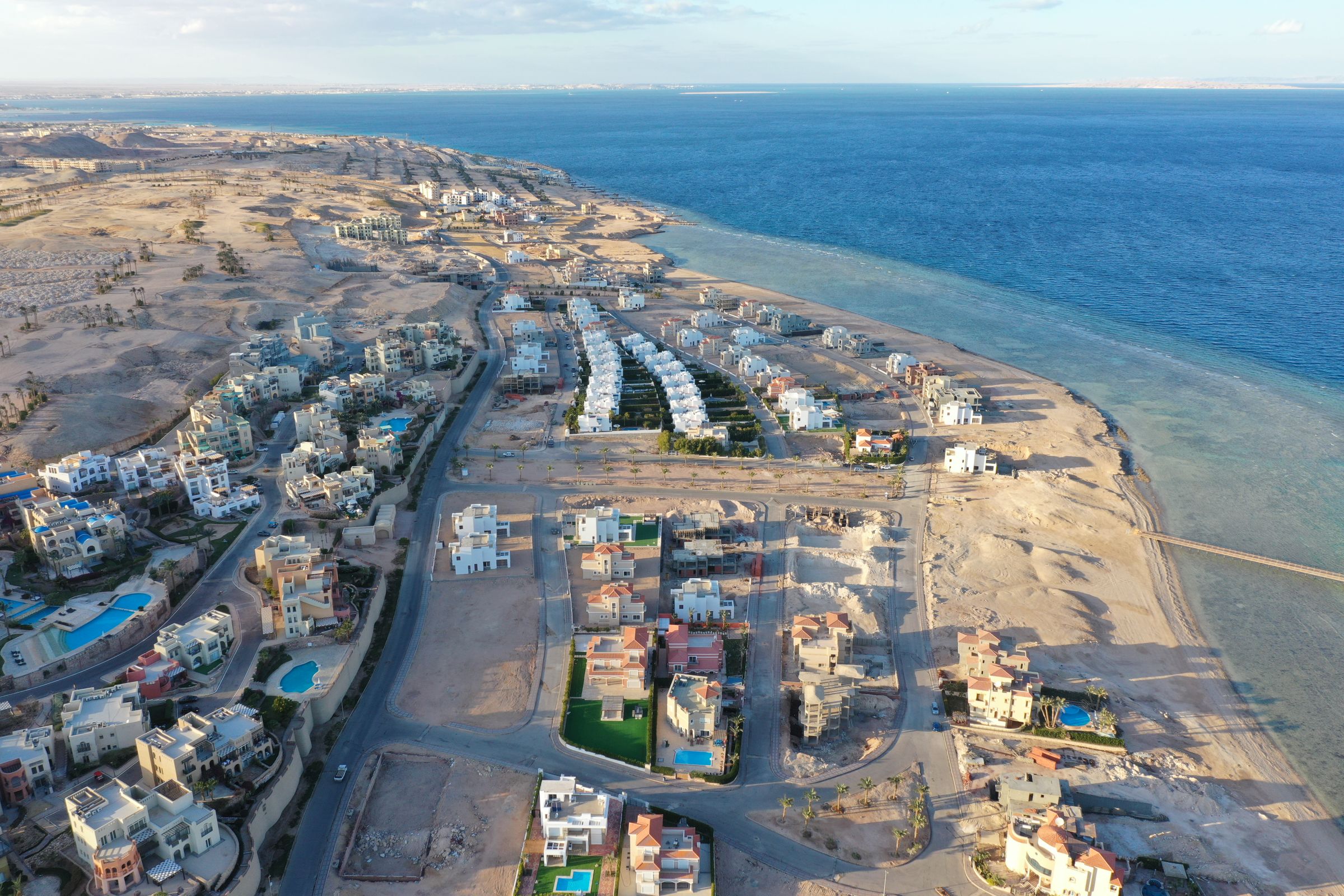
Hurghada, Egypt: a fishing harbour grown into the main resort city of Egypt's Red Sea coast. Abu Tig Marina and Baron Palace Sahl Hasheesh.
Read the Hurghada guideExplore the rest of Hurghada
A fishing harbour grown into the main resort city of Egypt's Red Sea coast, stretched along the shore with the reef-ringed Giftun Islands…
Finished in 2008, the boulevard wraps a basin of about two hundred yacht berths in Sakkala with a pedestrian, palm-lined promenade of…
Two low desert islands lie off Hurghada inside a protected marine park: Giftun Kebir, the larger, nearer the coast, and little Giftun…
A resort city at the southern tip of Sinai, where hotels line a coast whose coral reefs begin a few metres from shore. Two protected areas…
Columns for the portico of the Pantheon in Rome were cut at this granodiorite quarry, worked from the first to the mid-third century. The…

Save Shaab Abu Nuhas to your Egypt trip in the Meridian Dispatch app and build the day around it, with the best of Hurghada pinned on one map.
Download on the App StoreLast updated