
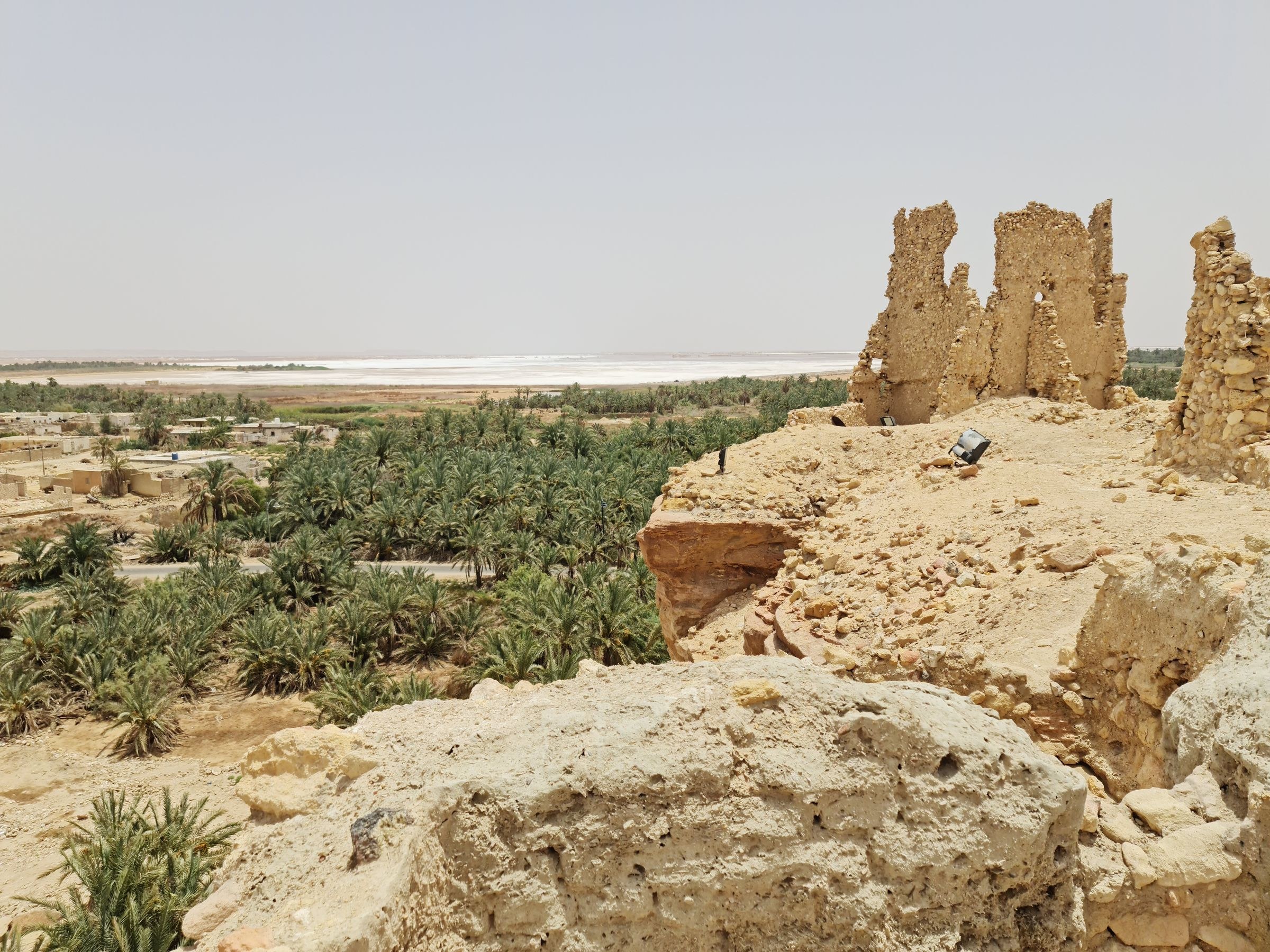
You climb past empty houses on the rock of Aghurmi to the temple where Alexander the Great consulted the oracle of Amun in 331 BC. From the top you look over palm groves, a lake and the desert.
Temple, Siwa Oasis. Meridian Dispatch.
As of November 2026, the site opens every day at 09:00, in summer and winter alike. Last entry is at 17:00, or 16:00 during Ramadan. Egypt's antiquities ministry lists it as the Temple of Aghurmi in Siwa.
Entry is ticketed, with one rate for Egyptians, a higher one for other nationalities, and a reduced student rate in each. Current rates are on the antiquities ministry's ticket site, which also takes bookings.
By bicycle in about 30 minutes on flat roads, or by tuk-tuk in about 10. The hill is some 4 km east of town: take the road from the northeast corner of the market square and head east past the Siwa Paradise Hotel.
About 45 minutes to an hour for the hill and the temple. A stop at the other Amun temple, Umm Ubayda, adds another 15 to 20 minutes.
It was one of the most famous oracles of the ancient world, and the only one of that rank not Greek in origin. Alexander came to ask whether he was the son of Zeus, the god the Greeks identified with Amun. He said afterwards only that the answer suited him.
Yes, for the Alexander story and the carved sanctuary. Expect a damaged ruin: a major earthquake hit it in 1811, and it is far less complete than Karnak or Luxor Temple.
The temple is a limestone building about 8 metres tall, at the north end of a hill 20 to 25 metres high. It is partly cut into the bedrock, and it never had a stone ceiling: halved palm trunks covered it.
The doorways line up, so you can see straight through to the sanctuary. Two plain halls come first, one behind the other, then the holy room itself, about six metres deep.
That innermost chamber is the only one with carved figures and inscriptions. As you go in, the right wall shows King Amasis offering wine to a row of gods. On the left wall the local prince Sethirdis honours eight more, though his own figure has been destroyed.
The corridor to the right of the sanctuary is narrower than a metre. It led on along the north wall to a secret room overhead, where priests could listen to what was asked below.
On the south side of the hill, close to the entrance, a hut sells the tickets. A small rise then brings you to a wooden gate, and the steps behind it lead up to the plateau.
The tall tower by the way in is a minaret. Its mosque has been restored, and you can look inside. Before the temple you pass an old stone well; a narrow staircase leads to its shaft from the west.
Follow the path north, with the old homes on your right and the temple on your left. At the far end of the plateau, look north to the tomb hill of Gebel al-Mawta and, a little to the west, the old town of Shali. The ridge to the south is Gebel Dakrur.
Carry water. Umm Ubayda, the other Amun temple, is about 400 metres south: one wall and some large fragments survive.
Then cycle on to Cleopatra's Spring for a swim. A small café stands by the spring, about 1.5 kilometres from the hill, but for a full meal go back to Siwa town.
You swim two ways in Siwa, floating in turquoise salt pools and bathing in freshwater springs among the palms, and the dunes of the Great Sand Sea start close enough for an afternoon drive.
Read the Siwa Oasis guideExplore the rest of Siwa Oasis
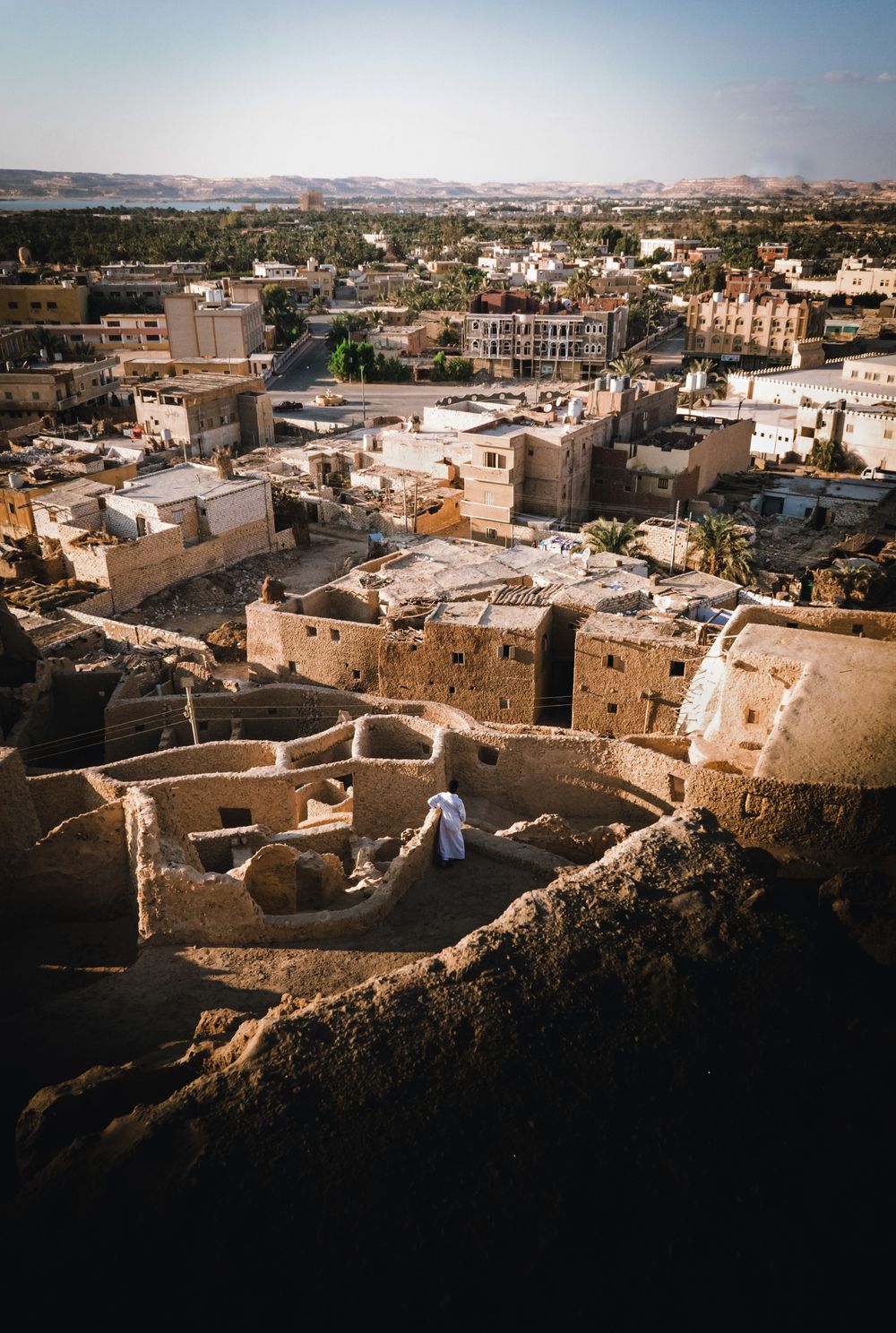
A thirteenth-century hill town of kershef, a mud of salt and clay, rises in a melted heap above the market square. Rain in 1926 dissolved…
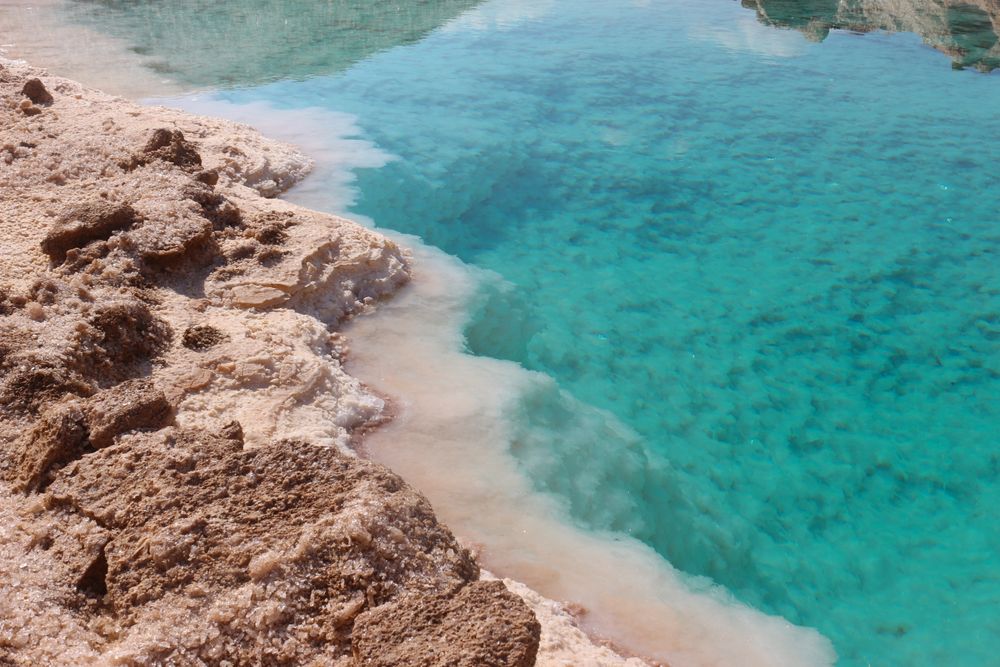
About twelve kilometres east of town, salt mining has left a chain of pools filled by groundwater, turquoise against banks of white crust.…
A circular stone pool fed by a warm natural spring, at about 29°C, lies among palm gardens some 900 metres south of the Umm Ubayd temple.…
A low limestone hill a kilometre north of the town centre is honeycombed with rock-cut tombs. Four painted tombs are open to visitors. The…
Six kilometres west of town, this palm-covered spit was once an island in the salt lake before silt joined it to the shore. A small…
Bungalows on an island in Siwa's salt lake, about 13 km from the town centre and reached by a causeway across the water. Accommodation runs…
Forty rooms built from kershef, the local mix of salt rock and clay, at the foot of the White Mountain on the shore of Siwa's salt lake,…
An ecolodge built in the traditional Siwan way below the Red Mountain, on the shore of the salt lake outside Siwa town. Most rooms have no…




Save Temple of the Oracle of Amun to your Egypt trip in the Meridian Dispatch app and build the day around it, with the best of Siwa Oasis pinned on one map.
Download on the App StoreLast updated