Things to do
6-
Anegundi
Older than the capital it faces, this fortified village on the north bank of the Tungabhadra is held in the Ramayana to be Kishkindha, the kingdom of the monkey king Sugriva. Temple gateways, the old fort wall and craft workshops make up a quiet half day. Coracles cross from near the Vittala temple when the river allows, and the road route runs about twenty kilometres.
-
Group of Monuments at
Inscribed by UNESCO in 1986, the protected area takes in more than a thousand structures across some forty square kilometres: temples, water tanks, colonnaded market streets, gateways and the royal enclosure. This was the capital of Vijayanagara until an alliance of sultanates broke its army at Talikota in 1565 and the city was abandoned. Covering the whole spread takes two days at least.
-
Lotus Mahal
Arches of the Deccan sultanates meet Hindu bracketing in this two-storey pavilion inside the walled Zenana enclosure, once the women's quarters of the royal centre. The recessed bays and the tiered roof give it the shape that named it. The elephant stables stand a short walk away behind the same wall, and one ticket, valid for the day, covers both along with the Vittala temple.
-
Matanga Hill
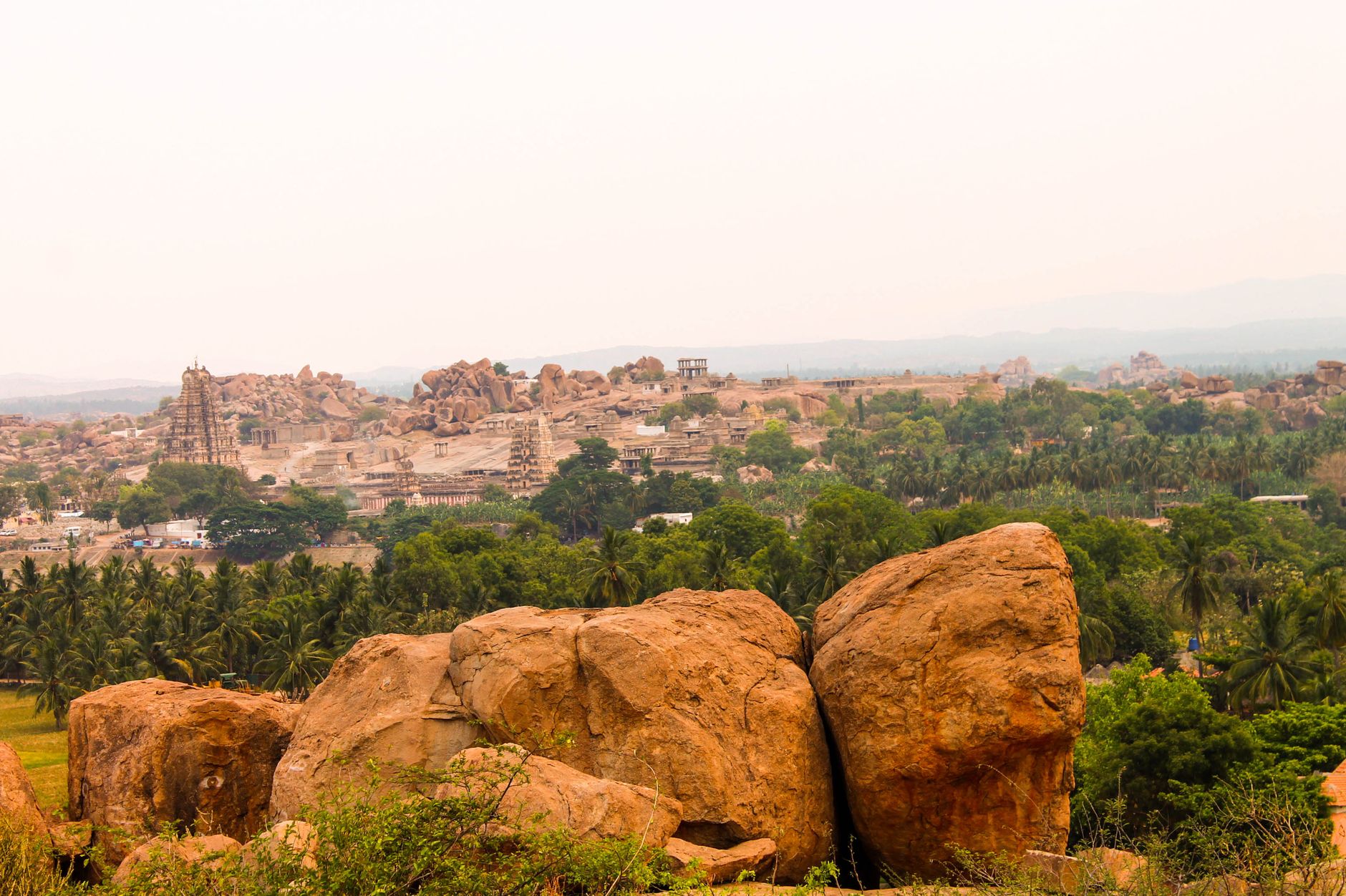
Sunrise draws climbers to this rocky rise in the middle of the site, where a small Shaiva shrine, the Veerabhadra temple, crowns the summit and the view runs over the Virupaksha gopuram, the river and boulders to the horizon. The climb takes around half an hour on steep rock-cut steps. The eastern path from the Kadalekalu Ganesha temple is the gentler one.
-
Virupaksha Temple
Worship has carried on here since long before the Vijayanagara kings built around it, and the temple is still in daily use while the rest of Hampi stands in ruin. Its eastern gopuram rises nine storeys above the bazaar street, and shoes come off at the gate. Dedicated to Shiva as Virupaksha and to Pampa, it draws large crowds at the wedding festival in December and the chariot festival in February.
-
Vittala Temple
Vijayanagara stone carving reaches its high point in this complex east of the bazaar, where a shrine to Garuda takes the form of a chariot cut from granite, its wheels once able to turn. The pillars of the hall ring at different pitches when struck, and are now roped off to protect them. Vehicles stop a kilometre short; walk in or take the shuttle.