Ninety seconds on Remuh Synagogue
One visit here takes you through a working prayer hall on Szeroka Street and into the old Jewish cemetery behind it, where one rabbi's grave, still visited from abroad, came through the war undamaged.
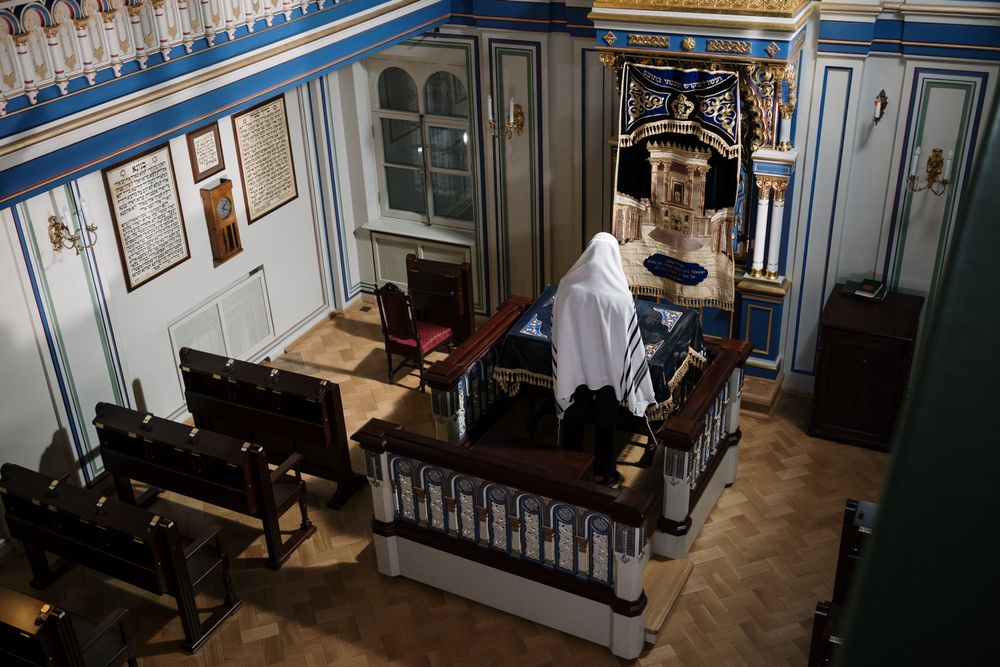
On the east wall of the prayer hall stands the original carved stone Ark, late Renaissance work from the second half of the sixteenth century. It is topped by the tablets of the Ten Commandments on a pedestal carved with a Hebrew verse. The wooden doors of the Torah niche carry Art Nouveau decoration.
The synagogue takes its name from Rabbi Moses Isserles, known by the acronym Remuh. A plaque to the right of the Ark marks where he prayed, and the chair beneath it stays empty during services. In the centre of the hall, the reconstructed bimah behind its wrought-iron lattice keeps a pair of gilded doors from the eighteenth century.
The walled cemetery behind is one of the oldest Jewish cemeteries in Europe, though today it covers only a fraction of its original ground. Its 711 gravestones include sarcophagus tombs and upright slabs called matzevahs. Most were found under a thick layer of soil when the cemetery was cleared.
Fragments of stones that could not be saved were set as a mosaic on the inner face of the wall along Szeroka Street, known as the Wall of Tears. You will see slips of paper on the grave of Isserles. These are kvitelach, written requests that visitors leave in the hope that he will intercede for them.
Szeroka Street's gate is the way in, under a Hebrew inscription naming this the New Synagogue of Remuh. Shoulders and knees should be covered. Entry is charged as you come in; the Jewish Community calls it a donation.
See the prayer hall first. It is small, and a single school or tour group can fill it, so give it a few minutes if one is inside. Then walk on through the synagogue to reach the cemetery behind it.
The cemetery is small, and its paths run between the stones, so it is easy to walk the whole of it.
No guide is required, and you can walk in on your own. Standard walking tours of Kazimierz take in the Remuh together with the Old Synagogue and Szeroka Street, which suits you if you want the whole district explained in one outing. Qualified city guides also lead visits to the synagogue itself.
In summer, come in the last hours before closing, when Szeroka Street is quieter. The synagogue takes walk-ins but has little room inside: if you arrive as a large group, call ahead.
If you plan to see other synagogues and cemeteries in Kazimierz the same day, carry a head covering of your own.
Explore the rest of Kraków
Traces of Memory, the permanent exhibition of this museum on Dajwór Street in Kazimierz, shows in colour photographs what remains of Jewish…

The royal residence on a limestone hill above the Vistula, rebuilt in the early sixteenth century around an arcaded Renaissance courtyard.…
A brick Gothic church with two unequal towers on the corner of the square. Its carved limewood altarpiece, twelve years' work by the…