Things to do
13-
Auschwitz-Birkenau Memorial and Museum
The preserved sites of the largest German Nazi camp, at Oświęcim, where about 1.1 million were murdered, nearly a million of them Jews. The main camp holds the brick blocks and exhibitions; Birkenau, three kilometres off, the railway ramp and the ruins of the gas chambers. Entry is free but requires a dated pass booked online well ahead. Allow a full day. It is not recommended for children under fourteen.
-
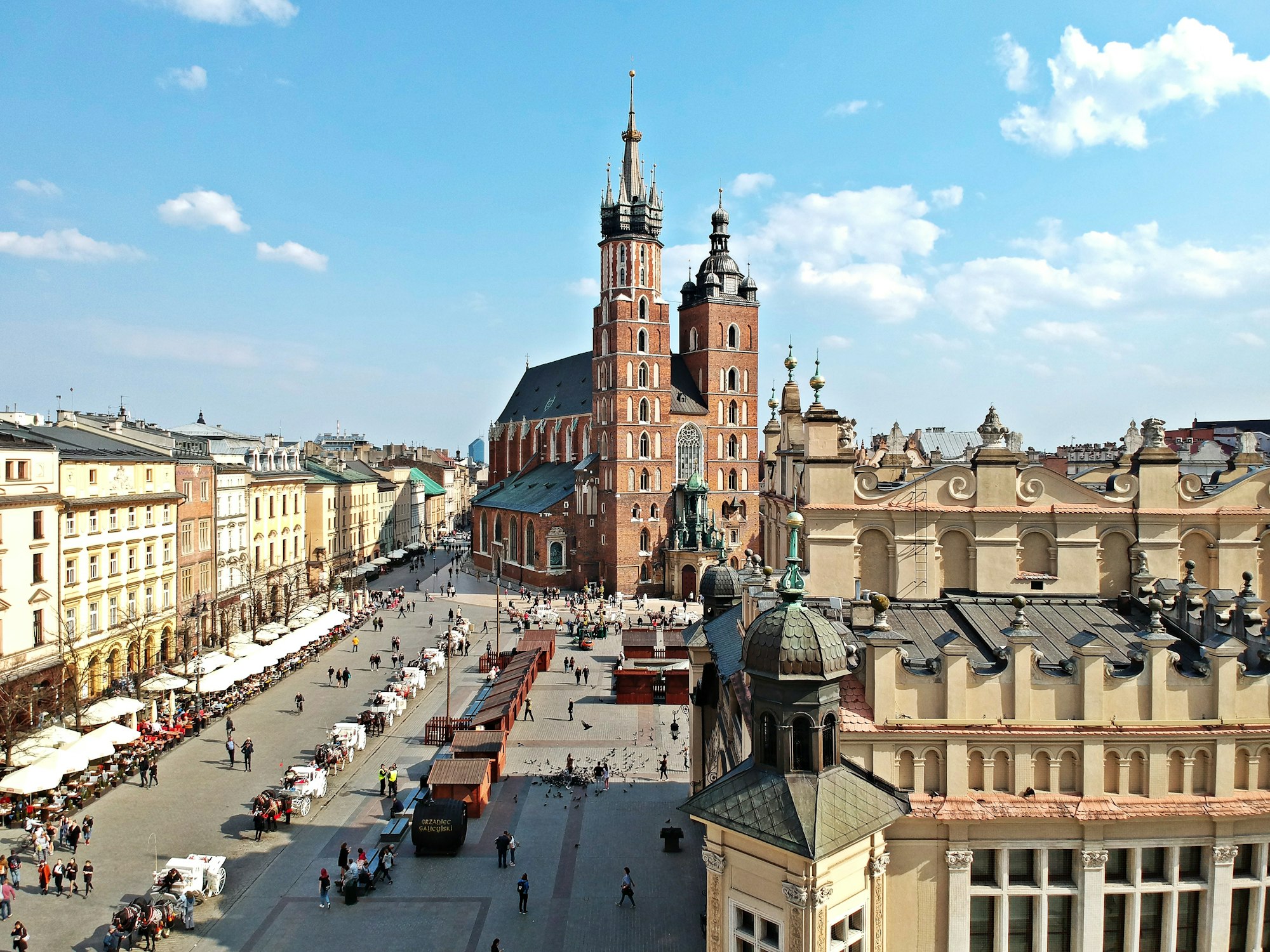
Cloth Hall
A covered trading hall in the centre of the square, given its Renaissance parapet of grinning masks after a fire in 1555. Textile merchants once dealt here; the stalls along the central passage now sell amber, carved boxes and sheepskin. Upstairs is a gallery of nineteenth century Polish painting, large canvases of national history, with a café terrace overlooking the basilica.
-
Collegium Maius
The oldest building of the Jagiellonian University, founded in 1364, arranged around a brick courtyard with a Gothic arcade. Copernicus studied here in the 1490s, and the museum keeps astronomical instruments of his time and a globe of about 1510 that is among the first to show America. At set hours a clock in the courtyard parades wooden figures of kings and professors.
-
Kazimierz
For five centuries the centre of Jewish life in the city, home to most of its sixty-five thousand Jews before 1939. Seven synagogues still stand, along with a Renaissance cemetery, and the district lay half abandoned until a film crew arrived in 1993. It is now the liveliest quarter for bars and restaurants. A June festival of Jewish culture fills the main street with music.
-
Kraków Barbican
A circular brick bastion with seven turrets, built in 1498 outside the main northern gate against an expected Ottoman attack and one of very few of its kind left in Europe. It was once joined to St Florian's Gate by a covered passage over the moat. Most of the city walls came down in the nineteenth century and became a ring of parkland, the Planty.
-
Main Square
Laid out in 1257 after the Mongols burned the town, and at two hundred metres a side the largest medieval market square in Europe. The Cloth Hall stands in the middle, with a lone town hall tower and a tiny Romanesque church marooned on the paving. Flower sellers, horse cabs and café terraces fill the rest. It is never empty, and finest late at night.
-
Oskar Schindler's Enamel Factory
The administrative building of the factory whose owner saved more than a thousand Jewish workers now houses a museum about Kraków under German occupation from 1939 to 1945. It is an immersive walk through reconstructed streets, a tram, a ghetto flat and a camp quarry. Schindler's own office is preserved. Tickets are timed and limited, and unsold ones are rare in summer.
-
Planty Park
When the medieval walls were demolished in the 1820s the moat was filled and planted, leaving a belt of chestnut and lime trees four kilometres around that completely encircles the old town. It is the natural way to walk between sights without crossing traffic. Low stone outlines mark where gates and towers stood. Benches fill with students from the university in term time.
-
Rynek Underground
Archaeologists digging under the market square between 2005 and 2010 found the medieval town four metres down: cobbled roads, burnt stalls, a cemetery, merchants' lead seals from across Europe. The excavation was roofed over and opened as a museum, with glass walkways above the remains and holograms to explain them. Entry is limited and timed. The entrance is inside the Cloth Hall.
-
St. Mary's Basilica
A brick Gothic church with two unequal towers on the corner of the square. Its carved limewood altarpiece, twelve years' work by the Nuremberg master Veit Stoss, is ceremonially opened each day shortly before noon. Every hour a trumpeter plays a call from the taller tower that breaks off mid-note, recalling a watchman shot through the throat by a Tatar arrow.
-
Wawel Castle
The royal residence on a limestone bluff above the Vistula, rebuilt in the early sixteenth century by Florentine architects around a three-tiered arcaded courtyard. A set of enormous Flemish tapestries woven for the last Jagiellonian king survived evacuation to Canada in the war. Each exhibition is ticketed separately with a daily quota, so buy early in the day. The hill itself is free to walk.
-
Wawel Cathedral
The coronation church of Polish monarchs and the burial place of most of them, along with national poets and heroes, in a crypt that serves as the country's pantheon. Chapels of every period crowd its flanks, one under a dome of real gold. A wooden stair climbs the tower to the Sigismund Bell, cast in 1520 and rung only on great occasions.
-
Wieliczka Salt Mine
Worked from the thirteenth century until 1996, this mine outside the city has chambers, lakes and chapels carved from grey rock salt by generations of miners. The largest chapel lies about a hundred metres down, with salt chandeliers and a salt relief of the Last Supper. Visits are guided only, begin with a descent of several hundred steps and cover three kilometres at fourteen degrees.