 Submit a photo
Ninety seconds on Cape Cross
About 120 km, straight up the coast on the C34. The reserve is signed from the road, and the entrance gate sits 3 km in from the turnoff. Reception lies a further 1 km beyond the gate, so the stretch off the main road runs to about 4 km in all.
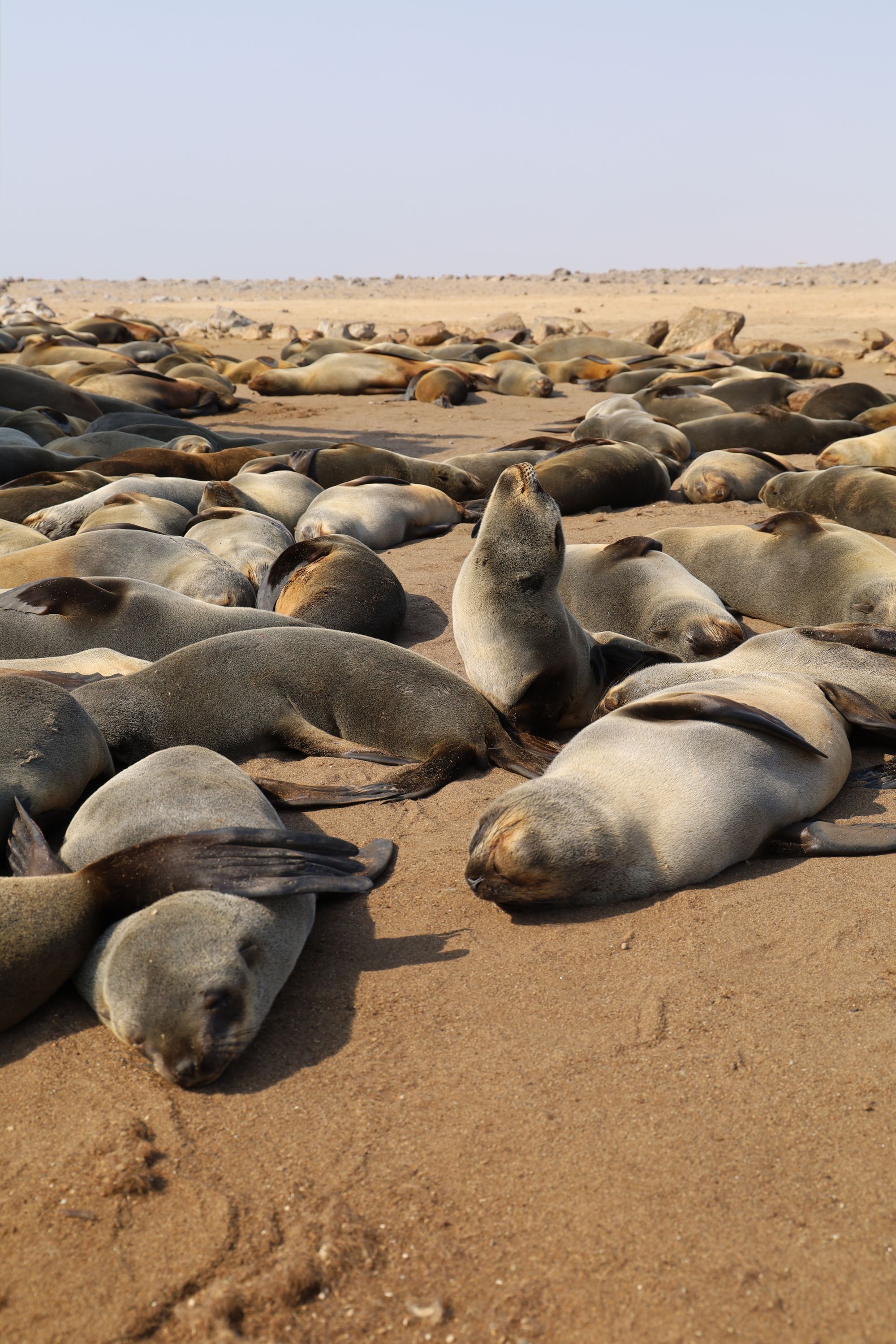
Up to 210,000, in November and December, the breeding season. Cape Cross is home to the world's largest colony of Cape fur seals. Of the 23 colonies of the species along the coasts of Namibia and South Africa, it is the biggest, and those two months are when it is at its fullest.
Yes, and it ranks among the most visited parks in Namibia. A walkway runs beside the seals and carries information signs the whole way, and the reserve has picnic areas and five campsites with fireplaces. Beyond the colony, a self-guided driving route with six points of interest is available inside the reserve.
No to all three. Angling is not allowed anywhere in the reserve, and pets and motorcycles cannot come in, though the gate has kennels where a pet can wait. The bird platforms in the southern part of the park are off limits to visitors as well.
Short and level, a 200 m boardwalk takes you within a few metres of wild Cape fur seals in the world's largest breeding colony of the species. No guide or vehicle stands between you and them, on an easy stop north of Henties Bay.
From the boardwalk you look over a carpet of brown bodies on the rocks and the sand, with up to 210,000 seals ashore in November and December. It is one of 23 Cape fur seal colonies spread along Namibia and South Africa's shores.
Look for the gap in size between the animals. A full-grown bull runs to about two and a half metres and 300 to 360 kg, while a pup is born at four and a half to a little over six kg.
Watch the edges of the colony as well as the middle, where black-backed jackals work the perimeter.
A replica padrão, a stone pillar topped with a cross, stands on a terraced platform within the reserve. The Portuguese navigator Diogo Cão planted the first one here when he came ashore in 1486, and the original came back to Namibia in 2019.
Buying your permit at reception, which you pass on the drive in, comes first, and cards as well as cash are accepted. From there you walk out along the raised walkway beside the colony, with information signs along the way. The smell of fish and ammonia is at its worst for the first two minutes, and after that most visitors stop noticing it.
Seals lie right against the walkway and wriggle underneath it, so never reach down to touch one. A seal that feels cornered bares its teeth, and the bulls turn aggressive in the pupping season. Leave any pup alone even when it looks lost, since a mother may reject a pup that carries a human scent.
In the birth months you will see dead pups on the sand, and no staff clear them away.
Wear clothes you can wash afterwards, because the smell gets into fabric, and leave the jacket you plan to wear at dinner behind. There is nowhere to buy a meal inside the reserve, so bring your own food, and carry water from Henties Bay because supplies are limited.
Come in November or December if the pups are what you want. The bulls arrive in force from late October and can be boisterous near the walkway, so keep your distance.
Before the drive, stop at the Swakopmund Museum, housed in the rebuilt Imperial Customs Building.
For a second day out of Swakopmund, pair it with the Welwitschia Drive, a self-drive route whose twelfth stop is the oldest welwitschia.
Swakopmund, and further afield
German colonial streets run down to a cold Atlantic here, and the town has served as Namibia's holiday coast since the railway reached it.…
Namibia's highest mountain is one great massif, with its summit, Königstein, at 2,573 metres. Its core has been a National Monument since…
Last updated