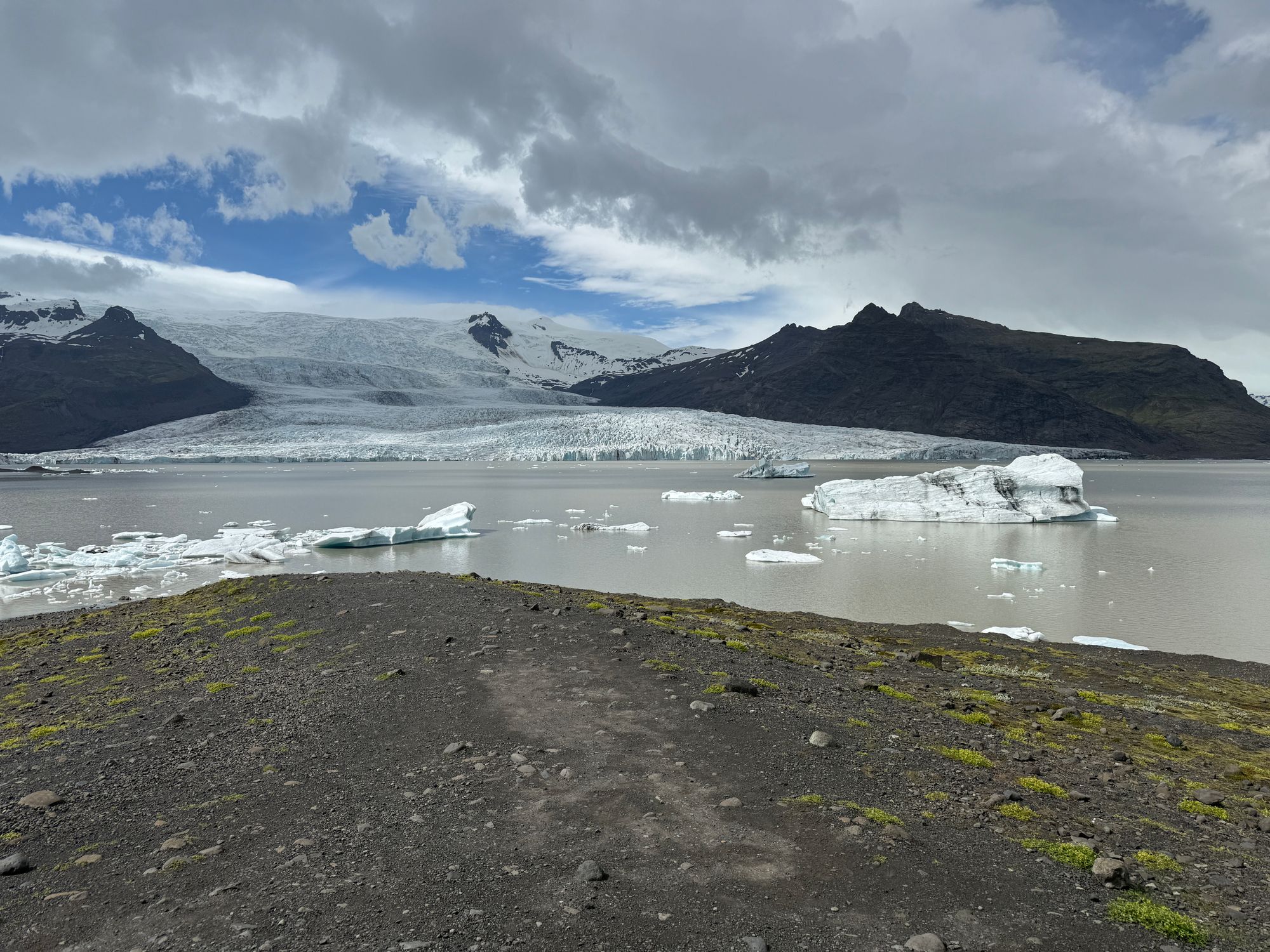
Ninety seconds on Fjallsárlón Glacier Lagoon
Come here for a closer look at a glacier than Jökulsárlón gives you: Fjallsjökull runs down almost to the shore, and on a still day you can stand at the water and hear the ice crack.
Fjallsjökull, an outlet glacier of Vatnajökull, comes down the far side of the lagoon and ends almost at the water. The lagoon is narrower than Jökulsárlón, so the ice front fills the view from the shore, with the peaks of Breiðamerkurfjall and Ærfjall standing over it.
Pieces break off that front all year, which is called calving, and it is why new icebergs drift in even on still days. Most are brilliant white or a deep blue, and now and then one rolls over in the water.
Look closely at the bergs for grey and black stripes running through the ice. They are layers of volcanic ash from past eruptions, trapped in the glacier as it grew.
The flat land around the lagoon, Breiðamerkursandur, is sand, grassland and wetland laid out in front of the ice. As Vatnajökull retreats it uncovers new ground and shifts the glacial rivers, so the shore you walk on is still changing, and birds nest across it in summer.
Most visits begin at the viewpoint above the car park, beside the park's information sign, where the whole lagoon and the glacier front are in sight at once. From there a marked gravel path drops gently to the shore in about ten minutes.
Where the path meets the water, turn right and follow the bank for a few hundred metres. The ice front is closer from there, and you can stay twenty minutes or a couple of hours watching the bergs drift.
To make a loop of it, carry on along the shore until it bends left, climb the small hill and walk back to the restaurant on the old main road. The park rates this 1.5 km circuit challenging.
For the boat, check in at the tour reception behind the FROST restaurant and walk on gravel to the dock. You are given a warm flotation suit, and the zodiac weaves between the icebergs towards the glacier wall while the guide explains how the lagoon formed.
The Breiðármörk trail also starts here and crosses 15 km of sand, rock and moraine to Jökulsárlón, about five hours one way.
The shore needs no guide and nothing booked. A guide matters only on the water, because the zodiac is the one way to get close to the glacier wall. Boats carry at most 12 and children must be at least five, so book ahead to secure your place.
The trip takes about 75 minutes in all. In rough weather the operator may put fewer people in each boat, which can move part of a group to a later departure.
On the boat, dress for the day under the flotation suit: a summer afternoon on the water can be warm, and by autumn it is cold. In winter, add microspikes to grippy boots for the gravel path.
Once the boats stop for winter, you can still walk the shoreline and see icebergs frozen in place. In December and January, bring a headlamp if you will arrive after half past three, because the light goes fast. Carry water if you set out on the Breiðármörk trail, because there is none along the way.
Explore the rest of Höfn
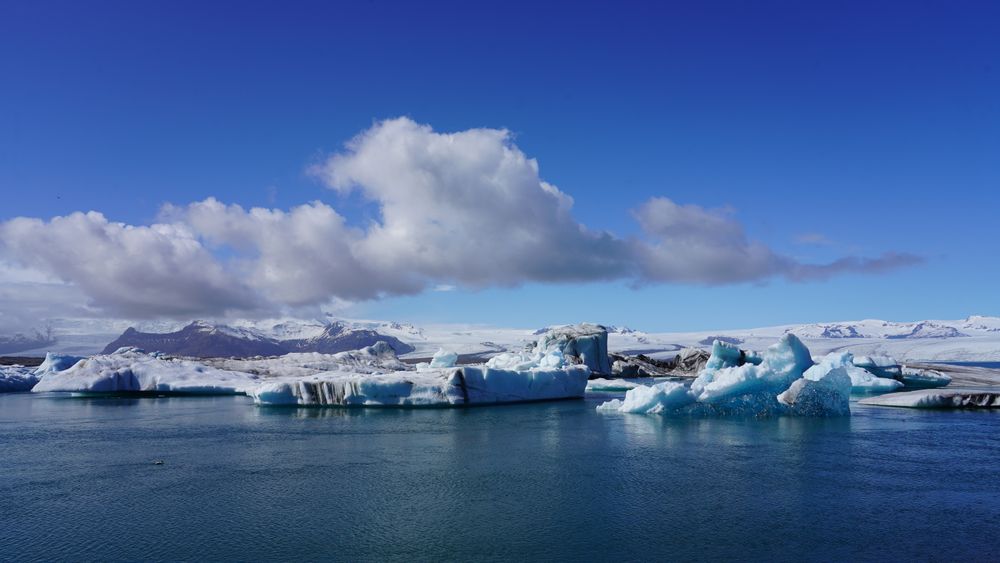
A glacier lagoon beside Route 1 in south-east Iceland, fed by Breiðamerkurjökull, an outlet glacier of Vatnajökull. Icebergs calved from…
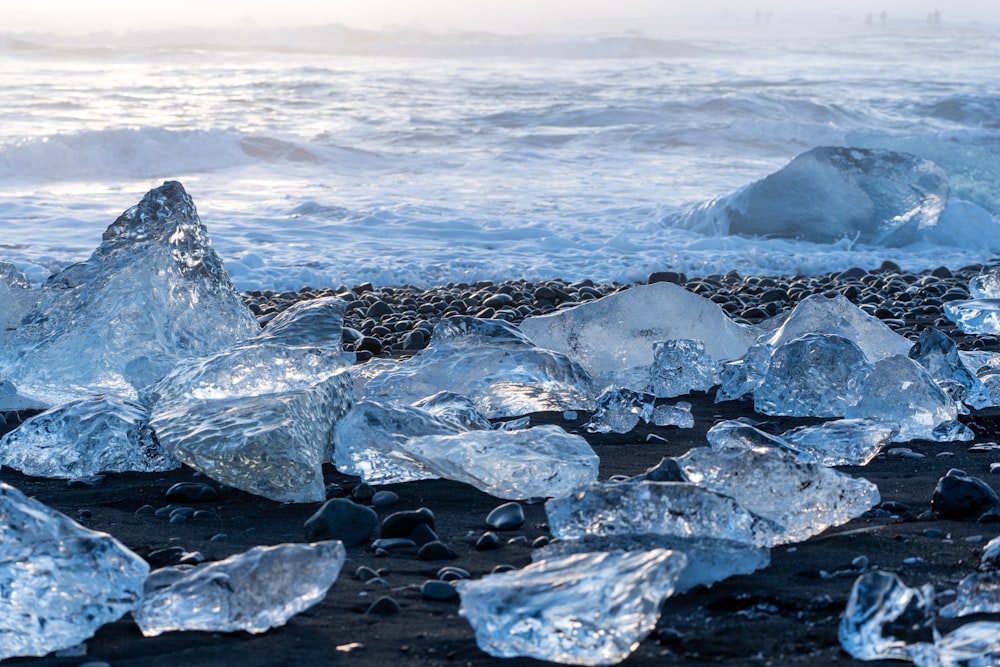
The black sand of Breiðamerkursandur at the mouth of the Jökulsárlón outlet, where icebergs carried out to sea are thrown back onto the…
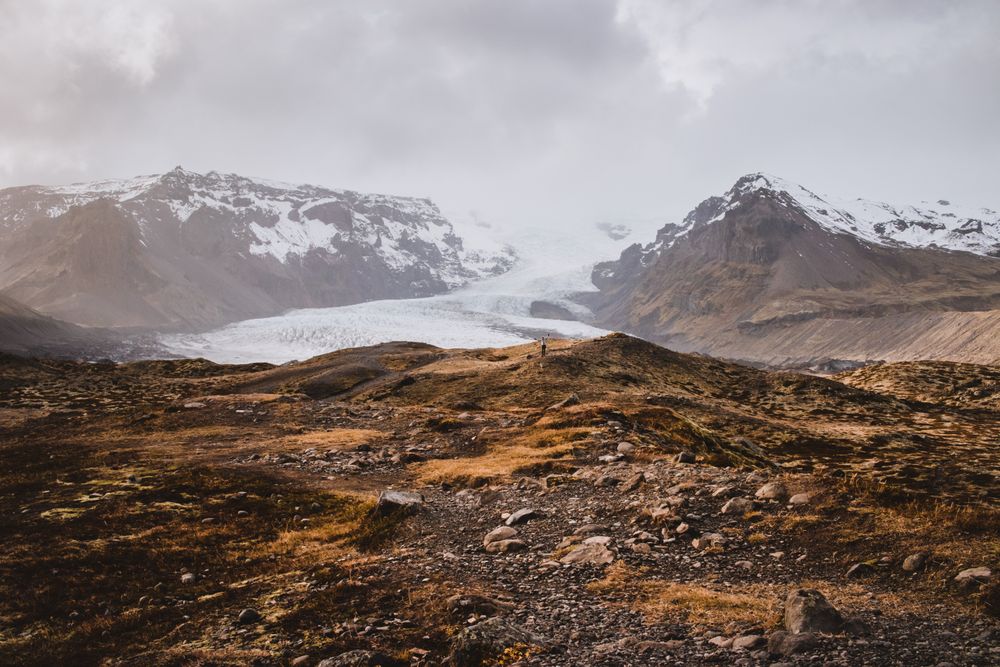
A guided walk on Falljökull, a steep outlet glacier of Vatnajökull above Skaftafell, among crevasses, ridges and blue ice. Tours leave from…