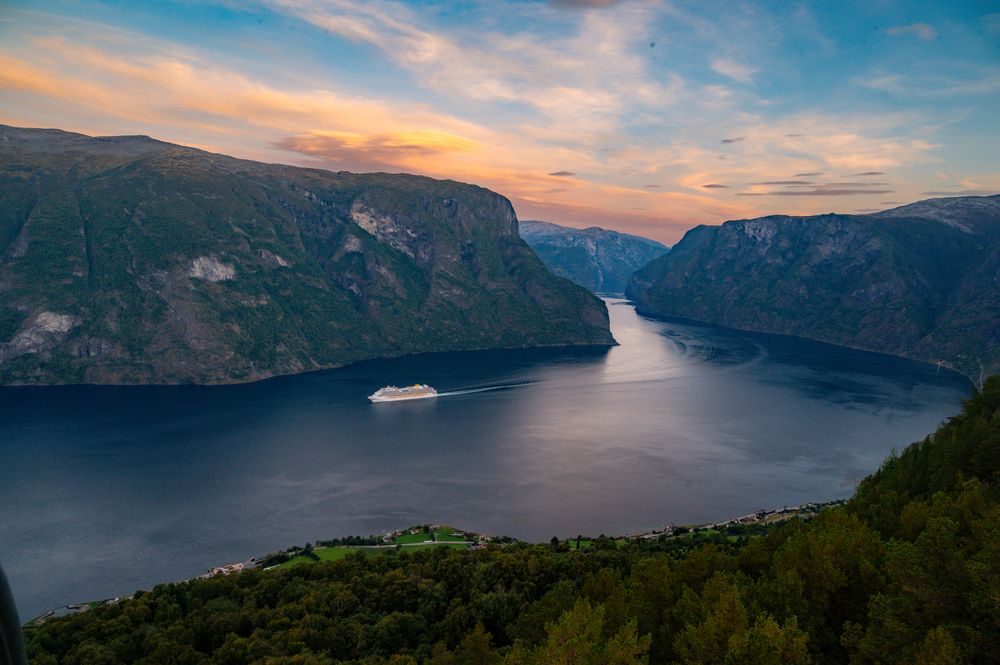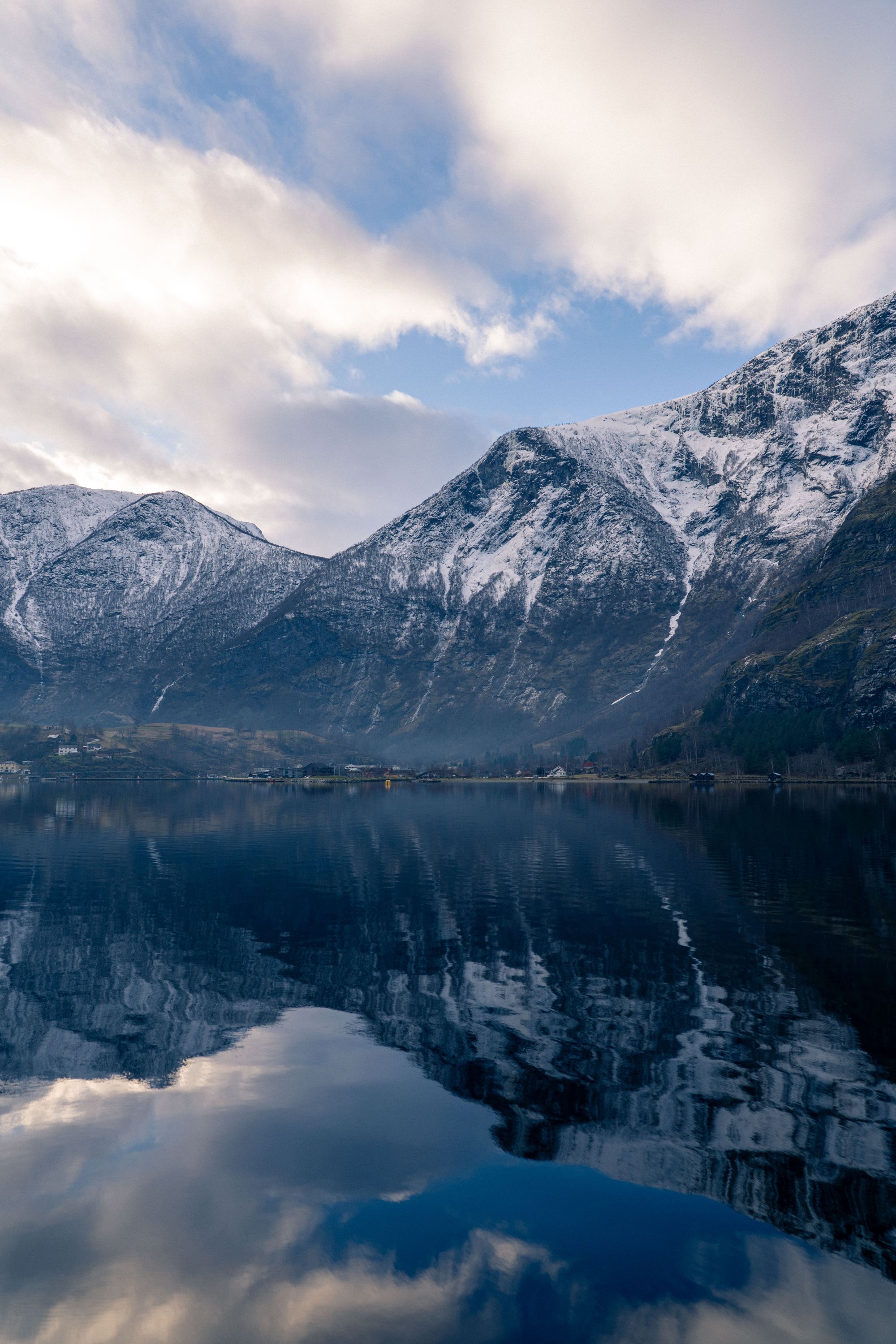
A seventeen kilometre arm of the Sognefjord that narrows to about 250 metres between walls rising well over a thousand, dark enough at the bottom that the sun reaches the water for only part of the day in winter. It was inscribed by UNESCO in 2005 alongside the Geirangerfjord. Boats run its full length between Gudvangen and Flåm, including electric vessels that make the crossing in near silence, and a handful of farms along the shore are still reachable only by water.
The narrow arm only gives itself up from the water; boats work out of both Gudvangen and Flåm, and the quiet electric sailings are worth choosing over the open-deck scrum.
The route turns inland toward the Sognefjord, the longest and deepest fjord in the country, and aims for its thinnest branch, the Nærøyfjord, which is the one to hold out for. It is barely two hundred and fifty metres wide where it pinches tightest, with walls going up a sheer kilometre on either side, and the electric boats run it slowly and almost silently from Gudvangen down to Flåm. Stand on the open deck whatever the sky is doing. On the ledges above sit farms that look unreachable, abandoned now, their hayfields gone to scrub; goats work the lower slopes; there is a waterfall at nearly every bend.

A white-clad stave church from around 1147 in the fjordside village of Undredal, roughly twelve metres by four and seating about forty,…
Twenty kilometres of track between Myrdal on the Bergen line and the fjord at Flåm, falling 866 metres on a gradient of one in eighteen for…
The arm of the Sognefjord that runs 29 kilometres inland to end at Flåm, deep enough in places to swallow a mountain and narrow enough that…
Every other travel app asks you to start logging. Meridian Dispatch opens with years of your travel already written, from the photographs you already took.