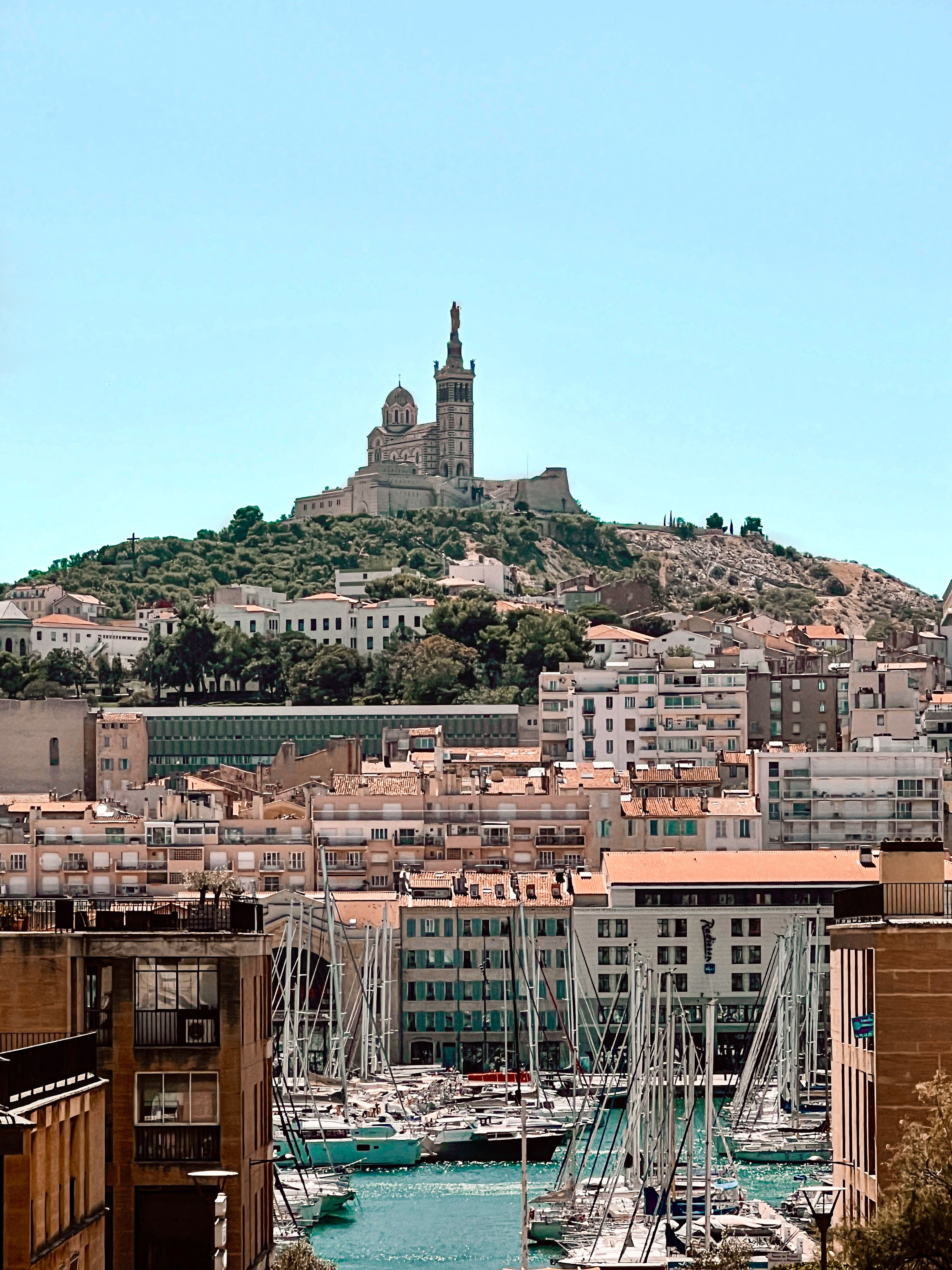
Things to do
13-
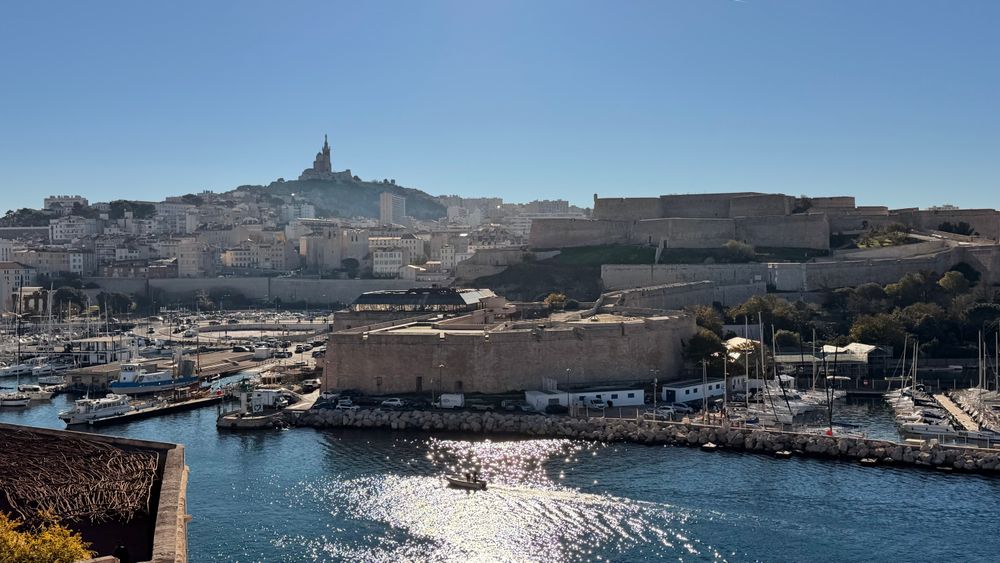
Abbaye Saint-Victor
Founded in the fifth century over a quarry used as a Christian burial ground, and rebuilt as something closer to a fort, with square towers and slit windows. The crypt below is the reason to come: rock-cut galleries, sarcophagi and the cave shrine that draws a candlelit procession every February for Candlemas.
-
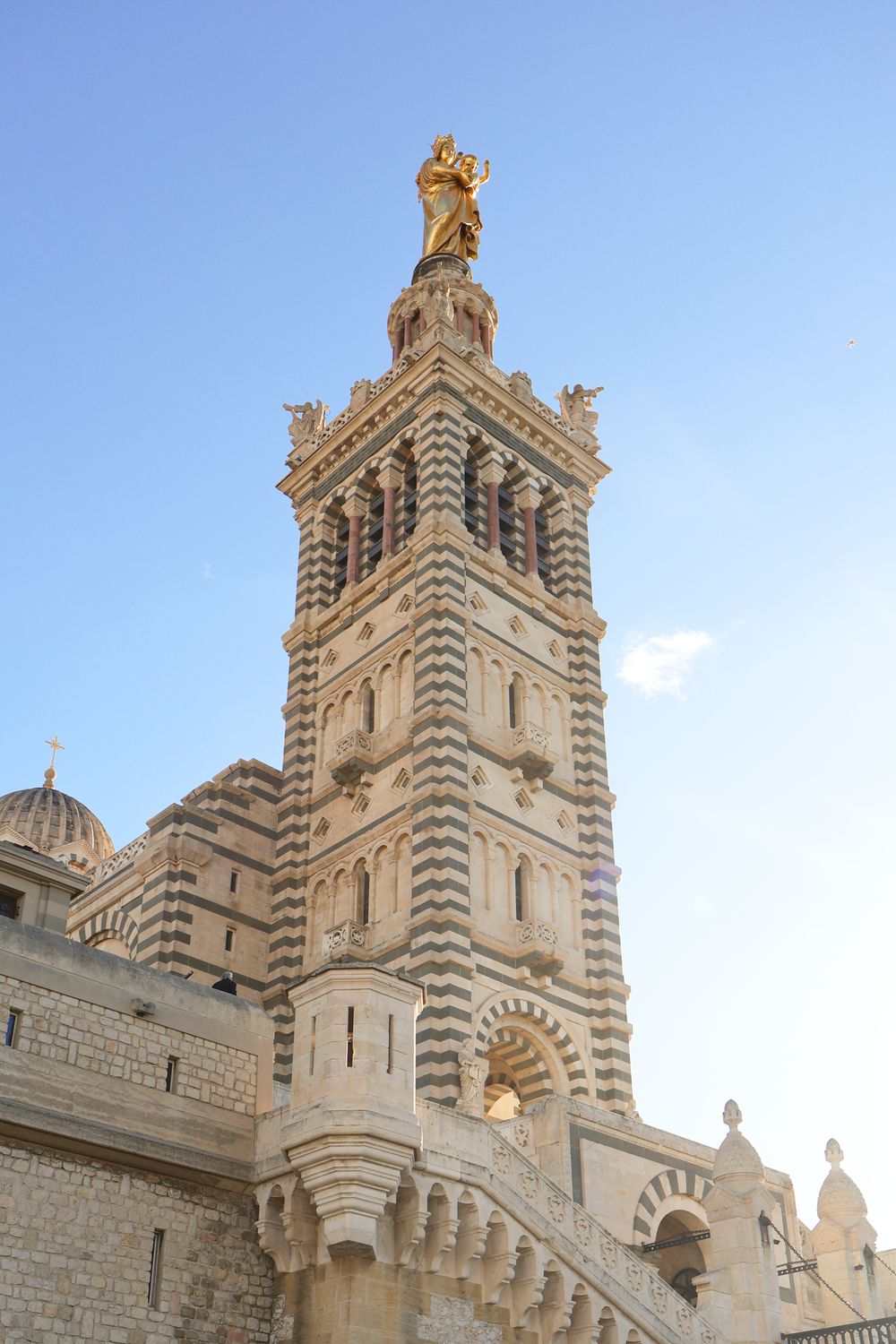
Basilique Notre-Dame-de-la-Garde
Striped stone on the highest limestone outcrop in the city, topped by a gilded Virgin the sailors call la Bonne Mère. Inside, the walls carry hundreds of votive offerings left by sailors and families who came through storms, crashes and illness, painted and modelled by hand. The terrace gives the whole coast, from the Frioul islands to the Calanques.
-
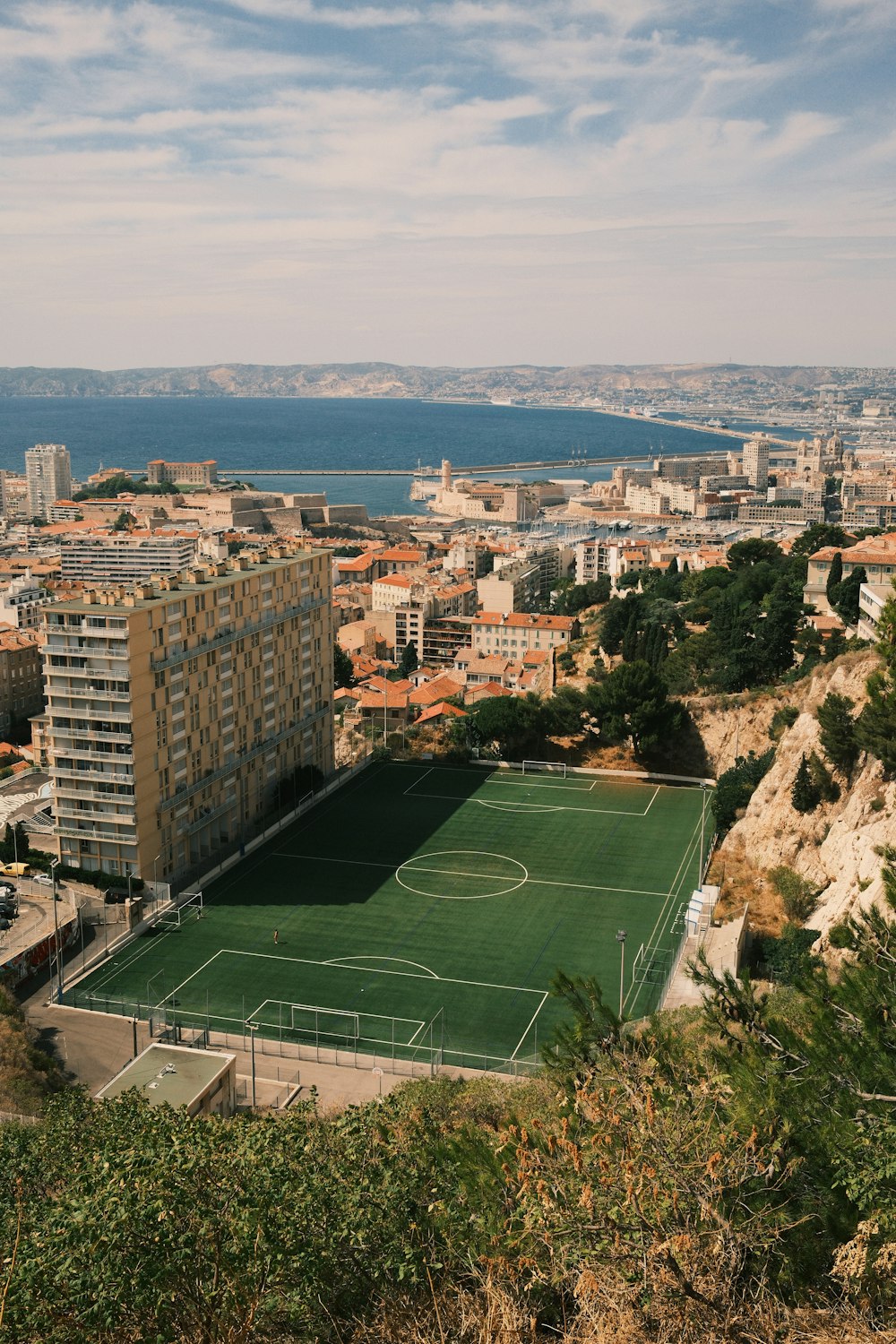
Cité radieuse
Le Corbusier finished this concrete block on legs in 1952 as a vertical village of flats, a shopping street inside and a roof of sculptural forms with a running track. Families still live in it. The third-floor hotel, the bookshop and the roof are open to visitors, and the roof is the part worth the trip.
-
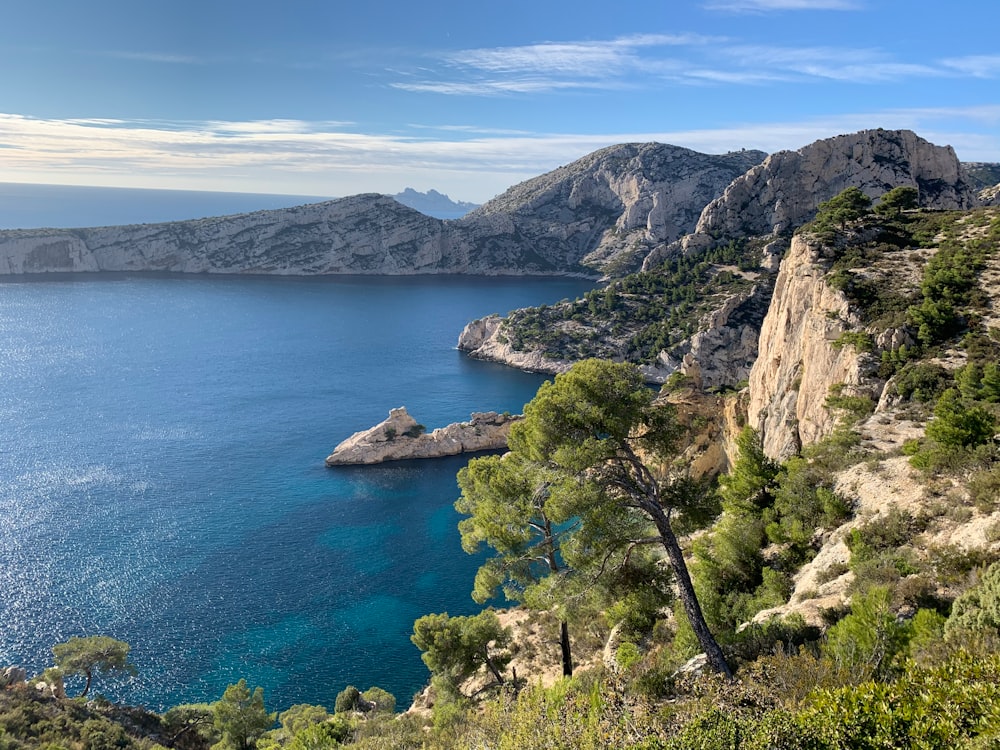
Parc national des Calanques
White limestone inlets running twenty kilometres east from the city, dropping to water that is turquoise because there is no sediment in it. Sormiou and Morgiou are reachable on foot in about an hour; En-Vau takes longer and is harder. Fire risk closes the massif on many summer days, and the ban is checked the night before.
-
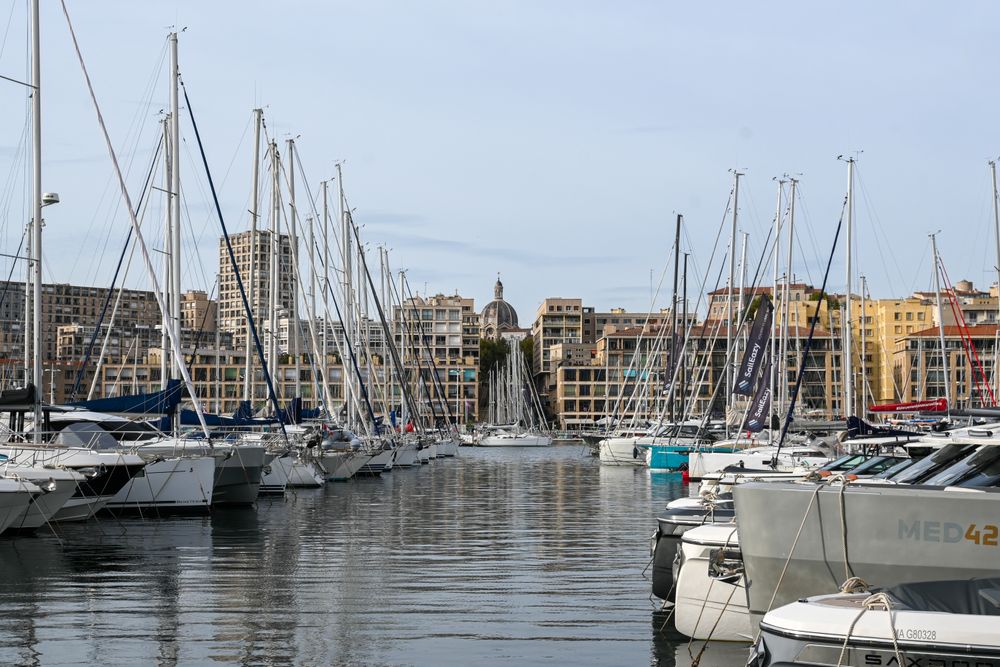
Vieux-Port de Marseille
Boats have tied up in this rectangle of water since the Greeks, and the fish are still sold off the quay each morning at the Quai des Belges, straight from the boat. Norman Foster's mirrored canopy shades the middle. Two forts guard the mouth and a ferry crosses the water for the price of a coin.
-
Cathédrale Notre-Dame-de-la-Major
Green and white banded stone in a Byzantine manner, raised under the Second Empire on a scale meant to answer the cathedrals of the north, and among the largest built in France since the Middle Ages. The small Romanesque church it replaced still stands beside it, half demolished, which makes the comparison unavoidable.
-
Château d'If
A fortress on a bare island two kilometres out in the bay, turned into a prison for Protestants and political detainees, and made famous by Dumas, whose invented Count escaped from a cell visitors are shown. Boats leave from the Vieux-Port and take about twenty minutes. Wind cancels crossings, so it is worth checking the day before.
-
Fort Saint-Jean
Louis XIV built this and its twin across the water with the guns pointing inward at a city that had rebelled, which he did not trouble to disguise. Gardens now cover the ramparts and two footbridges link it to the museum and to the cathedral quarter. Entry is free and it is the best walk in the port.
-
Îles du Frioul
Four bare white islands beyond the Château d'If, joined by a causeway, with a nineteenth-century quarantine hospital, a scatter of forts and small pebble coves reached by paths. There is almost no shade. The same ferry serves them and the prison island, so the two make one long half-day out of the port.
-
Le Panier
The oldest quarter, on the slope where the Greek town stood, and the one the occupying army dynamited in 1943 along the harbour edge. What survived is a knot of stepped lanes, painted shutters and ceramics workshops. The Vieille Charité, a seventeenth-century almshouse around an oval chapel, holds two museums at the top.
-
Musée des civilisations de l'Europe et de la Méditerranée
Rudy Ricciotti wrapped a black concrete lattice around a glass box at the harbour mouth and joined it to the old fort by a footbridge, which is the best approach. The collections take the Mediterranean as one civilisation rather than several. The roof terrace and the bridge are open without a ticket.
-
Palais Longchamp
A colonnade and a monumental cascade built in the 1860s to celebrate the canal that finally brought the Durance river to a city with no water of its own. Two museums sit in the wings, fine arts on one side and natural history on the other, with a park behind. The waterworks are the architecture.
-
Vallon des Auffes
A fishing cove of perhaps a hundred metres, hidden under a road bridge on the corniche, with wooden boats pulled up and cabins stacked around the water. Rope for the fishing fleet was made here, which is where the name comes from. Two long-established restaurants sit on the quay and both need booking.