 Submit a photo
Ninety seconds on Twyfelfontein Rock Engravings
Yes. The World Heritage Committee inscribed it in June 2007, at its meeting in Christchurch, New Zealand, under the name Twyfelfontein or /Ui-//aes. The listing covers the engravings in their natural red-rock gallery, cut into sandstone slabs around a desert spring, where the dry air has kept the lines sharp.
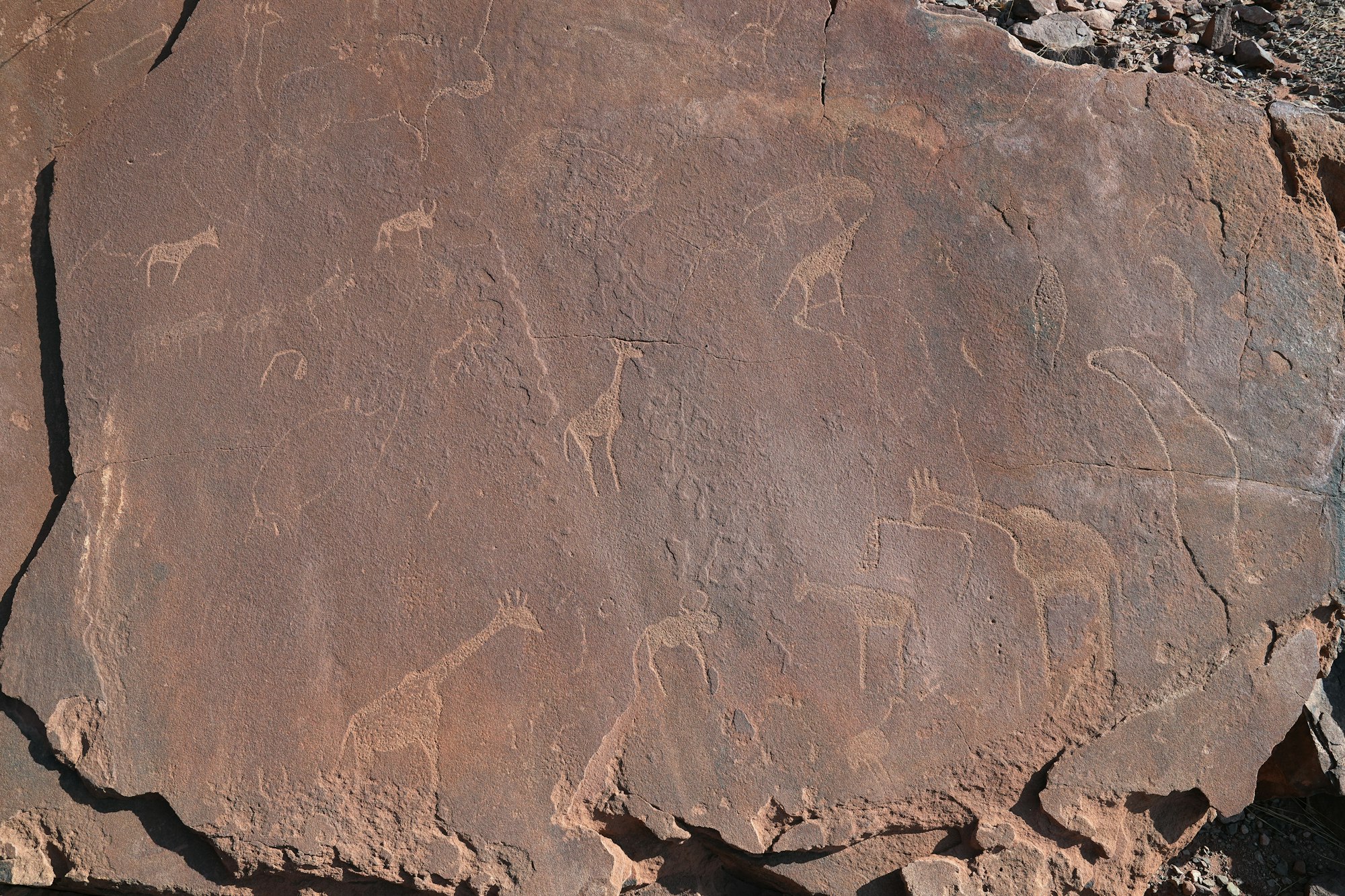
Almost all are engravings. More than 2,000 figures are cut into the sandstone, one of the largest concentrations of rock art in Africa. Paint appears only in a handful of places: six rock shelters on the site hold painted images, and some of them sit beside the engravings on the walking routes.
Twyfelfontein lies some 100 km southwest of Khorixas by road. The visitor centre was designed to blend into the red sandstone around it, and its displays cover the local plants and animals, how the engravings were made and what they are thought to mean. From there, stone pathways laid to limit erosion lead out to the viewing platforms.
Twyfelfontein puts more than 2,000 engravings of animals and their tracks on sandstone slabs above a desert spring, and a guide walks you to the Lion Man or the Dancing Kudu.
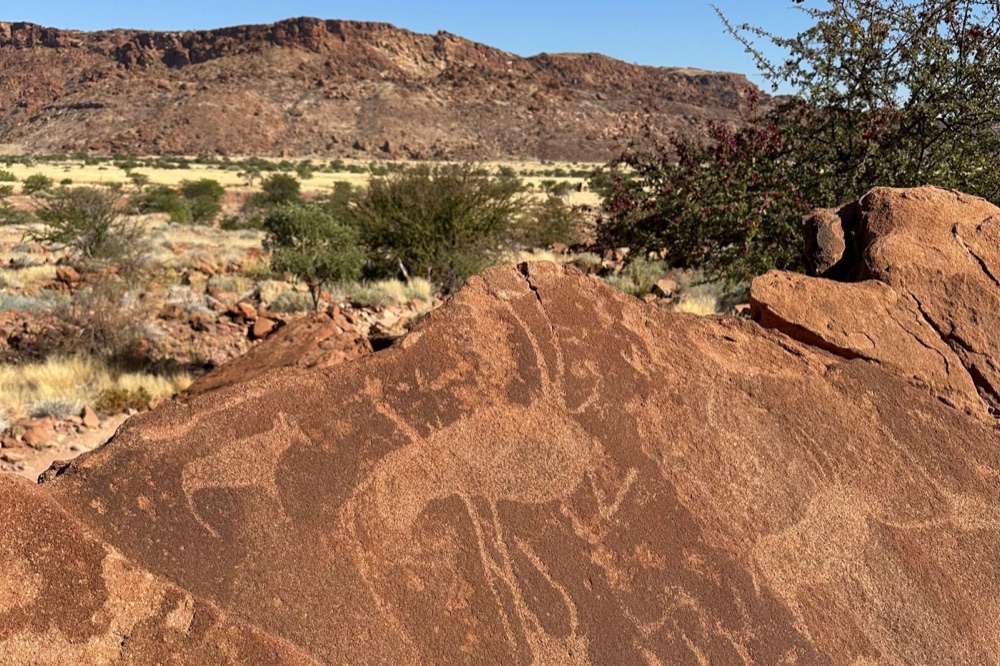
This valley holds the largest single concentration of rock engravings in southern Africa, cut into free-standing sandstone boulders around a spring. Every line was pecked with repeated small strikes through the dark skin of the rock, exposing the paler stone beneath. The dry air has kept that contrast sharp, so you can name most of the animals at a glance: giraffe, lion, zebra, kudu, elephant, ostrich and rhino.
Look closely at the giraffes, whose legs taper into long thin lines with no hooves. Then find the seals and flamingos, animals that live far from this valley. The artists were San hunter-gatherers, working here over thousands of years, and those two subjects show they knew places well beyond this spring.
On the Lion Man loop, the lion carries prey in its mouth, and its L-shaped tail ends in a paw print. Many experts read it as a shaman turning into a lion, and it is the most famous engraving on the site. The Dancing Kudu is a pregnant female, and a rocky overhang on the slope looks like a lion's mouth mid roar: ask your guide to point it out.
From the covered car park, a short walk brings you to reception, where you pay and meet your guide. There is no need to book: you join the next group out, and a few engravings sit beside the visitor centre. Each loop then walks up to the spring, past a ruined farmhouse, and climbs among large sandstone blocks to steel platforms in front of the main panels.
The Dancing Kudu loop takes about an hour, and the Lion Man loop about 80 minutes over rougher ground. Both stop at a shaded rest area with a toilet. On the way back from the Dancing Kudu, the path passes the Zwei Schneider site, where a few paintings sit among the engravings.
Afterwards, sit out the heat in the shade of the visitor centre, whose displays explain the making of the carvings and their possible meanings.
A guide is compulsory and the fee is part of your entry ticket, so a tip at the end is the only extra, and it is your choice. Your guide comes from the Uibasen-Twyfelfontein Conservancy, and you meet them at reception after you pay. The two guided loops, the Lion Man and the Dancing Kudu, cover different parts of the slope.
Carry at least 1.5 litres of water each, plus a hat and sunscreen, because nothing is sold beyond the visitor centre. Wear closed shoes with a good grip, since the paths cross bare rock that heats up fast in the warm months.
Bring Namibian dollars in cash, because the site does not take cards. Check your spare tyre before you leave, because the last stretch is gravel and help is far away.
Pair the morning with the Damara Living Museum, about 10 km north of the engravings on the D2612. A guide there shows the blacksmith's work and the plants gathered for food, perfume and medicine.
Explore the rest of Twyfelfontein
More than two thousand engravings are cut into the sandstone slabs of a valley here, and the site became Namibia's first World Heritage…
Namibia's highest mountain is one great massif, with its summit, Königstein, at 2,573 metres. Its core has been a National Monument since…
Halfway between Henties Bay and Khorixas, this old tin-mining settlement is the gateway to the Brandberg and the supply stop on the road…
A community-run open-air museum near the Twyfelfontein engravings, where Damara men and women show fire-making, blacksmithing, plant…
Last updated