Things to do
12-
Art Gallery of Ontario
Frank Gehry rebuilt the gallery he grew up beside, adding a long Douglas fir and glass arcade along Dundas Street and a spiral stair that climbs out through the roof. Holdings run from the Group of Seven and Inuit sculpture to European painting from a newspaper family's bequest. A hall of Henry Moore bronzes sits upstairs and is easily missed.
-
Casa Loma
Sir Henry Pellatt, who electrified Ontario and then lost his fortune, raised this Gothic Revival pile above the escarpment in the years before the First World War and held it for under a decade before unpaid taxes took it. Panelled halls, an unfinished swimming pool, towers with city views, and a tunnel under the road to the stables. Gardens open for the warm months.
-
CN Tower
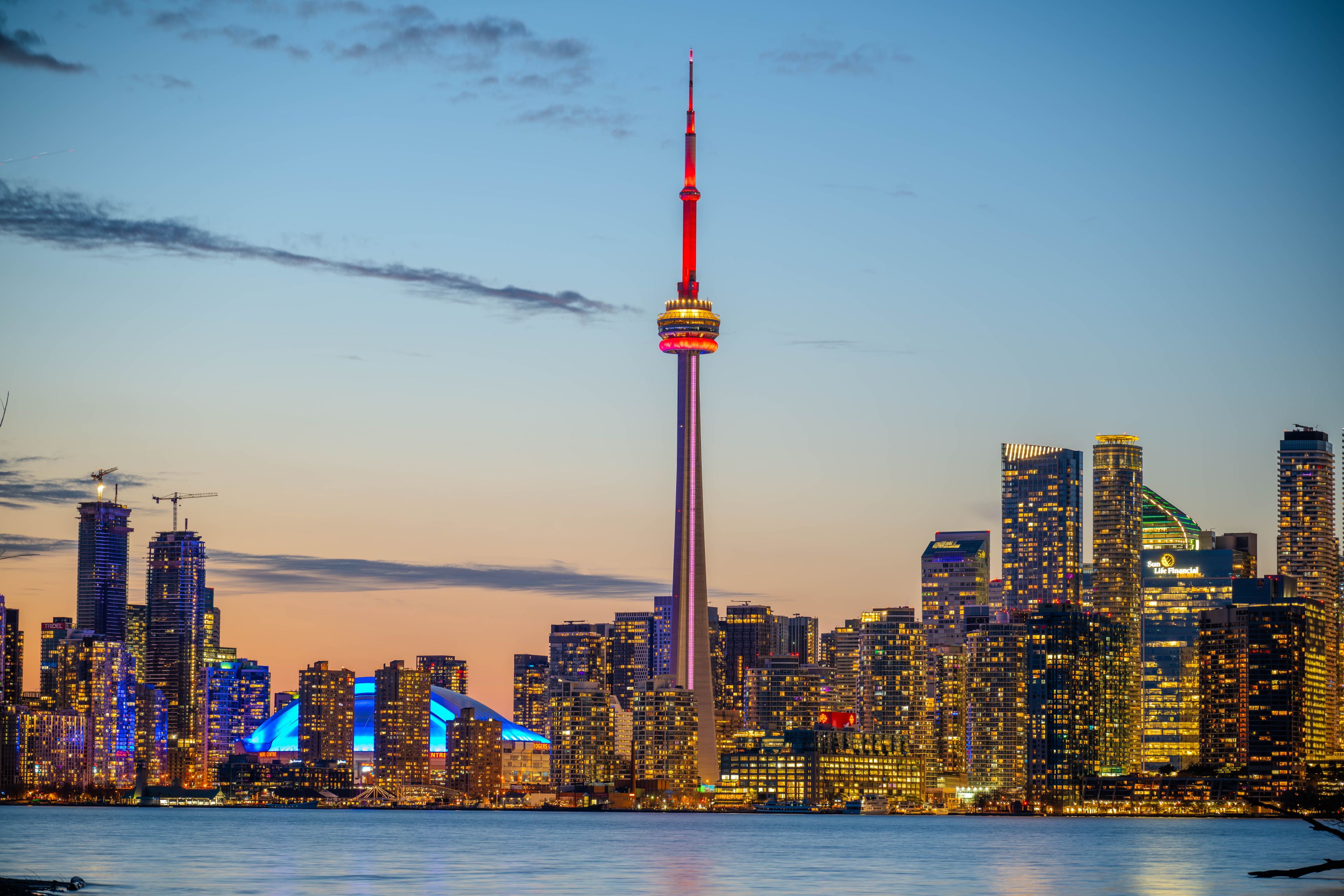
Concrete, 553 metres tall, and raised in the mid nineteen seventies because the new office towers were blocking television signals across the lake. Two observation levels look out over Lake Ontario and the city grid, one of them with a glass floor that visitors edge onto. The lift takes under a minute. Timed entry applies and sunset slots go first.
-
Distillery District
Red brick and cobbled lanes, the works of Gooderham and Worts, once the largest distillery in Canada and now a pedestrian quarter of galleries, studios, cafes and a theatre. Cobbles are punishing in smooth soles. A Christmas market takes over the lanes from late November and weekend entry is ticketed; by day, most of the year, it is quiet.
-
High Park
Some one hundred and sixty hectares of ravine, black oak savannah and pond in the west end, left to the city by a surveyor in the eighteen seventies. Japanese cherries on the slope above Grenadier Pond flower for about a week in spring, when the road through the park closes to traffic. Otherwise a neighbourhood park with allotments and a small free zoo.
-
Hockey Hall of Fame
Down at Yonge and Front, a Victorian bank hall under a stained-glass dome holds the Stanley Cup, which visitors may touch and photograph, every winning name engraved on its bands. Below it: goaltending and shooting simulators, a replica dressing room, masks and sweaters from the earliest professional teams. The queue for a photograph with the cup builds through the afternoon.
-
Kensington Market
A grid of Victorian houses west of Spadina whose ground floors became shopfronts: fishmongers, cheese counters, taquerias, vintage racks and produce spilling onto the pavement. Successive arrivals, Jewish, Portuguese, Caribbean, East Asian and Latin American, each left a layer. Cars are barred on one Sunday a month through the warmer half of the year, which is the afternoon to walk it.
-
Nathan Phillips Square
Viljo Revell's city hall of 1965, two curved towers cradling a saucer council chamber, faces a concrete square with a raised walkway, a reflecting pool and the illuminated TORONTO letters that arrived with the Pan American Games. The pool freezes into a skating rink for the winter, with skates for hire at the pavilion. Markets, concerts and protests take it by turns.
-
Ripley's Aquarium of Canada
Beside the foot of the CN Tower, galleries built around a moving walkway that carries visitors through a tunnel of sand tiger sharks, sawfish and rays. Jellyfish tanks, a kelp column and a touch pool of rays fill the rest, and staff talks run through the day. Weekend afternoons are shoulder to shoulder; the last hours before closing are calmer.
-
Royal Ontario Museum
Natural history and world cultures under one roof at Bloor and Avenue Road: dinosaur skeletons, Chinese temple sculpture, Egyptian galleries, Canadian painting. Daniel Libeskind's crystalline aluminium and glass addition of 2007 cuts into the original galleries of 1914, and the junction between old and new is disorienting on a first visit. Half a day is a fair allowance.
-
St. Lawrence Market
Butchers, cheesemongers, fishmongers and produce stalls fill a brick hall at Front and Jarvis that has fed the city since the eighteen forties. The peameal bacon sandwich at the upstairs bakery counter is the thing to order, and the queue for it moves quickly. Farmers take the north building on Saturday mornings. The south hall closes on Mondays.
-
Toronto Islands
A storm in 1858 cut this sandbar loose from the mainland, leaving a car-free archipelago fifteen minutes out by ferry from the foot of Bay Street. Boardwalks, beaches, a small amusement park and a lane of cottages at the eastern end. The skyline photographs best from the Ward's Island side. Summer ferry queues run long, so buy a crossing in advance.