 Submit a photo
Ninety seconds on Ginkaku-ji
Ginkaku-ji's garden gives you raked white sand and a damp hillside of mosses in one short loop, two very different gardens on a single walk.
The Silver Pavilion is the temple's Kannon Hall. Its ground floor is built as a residence and its upper floor as a Zen hall, two different styles in one building. Despite the name, no silver was ever applied to it.
Ashikaga Yoshimasa, the eighth Muromachi shogun, built it for his Higashiyama villa, modelled on the Golden Pavilion at Kinkaku-ji. After his death in 1490 the villa became a Zen temple, and the pavilion and the nearby Togudo hall are the only two buildings left from his time.
In front of the main hall lies the Ginshadan, the Sea of Silver Sand, with a carefully formed cone of sand said to stand for Mount Fuji.
Behind the buildings the path climbs into shaded woodland where the ground is carpeted in moss. The air under the trees is damp and still, a sharp change from the open sand below.
Set your expectations by the garden, not the building. The pavilion is less ostentatious than the Golden Pavilion at Kinkaku-ji, and the Shakyamuni Buddha enshrined in the Hondo, the main hall, is a recent statue.
The central gate at the top of the approach lane is where you pay. The path is a single loop, so the order below is the order you walk it.
It passes the sand gardens in front of the main hall, then circles the pond below the Silver Pavilion. The pavilion's interior is closed, so you see it only from the path.
Next the path climbs the hillside behind the buildings, past the ruins of the Sosentei and the Ochanoi tea well, to a viewpoint over the garden. The planting grows less manicured as you climb, and some viewpoints on this stretch are not wheelchair accessible.
Winding back down, the loop passes through the moss garden and comes out on the far side of the Silver Pavilion.
Pair the temple with the Philosopher's Path, the canal walk of about two kilometres that begins by the gate and runs south to Eikan-do Zenrin-ji. Walking it after your visit takes you on towards the southern temples without retracing your steps.
The garden is busy most of the day, and on the narrow hillside stretch the loop moves at walking pace in single file.
Explore the rest of Kyoto
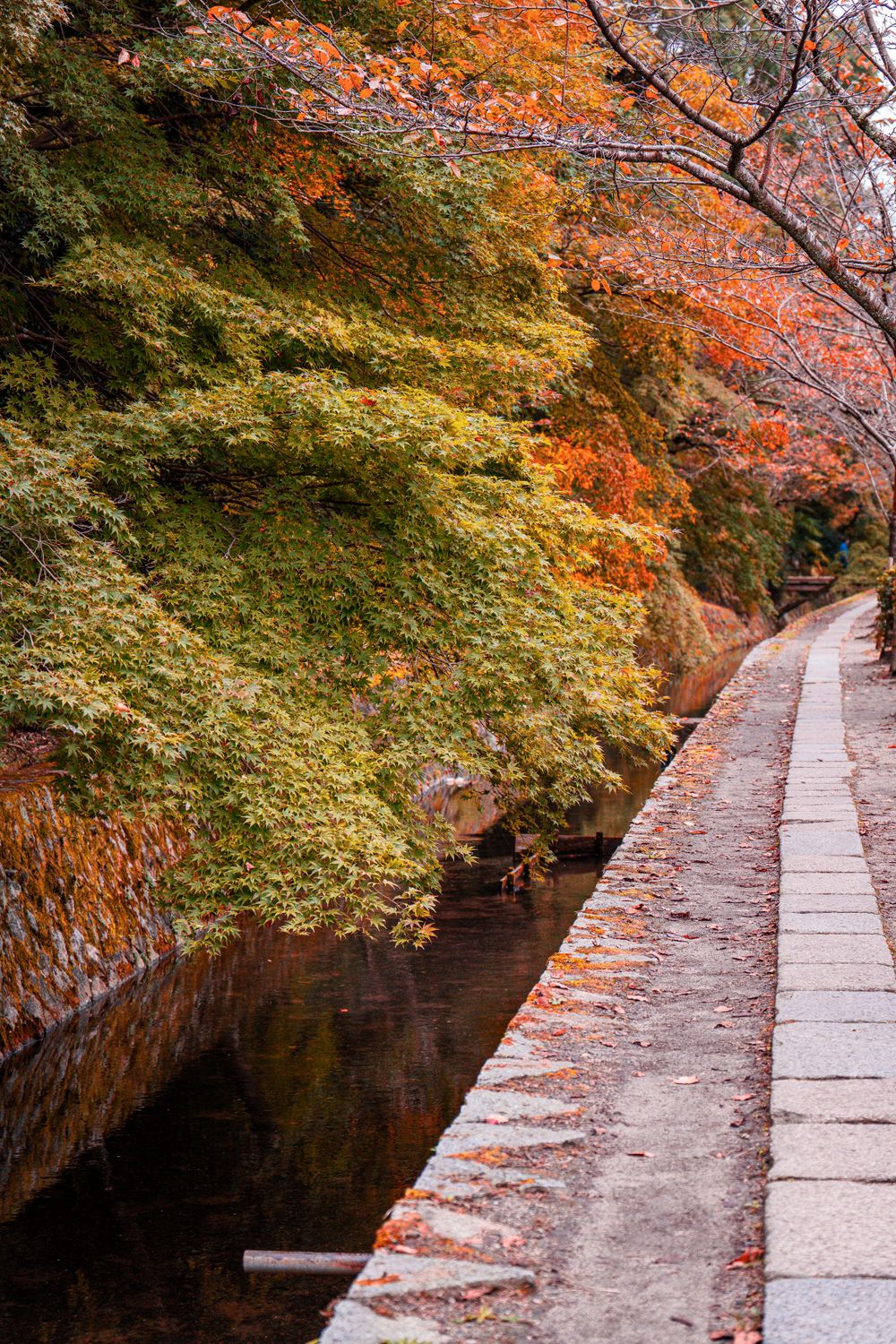
Stone paving follows a narrow canal for about two kilometres at the foot of the eastern hills, from Ginkaku-ji at the north end towards the…
An art museum in Kyoto's Okazaki park district, opened in 1933 in the imperial crown style and renewed for 2020 by the architects Aoki Jun…
A national museum of twentieth-century art on the Lake Biwa Canal in Kyoto's Okazaki district, in a building by Maki Fumihiko. Its…
Last updated