 Submit a photo
Ninety seconds on Tōfuku-ji
Tōfukuji Station is the stop for the temple, served by both the JR Nara Line and the Keihan Main Line. From Kyoto Station the JR Nara Line runs there directly. The temple is roughly ten minutes on foot from the station.
Only in part. Gaun-kyo can be crossed at no charge, while Tsūtenkyō with the Kaisandō hall, and the Hōjō gardens, each require a paid ticket. The bridge ticket costs more during the autumn season, and the Hōjō ticket stays the same all year.
Colour usually peaks between mid-November and early December, and in some years the best of it lasts into December. Those weeks are the busiest of the year at the temple, while the other three seasons see moderate numbers.
Not by stopping on the bridge in autumn. During that season, halting on Tsūtenkyō to take pictures is prohibited so the walkway does not jam. Photography at Gaun-kyo may also be limited when crowds build there.
Usually not, as the gate is normally closed to the public. It can still be seen from the ground. It is the oldest sanmon of any Zen temple in Japan listed as a National Treasure, and one of the largest.
Walk a covered wooden bridge a hundred metres long, high above a valley filled with maples in late autumn, then look back at it from a deck behind four Zen gardens.
Tsūtenkyō is a covered wooden corridor built over a ravine, and the ravine is planted thick with maples. From the bridge the trees fill the valley on both sides, so in autumn you look down onto a canopy of coloured leaves.
Tōfuku-ji is one of Kyoto's major Zen temples, with 25 sub-temples in its grounds. Its Hōjō is ringed by four dry gardens, each facing a different direction, laid out in 1939 by the garden designer Mirei Shigemori.
In the south garden, the white sand in front stands for the sea, in a scene drawn from Chinese mythology. The east garden traces the Big Dipper with seven stone columns, and the north garden is a checkerboard of square moss patches and stones.
Start on Gaun-kyo, then buy the Tsūtenkyō ticket. Crossing Tsūtenkyō takes you from the main temple area to Jōrakuan, the northern part of the complex.
Afterwards, go to the Hōjō, which has a ticket of its own. Walk round the building to see all four gardens, then sit on the terrace behind them, which looks back across the valley to the bridge.
On a busy autumn day the Hōjō is the quieter ticket. If the bridge is packed when you arrive, see the gardens first and go back for Tsūtenkyō afterwards. If there is time, add Kennin-ji.
Explore the rest of Kyoto
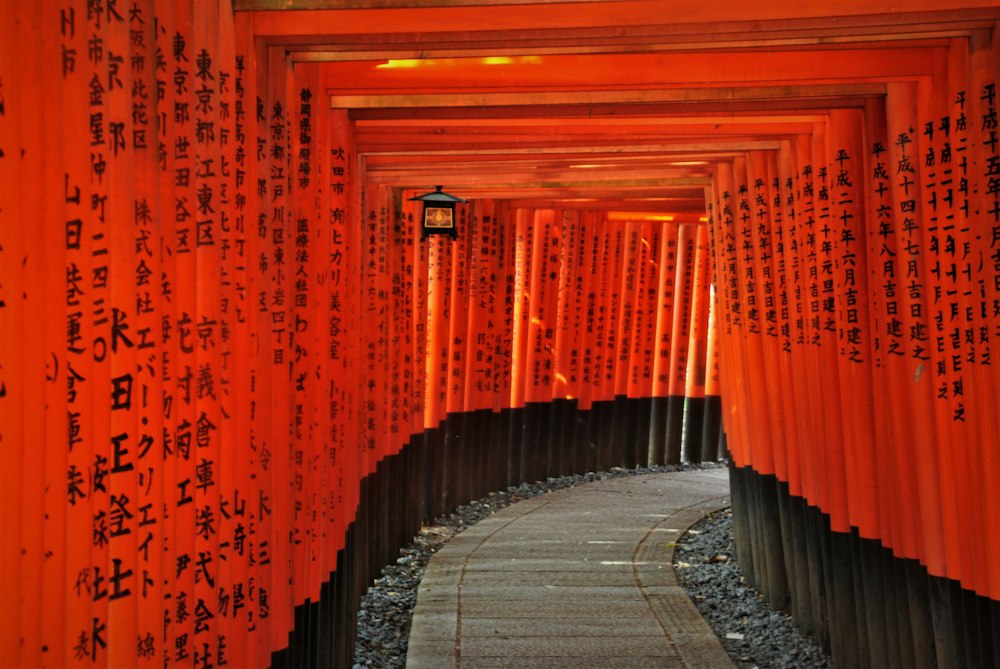
Thousands of vermilion torii, the gateways of a Shinto shrine, run in tunnels up the wooded slopes of Mount Inari behind the main hall,…
Opened in 1897 with a Meiji-era brick hall by Katayama Tokuma and a 2014 Heisei Chishinkan wing by Taniguchi Yoshio. Holds National…
A wooden stage on a nail-free frame of pillars, high above a hillside of cherry and maple. Below it, the Otowa waterfall splits into three…
Last updated