Things to do
8-
Kilkenny Castle
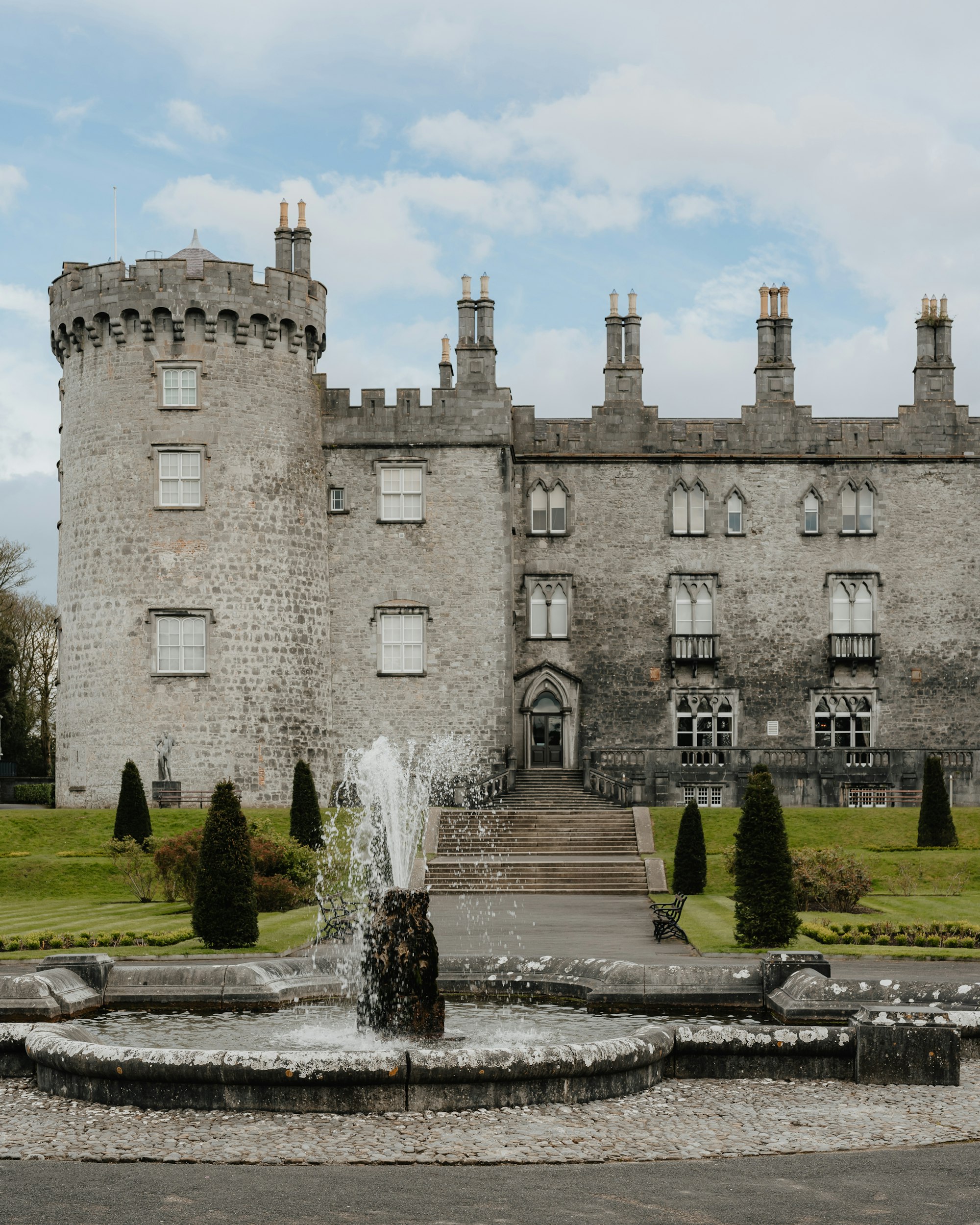
The Butler stronghold above the Nore, held by one family from 1391 until they sold it to the city for a nominal sum in 1967, with a Victorian picture gallery under a hammerbeam roof. The parkland behind it is free and open, and the restored rooms are a timed ticket.
-
Black Abbey
A Dominican priory of 1225 named for the friars' black cappa, suppressed under Henry VIII, used as a courthouse, and restored to worship in 1816. The Rosary Window of 1892 is the largest stained glass window in the country, and the nave is still a parish church.
-
Dunmore Cave
A limestone cave north of the town where the Annals record a Viking massacre in 928, and where the bones of women and children were later found in the chambers along with a hoard of silver and Arab coins. Access is down steep steps and the temperature holds near nine degrees.
-
Jerpoint Abbey
A Cistercian abbey of about 1180 near Thomastown, roofless but nearly complete, whose cloister arcade carries carved knights, bishops and a set of stone figures with folded arms unmatched anywhere in Ireland. It is eighteen kilometres south and has an OPW guide on site.
-
Medieval Mile Museum
The deconsecrated Saint Mary's church on the High Street, opened as a museum in 2017 around the Rothe chantry chapel and a collection of carved tomb slabs moved in out of the weather. It is the clearest explanation of how the town was built.
-
Mount Juliet Estate
A Georgian house of 1757 in seven hundred hectares on the Nore near Thomastown, with a Jack Nicklaus course, a walled garden and rooms in the old stableyard as well as the main house. It is the county's country-house option and twenty minutes from the town.
-
Rothe House
A merchant's house of 1594 built as three ranges around two cobbled courtyards, the only complete Tudor townhouse left in Ireland, with a walled garden reconstructed behind it. It holds the county archive and the genealogy service, and the garden is the quiet part of the High Street.
-
Saint Canice's Cathedral
A thirteenth-century cathedral with the finest collection of medieval funerary monuments in Ireland and a round tower beside it that predates the church. The tower can be climbed by ladder for a hundred and twenty-one steps, one of only three medieval round towers in Ireland that can still be climbed.