Things to do
8-
Al-Attarine Madrasa
Beside the spice and perfume market that gives it a name, this small Marinid madrasa packs stucco, cedar and tilework around a courtyard barely wide enough to step back in. Upper floor cells open onto a view over the rooftops toward Al-Qarawiyyin. Crowds are lighter here than at Bou Inania, and visits take under half an hour.
-
Al-Qarawiyyin
Founded in 859 by Fatima al-Fihri, this mosque and teaching institution has run continuously ever since, and its library holds manuscripts returned to view in a restoration completed in 2016. Non-Muslim visitors cannot enter the prayer hall, though doorways along the surrounding lanes give glimpses of the courtyard. The complex is woven into the medina and easy to walk past.
-
Bab Bou Jeloud
Three horseshoe arches in blue tile mark the western entrance to the old city, built under the French protectorate in 1913 and faced in green on the inner side. The gate opens onto Talaa Kebira and Talaa Seghira, the two spines of the medina. Cafes on either side are useful for a first bearing before the lanes close in.
-
Bou Inania Madrasa
Marinid builders finished this madrasa in the fourteenth century and gave it a minaret, unusual for a religious school, along with carved cedar, marble and zellige around a bright courtyard. Non-Muslim visitors are admitted, which is rare among the working mosques of the medina. A ruined water clock stands on the lane opposite, above the shops.
-
Chouara Tannery
Stone vats of dye and lime fill a courtyard where hides have been worked by hand since medieval times, viewed from the terraces of the leather shops that surround it. The smell is strong and shopkeepers hand out mint at the door. Terrace access comes with a sales pitch, and morning light reaches the vats before the glare.
-
Fes el-Bali
Donkeys and handcarts still carry goods through the walled medina, a ninth century tangle of lanes too narrow for vehicles and listed by Unesco. Workshops for brass, weaving and leather sit among food stalls and tiled fountains. Signage is minimal and lanes double back, so a guide for the first morning saves hours of circling.
-
Marinid Tombs
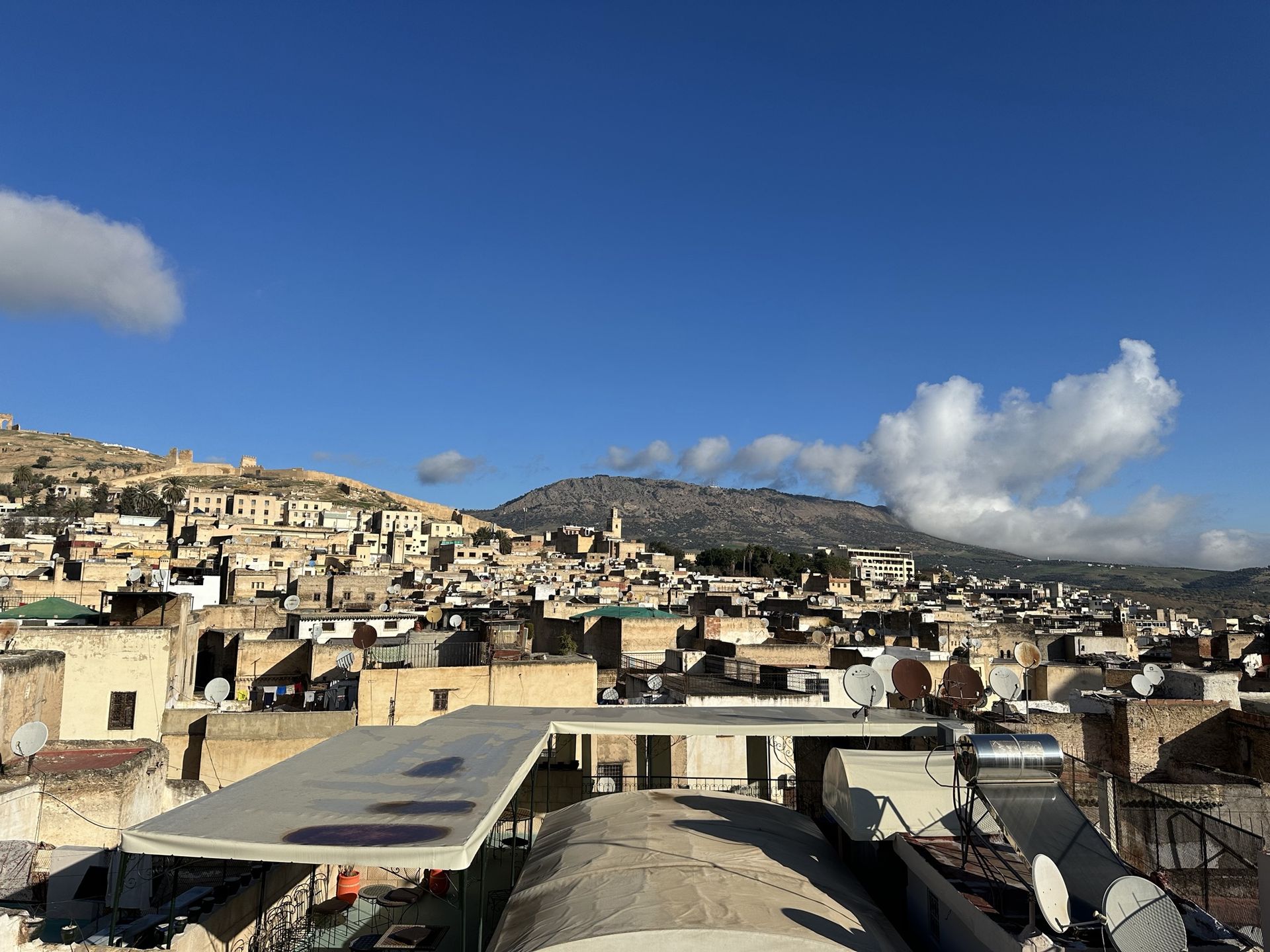
Ruined mausolea on the hillside north of the walls give the wide view over the medina, with tanneries and minarets laid out below and the call to prayer carrying up at dusk. Little of the fourteenth century stonework survives. Taxis climb to the parking area, and the slope is exposed, with no shade or water.
-
Royal Palace
Seven brass doors framed in zellige and carved cedar face a square in Fes el-Jdid, and they are as much of the royal residence as visitors ever see. The grounds stay closed. The Mellah, the old Jewish quarter, and its hillside cemetery lie a few minutes away, which makes the square a short stop on a longer walk.