Things to do
6-
Great Meteoron
The oldest, highest and largest of the monasteries, founded in the mid fourteenth century by a monk from Mount Athos who named the rock. Around three hundred steps lead down and then up to the gate. Inside are a frescoed church, the old kitchen with its blackened dome, a carpenter's shop, wine barrels of remarkable size and a shelf of the skulls of former monks.
-
Holy Trinity Monastery
The most dramatically placed of the six, alone on a slender column separated from the road by a ravine. Visitors walk down into the gap and climb some 140 steps cut into the rock face. A Bond film used it as a villain's lair in 1981. It is small inside, and because of the climb it is also the least crowded. The view over Kalabaka is complete.
-
Meteora
The rock forest itself: dozens of smooth grey towers of sandstone and conglomerate, the remains of a river delta lifted and carved by erosion. Hermits took to the caves a thousand years ago and monks followed them to the summits. A road loops past all six working monasteries, and old footpaths climb through the woods from Kastraki village. The viewing rocks along the road fill at sunset.
-
Monastery of St. Stephen
The one Meteora monastery reached without any steps: a short bridge crosses from the car park straight to the gate, which makes it the choice for anyone who cannot manage the stairs elsewhere. It has been a convent since 1961. Wartime shelling and the civil war damaged the old church. The terrace looks straight down on the roofs of Kalabaka and across the plain.
-
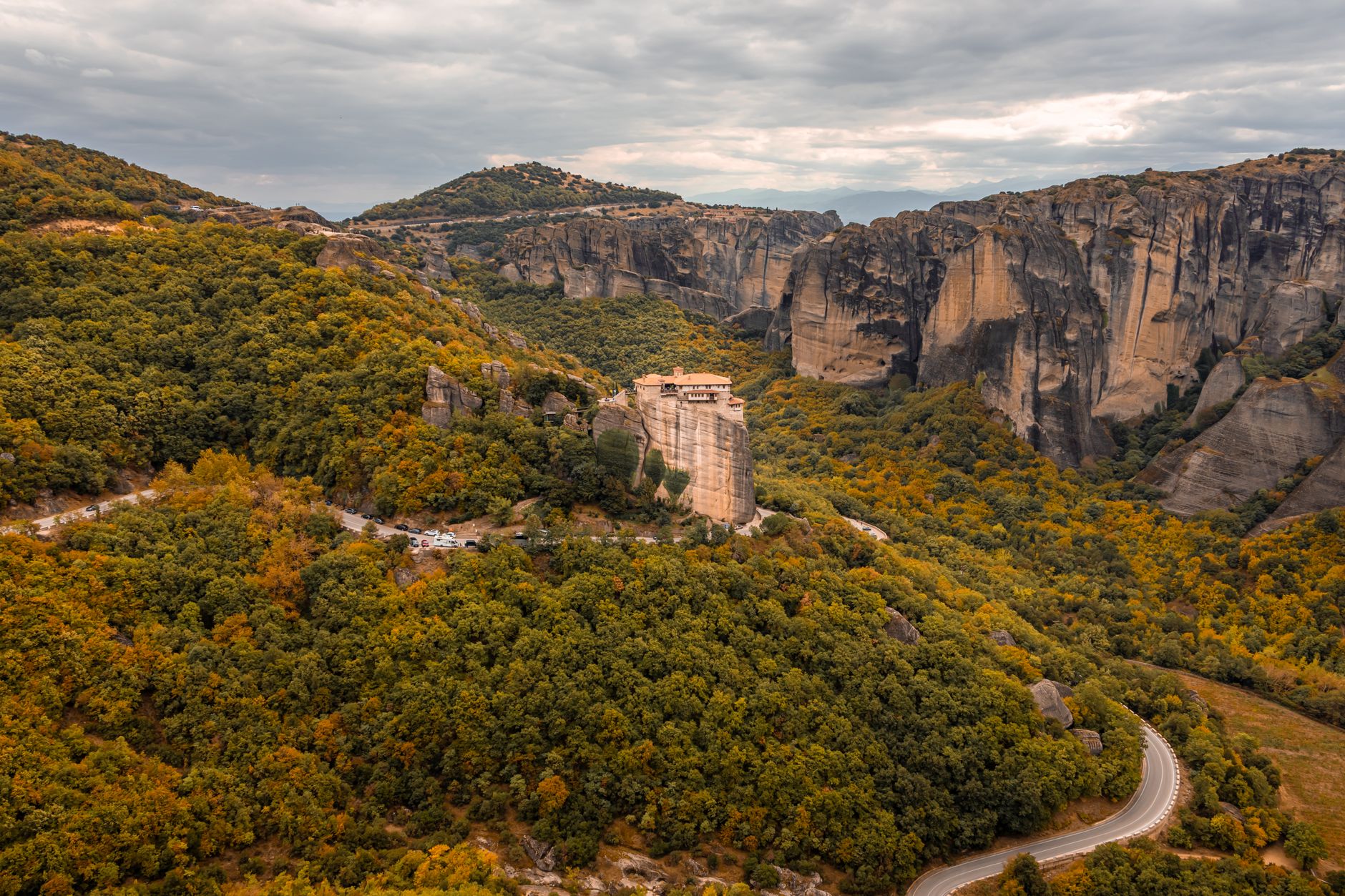
Roussanou Monastery
A convent that covers the whole top of a low pillar in the middle of the valley, so that its walls seem to continue the rock. Two small bridges replaced the rope ladders in the last century. The nuns keep a garden and sell honey at the door. Frescoes in the church, from 1560, include martyrdoms painted in vivid detail.
-
Varlaam Monastery
Built in 1517 on the pillar next to Great Meteoron, after twenty-two years spent hauling materials to the top. The rope net and wooden windlass once used to lift monks and supplies survive in the tower, and the windlass was in service until the 1960s. The church frescoes are by a noted Theban painter. A bridge and a stair make this one of the easier climbs.