Things to do
11-
Belmond Casa de Sierra Nevada
Several colonial houses a few streets from the Parroquia were joined to make this hotel, which is now run by Belmond. Rooms are spread across the houses and open onto stone courtyards with fountains and climbing plants. The main entrance is on Calle Hospicio, within walking distance of the Jardín Principal.
-
Cañada de la Virgen
The main pyramid here, the House of the Thirteen Heavens, rises over a sunken courtyard on a ridge above the Laja river, raised by Otomí builders more than a thousand years ago and aligned to the moon. Entry is by guided tour only, and since the site reopened in May 2026 it has opened on only some days. Confirm the days with INAH before going.
-
Centro Cultural Ignacio Ramírez El Nigromante
Known locally as Bellas Artes, this cultural centre fills the cloister of a former convent, a double arcade wrapped around a garden of tall trees and a stone fountain. In a long room off the cloister, David Alfaro Siqueiros left an unfinished mural on the life of Ignacio Allende. Classes in painting, music and dance run in the rooms around the patio.
-
El Charco del Ingenio
Sixty odd hectares of botanical garden and nature reserve on the canyon rim above the town, given over to the cacti and succulents of the Mexican highlands, with a reservoir, a dam and a conservatory built as a greenhouse of columns. Trails run along the canyon edge and down to the water. Walk up from the centre in about half an hour; shade is scarce.
-
Fábrica La Aurora
A textile mill that spun cotton from the early twentieth century until the nineties now holds studios, galleries and design shops under its sawtooth roof, with the old machinery left standing between them. Painters and furniture makers work with the doors open. A short walk or a cheap taxi north of the centre; the café in the yard is where the morning goes. Most studios close on Sundays.
-
Instituto Allende
Founded as an art school in the nineteen fifties inside a former hacienda and convent complex, the institute drew American veterans studying on the GI Bill, which is how the town became an expatriate colony. Courses in painting, printmaking and Spanish still run, and the arcaded courtyard, a chapel and a small gallery are open to walk through. The garden terraces look across the rooftops to the parish church.
-
Museo Histórico Casa de Allende
Ignacio Allende, the cavalry officer who helped start the independence war in 1810, was born in this corner house on the Jardín Principal, and the town later took his surname. Upstairs, rooms are furnished as a wealthy colonial home; downstairs, displays run from the valley's first settlers to the insurgency. The museum is run by INAH, entry is ticketed, and it closes on Mondays.
-
Parroquia de San Miguel Arcángel
Pink stone spires rise over the Jardín Principal in a Gothic idiom unusual in Mexico, drawn in the late nineteenth century by Zeferino Gutiérrez, a local mason said to have worked from engravings of European cathedrals. The church behind the front is older and much plainer. Floodlights come on after dusk, when the benches in the square below fill and the bells carry.
-
Rosewood San Miguel de Allende
Built in a hacienda style around terraced gardens and courtyards, this hotel opened in 2011 on Calle Nemesio Diez, a short walk south of the historic centre and close to the Instituto Allende. Its rooftop terrace looks north across the town to the spires of the Parroquia. Most rooms have fireplaces for the cold nights of the dry season.
-
Sanctuary of Atotonilco
Every surface of the nave and side chapels is painted, floor to vault, in an eighteenth-century folk Baroque that earned the church its place on the World Heritage list alongside the town. Pilgrims still come for retreats, and the village around it sells little else. A taxi or the local bus covers the fifteen kilometres from San Miguel in about twenty minutes. Silence is expected inside, and the light is best mid-morning.
-
Templo de San Francisco
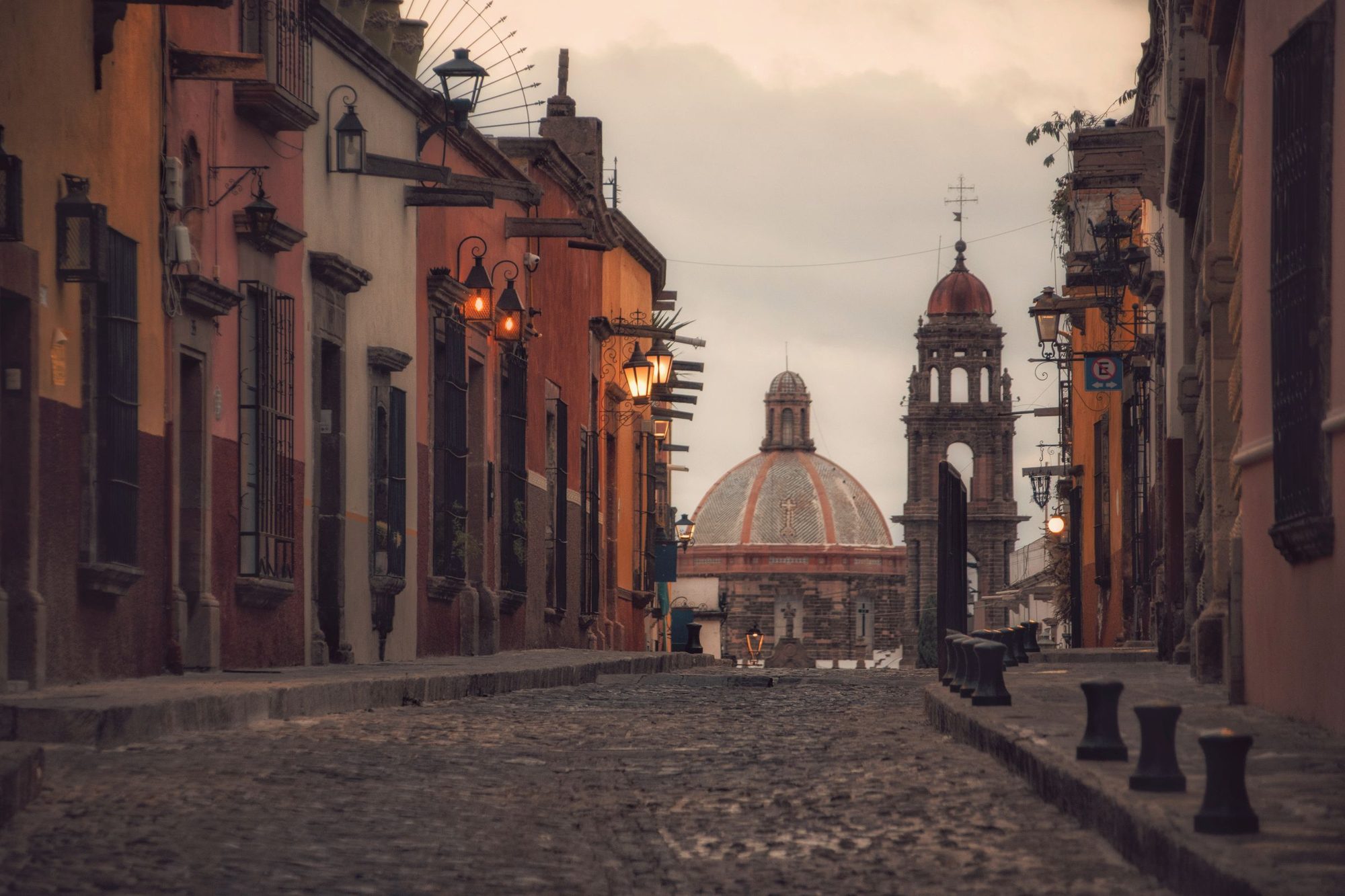
Churrigueresque carving crowds the front of this Franciscan church two blocks northeast of the Jardín Principal. Its tower, added decades after the facade, is plain and neoclassical, and is attributed to the architect Francisco Eduardo Tresguerras. The small square in front, Jardín de San Francisco, has shaded benches and a view of both styles at once. Visits pause during mass, when the doors stay open for worshippers only.