Things to do
11-
Langjökull
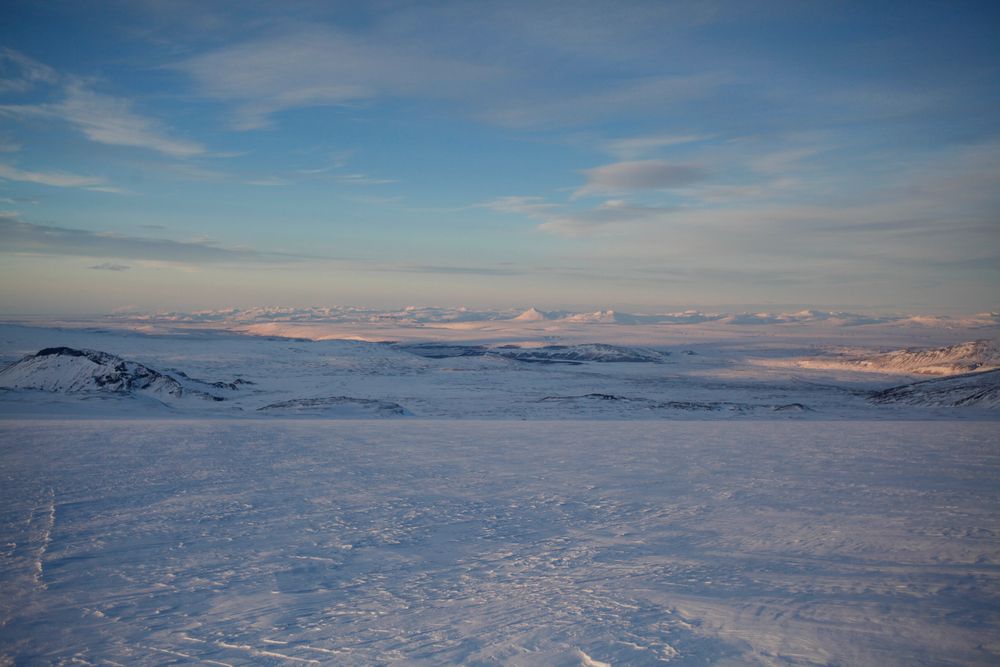
The second largest ice cap in Iceland after Vatnajökull, covering about 870 square kilometres with ice up to 580 metres thick. The volcano beneath it produced the lava field that Hraunfossar runs out of. A tunnel cut into the ice near the western edge is reached by modified vehicles from Húsafell, year round, and closed in high wind.
-
Barnafoss
A narrow, violent chute on the Hvítá immediately upstream of Hraunfossar, where the whole river forces itself through a cleft in the lava. A footbridge crosses at the neck of it. The name means children's falls, from a local story of two children lost from a natural stone arch that once spanned the gorge.
-
Deildartunguhver
Europe's highest-flow hot spring, pushing about 180 litres a second out of the ground at close to boiling. Its water is piped to Borgarnes and on to Akranes to heat both towns. Struthiopteris fallax, a fern endemic to Iceland, grows in the steam along its edge.
-
Hotel Húsafell
A low modern hotel on the Húsafell estate, set in birch wood with the Ok and Eiríksjökull ice caps in view and geothermal pools beside it. It is the departure point for the glacier tunnel and the Víðgelmir cave, and the only full hotel in the upper valley. The rooms facing away from the service yard are the quiet ones.
-
Hraunfossar
Not one fall but a run of rivulets seeping out of the Hallmundarhraun lava field along about 900 metres of bank and dropping into the Hvítá. The water is groundwater filtered through porous lava, which is why it runs clear and blue against black rock and birch scrub. A boardwalk and two platforms reach it from the car park.
-
Húsafell
The innermost farm estate in Borgarfjörður, now a service hub with a swimming pool, a golf course, campsites and summer houses spread through birch wood. It is the last fuel and supplies before the highland track over Kaldidalur and the approach to Langjökull. Most cave and glacier trips in the valley start from here.
-
Krauma
Geothermal baths built at Deildartunguhver and fed straight from it, with the near-boiling water tempered by cold water off the Ok ice cap rather than by heat exchangers. Several hot pools, a cold tub and two steam rooms face the valley. It is the only bathing complex in Reykholtsdalur and is busiest in the early evening.
-
Reykholtskirkja
Two churches share the yard at Reykholt: a restored timber parish church of the late nineteenth century, now used mainly for concerts, and a larger modern church consecrated in the 1990s with the Snorrastofa centre attached to it. The medieval farm site is the reason to stop.
-
Snorralaug
A circular stone bathing pool fed by a hot spring, one of the first ten ancient monuments protected in Iceland. It is one of thirteen baths known from early Iceland and one of only four still usable. A stone tunnel ran from it toward the cellar of Snorri Sturluson's farm. It sits open beside the church.
-
Snorrastofa
A research centre and exhibition on the site of Snorri Sturluson's farm, founded as a cultural centre in 1988 and constituted in its present form in 1995. The permanent display covers his writing, his politics and his killing here in 1241, and the manuscript tradition that carried the sagas forward. The church and Snorralaug stand in the same yard.
-
Víðgelmir
The largest lava tube in Iceland, 1,585 metres long and up to about 16 metres high and wide, formed in the Hallmundarhraun eruption around the year 900. A collapsed roof near the northern end gives the cave its only two entrances. Access is by guided tour on a walkway, gated to protect the formations.