Things to do
18-
Landmark
Antigua Universidad de Baeza
The old university of Baeza, around a two-storey Renaissance courtyard, now a secondary school. Visitors can see the courtyard, the main lecture hall with its carved ceiling and the classroom where the poet Antonio Machado taught French. It stands a few steps from the cathedral, so the two make one short walk.
-
Cathedral
Baeza Cathedral
The cathedral of Baeza, a short bus ride west of Úbeda, raised over a mosque and rebuilt inside by Vandelvira. Its painted iron screens, a silver monstrance and the cloister keep the visit to about an hour. Entry is ticketed, and the climb up the tower gives a view across the rooftops of Baeza to the olive groves.
-
Quarter
Barrio de San Millán
The potters' quarter below the old walls, where Calle Valencia is lined with family workshops selling plates, jugs and bowls in the green glaze the town is known for. Several workshops let visitors watch the wheel turning, and one keeps an old Moorish-style kiln still in use. The Paco Tito pottery museum stands on the same street.
-
Church
Basílica de Santa María de los Reales Alcázares
The main church of the old town, built on the site of the mosque, with a Gothic cloister, side chapels behind painted iron screens and a barrel-vaulted nave. It faces the Parador across Plaza Vázquez de Molina. Entry is ticketed, and several of the chapels belong to the brotherhoods that carry the Holy Week floats through the town.
-
Museum
Centro de Interpretación Olivar y Aceite
A centre in an old town-house that explains the olive groves around Úbeda, from the harvest in winter to the pressing, with tools, video and a shop. Tastings of local extra virgin oils run in small groups and are best booked ahead. It is a good first stop before a visit to one of the working mills outside town.
-
Monument
Hospital de Santiago
A sixteenth-century hospital by Vandelvira at the western edge of the old town, recognised from far off by its two tiled tower roofs. It now serves as a cultural centre with a library and exhibition rooms. The arcaded courtyard, the grand staircase and the painted chapel can be seen for free in the morning and again from late afternoon until about nine.
-
Church
Iglesia de San Lorenzo
A church built hard against the southern town walls, its terrace hanging over the olive groves. Restored by a local foundation, it shows a Mudéjar wooden ceiling and holds concerts. The longer guided visit goes down into the crypts and out along a stretch of the walls. The small square outside is one of the best viewpoints in town.
-
Church
Iglesia de San Pablo
On Plaza Primero de Mayo, San Pablo's walls mix Romanesque, Gothic and Renaissance work, with a carved south door and chapels closed by painted iron screens. The square in front, once the town's market and meeting place, is a good start for the walk down to the potters' quarter. Outside services it opens only for short spells, so the hours posted on the door are the ones to go by.
-
Museum
Museo Arqueológico
Finds from prehistoric, Iberian, Roman and Moorish sites around the town, laid out in the Casa Mudéjar, a medieval house with a courtyard of brick arches and carved wooden ceilings. Entry is free, and the courtyard and ceilings deserve as much time as the cases. It sits a short walk from the Sinagoga del Agua and is closed on Mondays.
-
Palace
Palacio de Jabalquinto
A palace in Baeza with one of the most ornate Gothic fronts in Andalucía, covered in carved diamond points, coats of arms and pinnacles. Behind it, a Renaissance courtyard and a Baroque staircase belong to the university that now uses the building. The courtyard opens on weekday mornings; at other times the carved front can still be seen from the street.
-
Palace
Palacio de las Cadenas
The town hall, named for the iron chains that once hung across its front, with a calm two-storey courtyard behind a classical façade on Plaza Vázquez de Molina. The courtyard is free to enter during office hours on weekday mornings. The building also holds the municipal archive and a small exhibition room on the town's history.
-
Palace
Palacio de Vela de los Cobos
A Renaissance mansion on Plaza de Santa Clara, still a private house, with an open gallery running along the top of its façade. Guided visits, booked ahead, take in the furnished rooms, the courtyard and a library of old books and first editions. The façade alone is worth the short walk from the main square.
-
Hotel
Parador de Úbeda
A state-run hotel in the Palacio del Deán Ortega, a sixteenth-century palace on Plaza Vázquez de Molina. The rooms open off a covered two-storey courtyard with stone arcades, and a few look straight onto the square and the Salvador chapel. Weekends and Holy Week book up well ahead, and the rooms facing the square are the ones to request.
-
Landmark
Plaza del Pópulo
A small square at the entrance to Baeza's old town, with a fountain of worn stone lions, an arched city gate and the old butchers' hall. The Plateresque house on one side holds the tourist office. It is the place to start a walk up to the cathedral, and it is floodlit in the evening.
-
Landmark
Plaza Vázquez de Molina
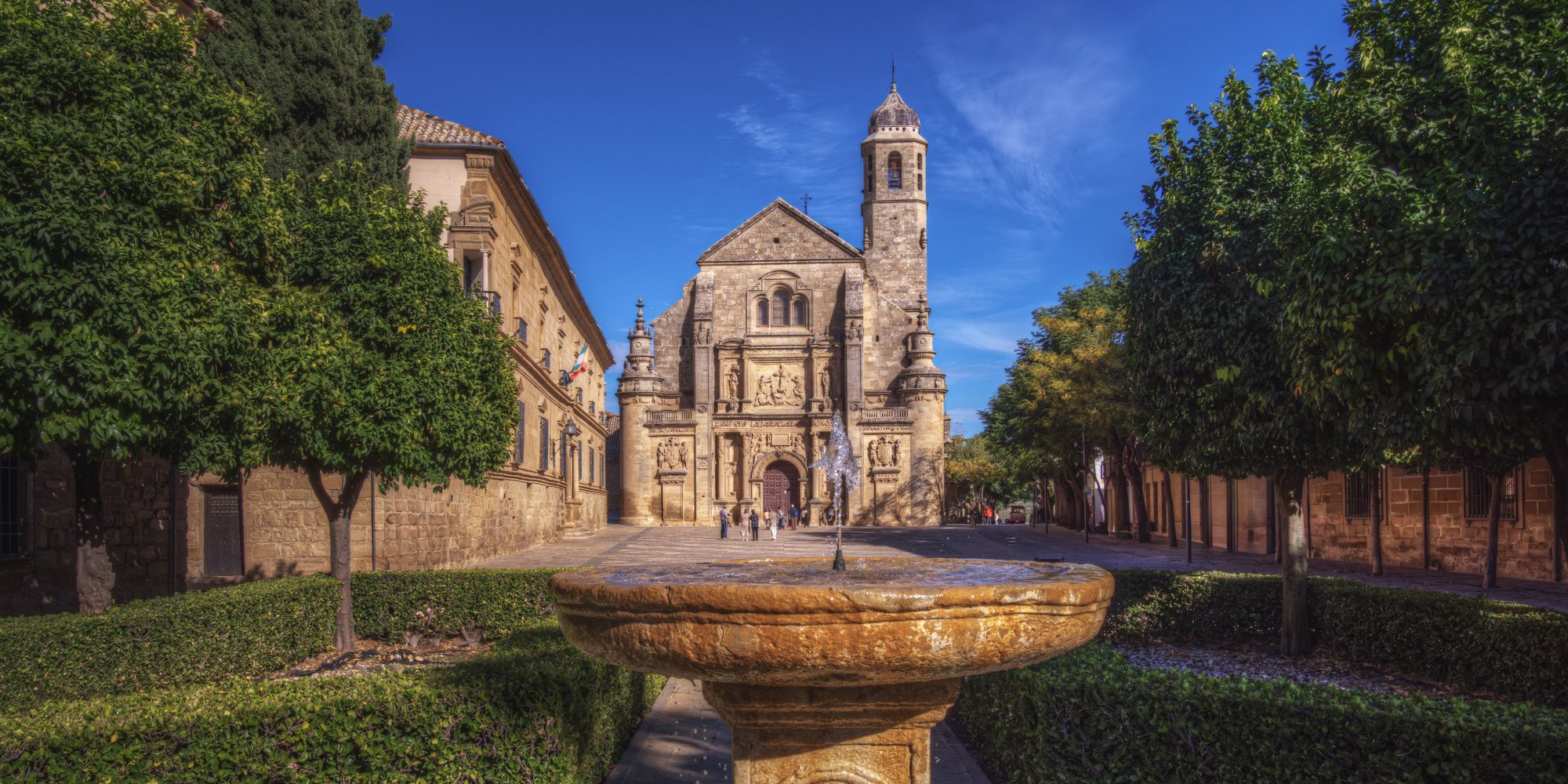
A long, quiet square lined almost entirely with Renaissance buildings: the Salvador chapel at one end, the town hall palace along one side, the basilica of Santa María and the Parador facing it. After dark the façades are floodlit and the square empties. Benches under the trees give a place to sit between visits.
-
Viewpoint
Redonda de Miradores
The road and walk along the southern rim of the old town, with views across the Guadalquivir valley and a sea of olive groves to the Sierra Mágina and the Cazorla mountains. It runs between the Salvador chapel and San Lorenzo past stretches of the walls. Late afternoon is the best time, when the low sun turns the groves gold.
-
Church
Sacra Capilla del Salvador
A private funerary chapel built for a royal secretary of Charles V, and the most richly carved building in the town. The west front is covered in Renaissance reliefs, and inside a gilded altarpiece shows the Transfiguration behind a tall iron screen. Entry is ticketed, and the sacristy is the room not to miss.
-
Temple
Sinagoga del Agua
Rooms found in 2007 during building work in the old Jewish quarter and opened as a medieval synagogue: a prayer hall with a women's gallery above, a cellar with ovens and a ritual bath still fed by spring water. Visits are guided only, in small groups of about half an hour, and slots are booked ahead. The ritual bath is reached by a steep medieval stair, hard going for visitors with limited mobility.