Things to do
16-
Fortress
Batería de Castillitos
Two huge naval guns of the 1930s still point out to sea from a mock castle on the cliffs of Cabo Tiñoso, west of the town. The site is open and free, with no café or toilets. The last stretch is a narrow, winding military road with few passing places and a small car park that fills by mid-morning; arrive early or near sunset.
-
Village
Cabo de Palos
A fishing village on a rocky cape, with a lighthouse above the harbour and fish restaurants along the quay. Offshore, the Islas Hormigas marine reserve draws divers to its wrecks and reefs, and the dive centres in the harbour run boats out daily. The lighthouse is a short walk from the village, and the cape sits at the southern start of La Manga.
-
Beach
Cala Cortina
The nearest beach to the centre is a small sheltered cove past the container port, with calm water, a short promenade and a restaurant terrace. The Sendero Azul path walks there from the yacht club in about 45 minutes, and a summer beach bus runs from the centre. From the roadside car park a steep staircase leads down to the sand.
-
Park
Calblanque Regional Park
Golden dunes, fossil-rock coves and long beaches with no buildings behind them run along this protected coast east of the town. In summer, cars are kept out and a shuttle bus runs from Los Belones. A marked 7.8km loop climbs the Cabezo de la Fuente from the Las Cobaticas visitor point, and the beaches have no services, so carry water and shade.
-
Landmark
Calle Mayor
The pedestrian main street runs from the town hall square into the old centre, lined with modernista facades, glazed balconies and the Casino's carved front. Cafés put tables out along its length, and the tapas bars in the side streets fill in the evening. The Holy Week processions pass along it.
-
Archaeological Site
Casa de la Fortuna
Below a small square off Calle Mayor lies a Roman townhouse with its wall paintings, mosaic floors and a stretch of paved street still in place. Walkways run above the rooms, so the plan of the house reads clearly in a short visit. Entry is ticketed and the site is small, so it pairs well with the Punic Wall a few streets away.
-
Castle
Castillo de la Concepción
A medieval castle on the highest of the town's hills, with gardens and peacocks in the Torres Park around it. A glass panoramic lift climbs about 45 metres from Calle Gisbert to the top, saving a steep climb, and the walk down takes ten to fifteen minutes. The castle holds a small interpretation centre; the park and its viewpoint over the harbour are free.
-
Museum
Civil War Shelter Museum
Tunnels dug into the Concepción hill sheltered townspeople from air raids, and a stretch of them now holds a small museum of the bombing, with photographs, recorded voices and a reconstructed shelter. The entrance is on Calle Gisbert, next to the foot of the panoramic lift, so the two pair easily. Entry is ticketed.
-
Fortress
Fuerte de Navidad
A nineteenth-century gun fort guards the western side of the harbour mouth, reached by the tourist boat from the Muelle de Alfonso XII. The boat tours the naval harbour and the defences on both shores, and a combined ticket includes a stop at the fort and its small interpretation centre. In busy periods the boat sells out, so buy a ticket ahead.
-
Beach
La Manga del Mar Menor
A sandbar about 21km long divides the open Mediterranean from the warm, shallow Mar Menor lagoon, lined with resort blocks along its whole length. The sea side has surf and open water; the lagoon side suits children and windsurfers. Lagoon water quality has led to swimming bans on some beaches in recent summers, so check the flags before going in.
-
Archaeological Site
Molinete Archaeological Park
Excavated streets, baths and a temple precinct of the Roman forum climb the Molinete hill in the middle of town. The hilltop park is free to walk and gives a wide view of the port. The Roman Forum Museum at the foot of the hill roofs over the excavated streets, baths and a banquet hall with painted walls, and is ticketed.
-
Museum
National Museum of Underwater Archaeology
Known as ARQVA, the museum stands on the quay five minutes from the cruise terminal. Its galleries hold a full-size replica of a Phoenician trading boat, amphorae raised from wrecks off this coast and silver coins from a frigate sunk in 1804. It is closed on Mondays, and entry is free on Saturday afternoons and Sundays.
-
Museum
Naval Museum
The Peral, an electric-powered submarine of the 1880s, is the centrepiece here, restored and shown in its own hall in a former arsenal workshop. Ship models, charts and navigation instruments fill the rest. The museum sits on the waterfront road beside the arsenal and opens mornings only, Tuesday to Saturday.
-
Palace
Palacio Consistorial
The modernista town hall stands on a triangular plot at the harbour end of Calle Mayor, faced in white marble with domes on its corners. Its ground-floor hall, with a grand staircase and stained glass, is open to look around, and it often holds free art exhibitions. The Roman Theatre museum, where the theatre visit begins, opens onto the square in front.
-
Ruins
Punic Wall
A stretch of the Carthaginian city wall, a rare survival of its kind in Spain, sits under a modern roof at the foot of the San José hill. The interpretation centre built around it also shows a crypt from a later chapel. It is ten minutes on foot from Calle Mayor. Entry is ticketed, alone or as part of a Puerto de Culturas multi-site ticket.
-
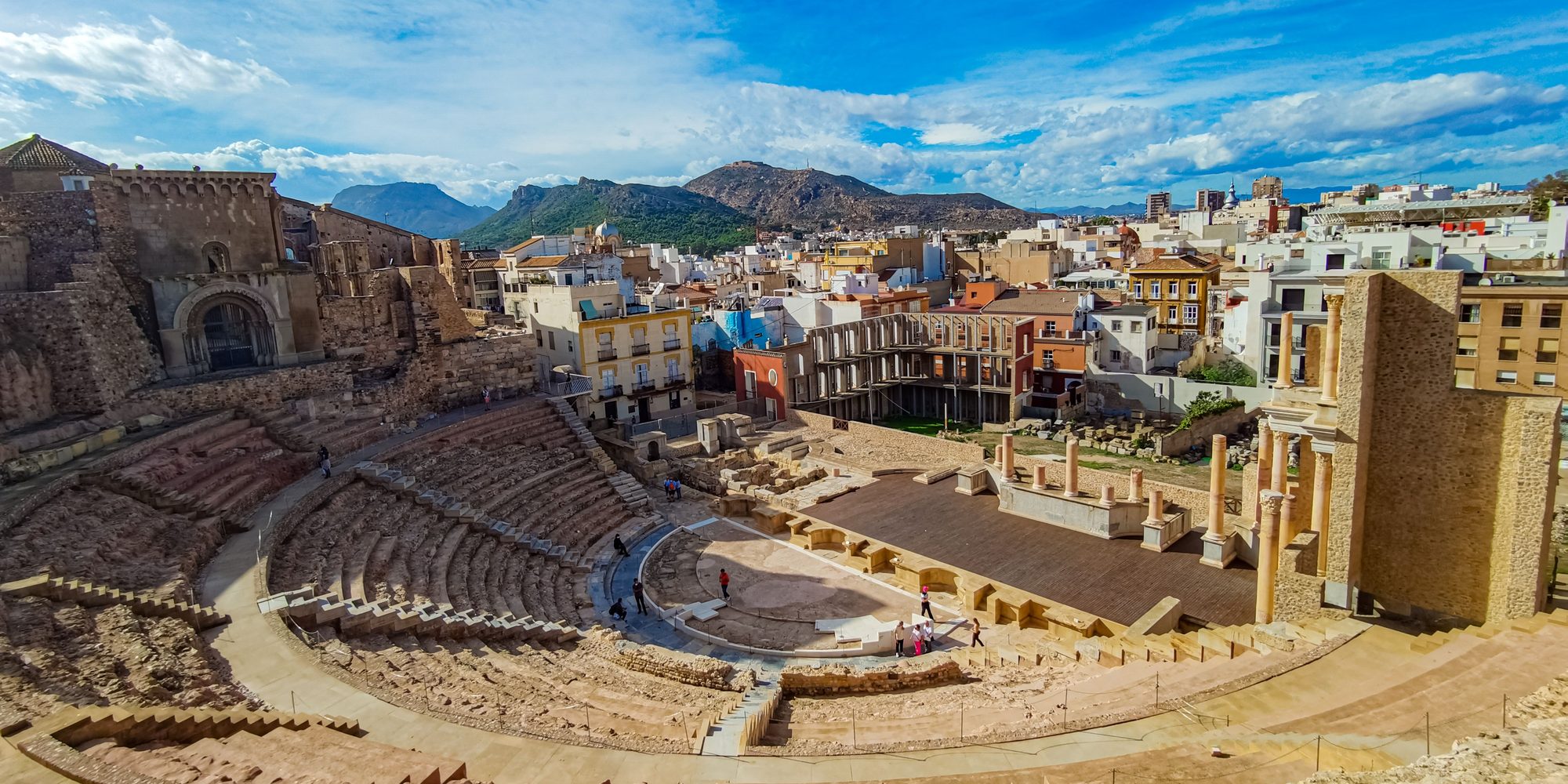
Archaeological Site
Roman Theatre
The theatre lay hidden under houses and the ruined cathedral of Santa María la Vieja until the late 1980s. The visit starts in a museum by the town hall square and runs through a tunnel under the street to come out among the seats. Entry is ticketed, closed on Mondays and short on Sundays; the Parque de la Cornisa above looks straight down into it for free.