Globe Countries Cities Dispatches World's Best Events Get the App
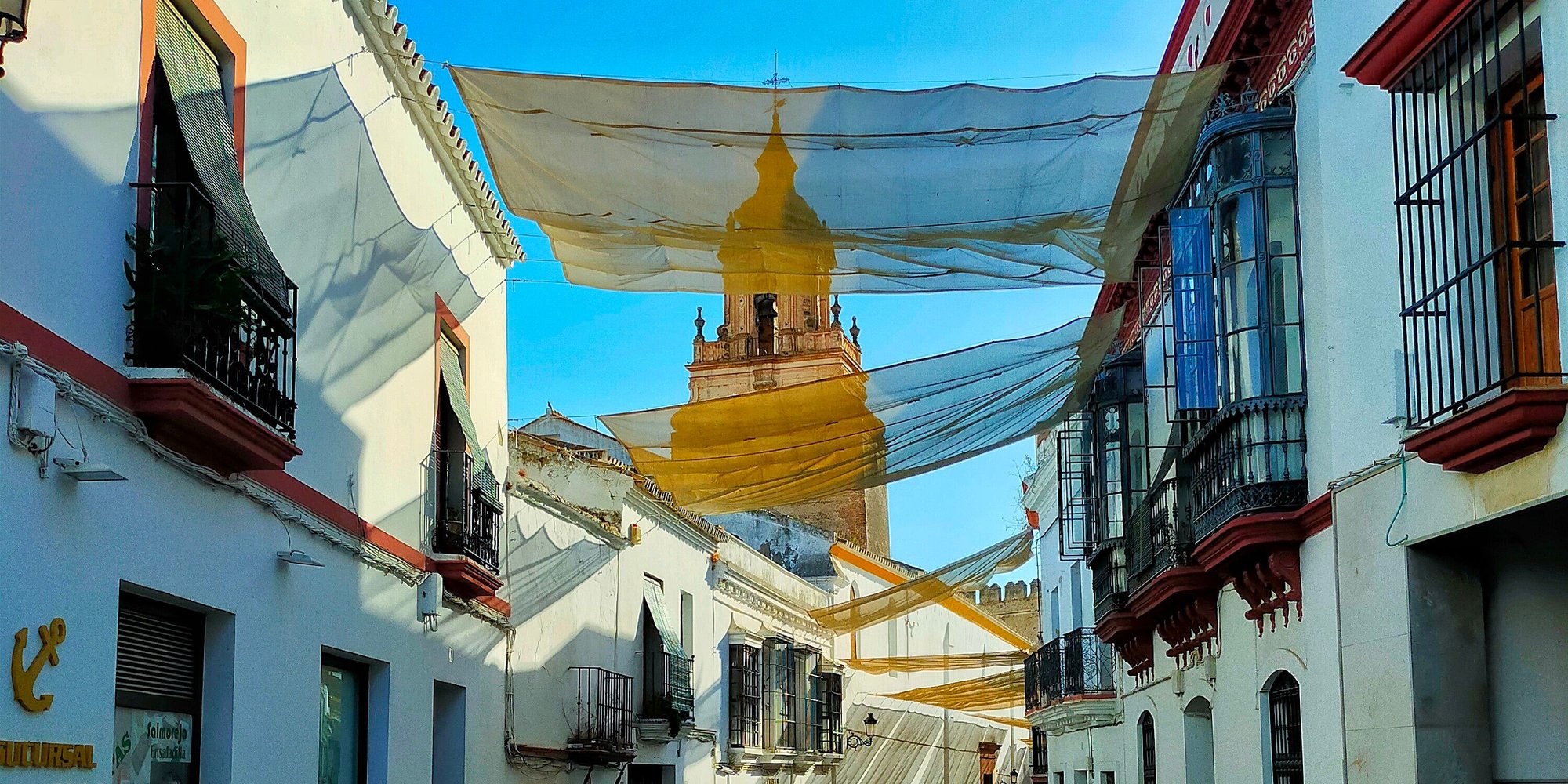
Summer awnings strung across a whitewashed lane in Carmona's old town, with a baroque bell tower and a crenellated wall at the end of the street
Summer awnings over a lane in the old town · they go up each year against the heat
Town brief · 37.4725°N 5.6388°W

Carmona

Stay in Carmona and keep the car here: Seville is half an hour away on the A-4 for a day trip, and you come back to a quiet walled town and a terrace over the plain at dusk.

View on globe

Why you should go

Ninety seconds on Carmona

How long
Two nights, one day for Sevillea day for the old town and the necropolis, a day in Seville
Getting around
On foot; car or bus for furtherthe old town is under a kilometre from gate to gate
When
March to May, October to NovemberJuly and August often pass 40°C; Holy Week fills the town
Language
Spanishless English is spoken than in Seville
Money
The eurothe necropolis is free for EU citizens
Airports
Seville SVQabout 22 km west on the A-4, 20 minutes by car
How long

How many days do you need in Carmona?

One full day covers the Alcázar de la Puerta de Sevilla, Santa María, the town museum and the Roman necropolis. Two nights allow a day in Seville as well, with the evenings back in the quiet old town. A weekend adds the guided visit to the Roman amphitheatre.

Getting around

How do you get around Carmona?

On foot inside the walls, where the lanes are steep in places and the stone is uneven. Free parking lies outside the walls, and parador guests park inside the fortress. Buses run to Seville's Prado de San Sebastián station, and the A-4 reaches the city in about half an hour.

When

When is the best time to visit Carmona?

Spring and autumn bring mild days for walking, and July and August are among the hottest months in Spain.

Language

What language is spoken in Carmona?

Spanish. English is spoken at the parador, the tourist office and the main sights, less so in the bars and the market. The tourist office has leaflets and town maps in English.

Money

What money does Carmona use?

The euro, and cards are widely taken. The Roman necropolis is free for EU citizens and ticketed for other visitors. The Alcázar de la Puerta de Sevilla is free on Mondays and the town museum on Tuesdays, and the Santa Clara convent visit is ticketed.

Airports

Where do you fly into for Carmona?

Seville SVQ, about 22 km west on the A-4 and around 20 minutes by car, which makes Carmona an easy first or last night of a trip. Jerez XRY is about 120 km south-west, and Málaga AGP about 200 km south-east.

Sleep inside the walls or at the parador, and go into Seville by day. Driving into Seville's old centre is restricted and parking there is scarce, so take the bus from the Paseo del Estatuto to the Prado de San Sebastián, or leave the car at a park-and-ride on the edge of the city. The evenings are for quiet lanes and dinner on the Plaza de San Fernando.

Plan your days around the closures. The Roman necropolis and the church of Santa María both shut on Mondays, when the Alcázar de la Puerta de Sevilla is free, and the Santa Clara convent closes on Tuesdays and Wednesdays. From late June to late September, and on Sundays all year, the necropolis closes at three in the afternoon, so go there first.

Start at the Alcázar de la Puerta de Sevilla, where the tourist office has town maps and sells the ticket for the terraces. From there the lanes climb past Santa María, the town museum and the convents to the Puerta de Córdoba. Save the last hour of daylight for the view over the plain from that gate or from the parador terrace.

In July and August, see the sights before one and rest through the afternoon, because the Guadalquivir valley is one of the hottest places in Spain. Book months ahead for Holy Week, when the brotherhoods carry their floats through the old town at night. The town fair takes over the third week of May.

Come at a weekend if you want to see the Roman amphitheatre: it opens only on guided visits on Saturdays, Sundays and holidays, at one in the afternoon from the necropolis, so ring ahead to book. On a weekday morning, step into the town hall courtyard on Calle El Salvador to see its Roman mosaic of Medusa, then buy cakes from the nuns at Santa Clara before you drive on.

Things to do

11
  1. Fortress

    Alcázar de la Puerta de Sevilla

    Fortress · 1 hr

    The fortified west gate of the old town, rebuilt and strengthened over two thousand years, with the tourist office just inside the arch. Stairs lead up to the terraces and the Torre del Oro, which give the widest view over the rooftops, the church towers and the plain. Entry is ticketed and free on Mondays. Come early in summer, because the terraces have no shade.

  2. Landmark

    Ayuntamiento de Carmona

    Landmark

    The town hall fills a former Jesuit college on Calle El Salvador, and its inner courtyard holds a Roman floor mosaic found in the town, with a head of Medusa at the centre. Entry is free on weekday mornings and on Tuesday and Thursday afternoons. The courtyard takes ten minutes and lies on the way between the Plaza de San Fernando and the market.

  3. Monastery

    Convento de Santa Clara

    Monastery · 30 min

    A convent of Poor Clare nuns in the upper town, with a Mudéjar church, a cloister and paintings from the circle of Zurbarán. The nuns still live here and sell their own cakes and biscuits through a revolving hatch. Visits are ticketed, and the convent closes on Tuesdays and Wednesdays.

  4. Church

    Iglesia de San Pedro

    Church · 30 min

    A church just outside the Puerta de Sevilla whose bell tower, known as the Giraldilla, copies the top of the Giralda in Seville and is the first landmark seen on the road in. Inside, the sacrament chapel is covered in gilded baroque plasterwork. It stands at the end of the Paseo del Estatuto, where the bus from Seville stops, so it makes an easy first or last visit.

  5. Museum

    Museo de la Ciudad

    Museum · 1 hr

    Housed in the Palacio del Marqués de las Torres beside Santa María, the town museum follows the hill and its plain from prehistory to the present day. The strongest rooms hold Tartessian and Roman finds, including painted pottery and carved stone. Entry is ticketed and free on Tuesdays, and an hour is enough. The palace courtyard and its upper gallery are worth a look on the way out.

  6. Archaeological Site

    Necrópolis Romana

    Archaeological Site · 1.5 hr

    A Roman cemetery cut into the soft rock on the western edge of town, with hundreds of family tombs and a small site museum. The Tomb of Servilia, laid out like a house around a courtyard, is the grandest. Entry is free for EU citizens, the site closes on Mondays, and it shuts at three on Sundays and every day from late June to late September. The amphitheatre opposite opens only on guided weekend visits.

  7. Hotel

    Parador de Carmona

    Hotel

    The state parador fills the ruins of the Alcázar del Rey Don Pedro, a Moorish fortress at the eastern tip of the ridge that a medieval king made his palace. Guests drive in through the walls and park inside. Ask for a room facing the Vega, the plain below, and book the terrace restaurant for the evening light. Visitors who are not staying can take a coffee on the terrace.

  8. Market

    Plaza de Abastos

    Market · 30 min

    Stalls of fruit, fish, olives and local oil fill this arcaded market square in the morning, a few steps from the town hall. Small bars under the arches serve tapas from late morning, and the square stays quieter than the Plaza de San Fernando. Spinach with chickpeas, a Seville-province staple, turns up on the tapas boards.

  9. Landmark

    Plaza de San Fernando

    Landmark · 30 min

    An irregular square at the heart of the old town, ringed by houses with painted and tiled fronts, the Renaissance former town hall and café terraces. Locals call it the Plaza de Arriba. Its café terraces fill for the evening walk and for tapas at lunch, and the lanes towards Santa María and Santa Clara climb away from its upper side.

  10. Church

    Prioral de Santa María de la Asunción

    Church · 30 min

    The main church of the old town, a Gothic building raised over the mosque, whose ablutions courtyard survives as the Patio de los Naranjos, with horseshoe arches and orange trees. One of its columns carries a Visigothic church calendar cut into the stone. Inside, a tall gilded altarpiece fills the east end. Entry is ticketed, the church closes on Mondays, and it shuts for a long break in the middle of the day.

  11. Monument

    Puerta de Córdoba

    Monument · 30 min

    The east gate, built on Roman foundations and given a classical front around 1800, at the far end of the old town from the Puerta de Sevilla. The walk between the two gates crosses the whole historic centre in about twenty minutes. Outside the arch, a terrace looks straight down over the Vega, the farm plain that runs east towards Córdoba, and the road below follows the old Roman way.
Basemap Meridian · data © OpenStreetMap
Explore

More of Spain

Spain
Country

Spain

Every Spain town, place and dispatch, on one map.

Seville
Town

Seville

Feria de Abril
Event · Seville

Feria de Abril

Come to see a whole city in its best clothes, out on horseback and dancing in its casetas until the small hours.

Córdoba
Town

Córdoba

Whitewashed lanes, flower-hung courtyards and a riverside old town surround the great mosque that later became a cathedral.

Museo Picasso Málaga
Museum · Málaga

Museo Picasso Málaga

Last updated

Meridian Dispatch for iPhone

Plan the trip.
Keep the journal.

Every other travel app asks you to start logging. Meridian Dispatch opens with years of your travel already written, from the photographs you already took.